“Of course, weaponizing the dollar beyond a certain point is not a good strategy because countries and people have memories.”
Masters in Business · October 2026
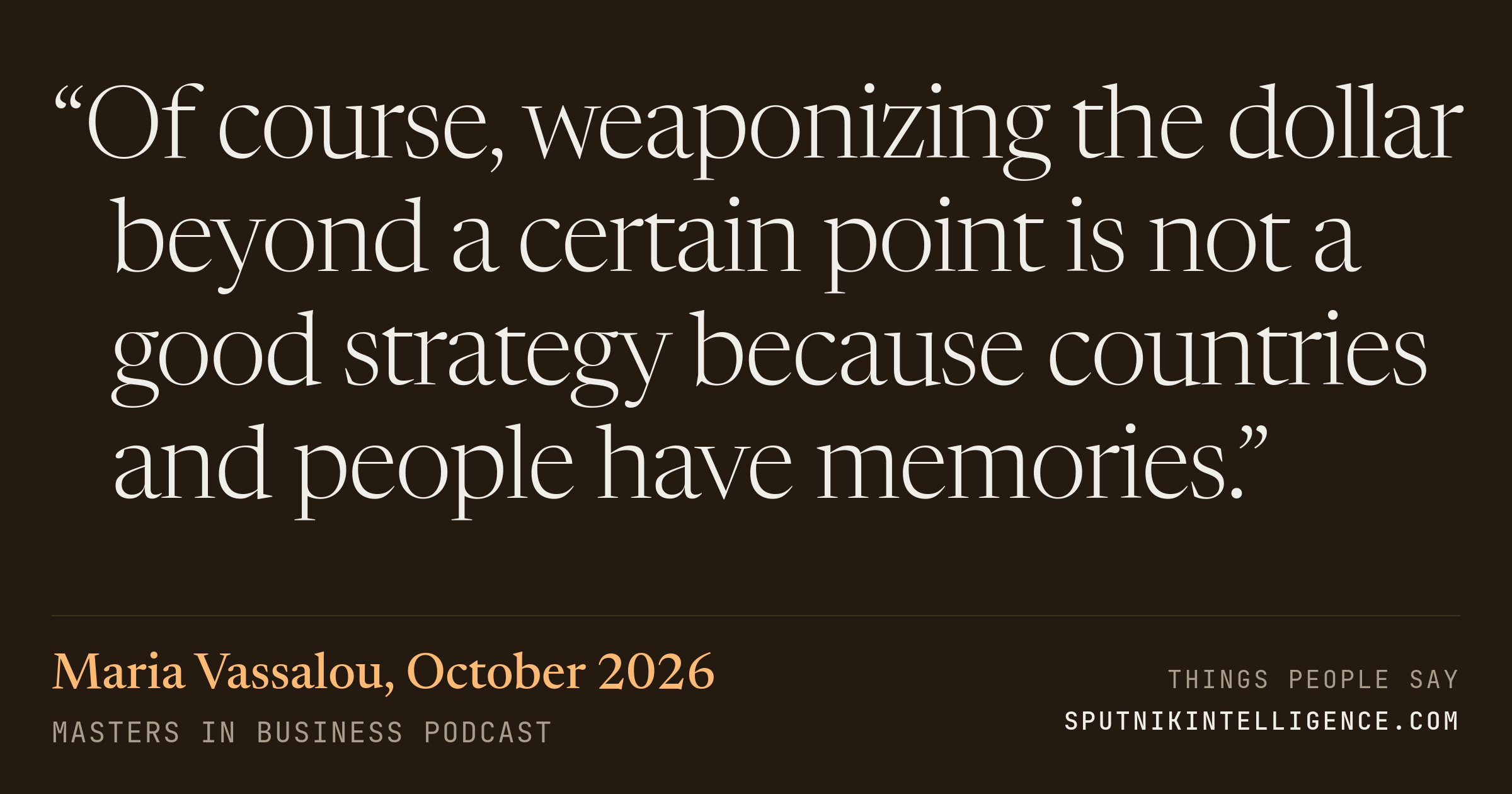
The host had put it to Vassalou that, whatever the geopolitical upheaval, the world has no real alternative to the dollar and US Treasuries. She agrees that it has no other choice, then adds this warning. She goes on to say the US position rests on staying a leading producer of technology and becoming self-sufficient in a few key industries.
Transcript
a big importer. And you need to be a producer of safe assets because if you hold Ramnibs, you don't have anything to invest them in. Whereas if you receive dollars, then you invest them in treasuries, you earn a yield.
…what that might do for productivity. At the same time, there's no substitute for the reserve currency of the U.S., the safe asset of U.S. treasuries. It would probably be in our interest to not alienate a lot of our allies, but the world really doesn't seem like it has any other choices, does it?
It doesn't have any other choices. Of course, weaponizing the dollar beyond a certain point is not a good strategy because countries and people have memories. But I think what is key is for the U.S. to remain, if not the world's leader in technology, but certainly one of the main producers of technology, and it has to improve its economic resilience. So I think the U.S. needs to some extent reindustrialize, not produce t-shirts and plastic toys, but be self-sufficient in certain key industries.
Semiconductors, everything from solar cells. Pharmaceuticals, you know, certain equipment and so on. So things where at a pinch they can. Be self-sufficient, but they can also, there's it's not just that, it's also that the process of producing innovation passes through the production of the…
there that then feeds into new innovation. And it also creates a pool of labor that can migrate from one sub-sector of the economy to another and cross-pollinate and enhance the production of further innovation.
The Silicon Valley flywheel.
More from Masters in Business