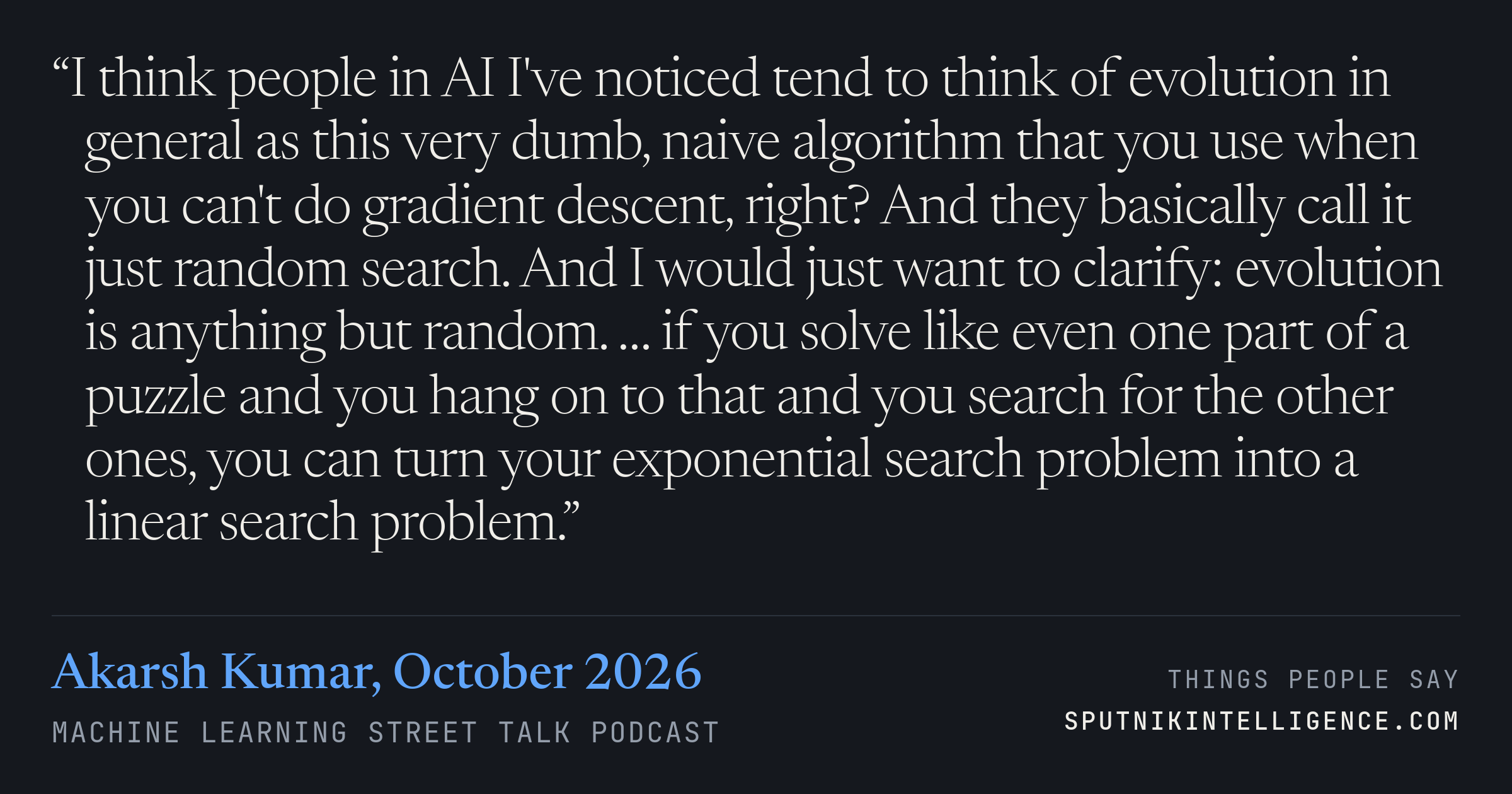
“I think people in AI I've noticed tend to think of evolution in general as this very dumb, naive algorithm that you use when you can't do gradient descent, right? And they basically call it just random search. And I would just want to clarify: evolution is anything but random. … if you solve like even one part of a puzzle and you hang on to that and you search for the other ones, you can turn your exponential search problem into a linear search problem.”
Machine Learning Street Talk · AI Research & Frontier Labs · October 2026
Kumar had just described an experiment in which a language model was used to mutate programs for the game Core War inside an evolutionary loop. The model writes that language badly when asked directly, he says, but evolved programs beat most of a set of human-written ones. His point is that selection, keeping each partial win and building on it, is the underrated part.
Transcript
Yeah, yeah, exactly. That's a good way to put it. Yeah.
Yeah. Well, tell me more. So how many generations, what was the population size? How did you set this thing up?
…we measure the behavior, but we have this vector. The variance in the behavior of these warriors goes down as you increase the number of rounds. So that kind of means that they're getting more general and they're trending towards like kind of like reducing variance. So they're kind of behaviorally becoming like a single generalist warrior. At least that's what the trend is towards. Exactly. And I think people in AI I've noticed tend to think of evolution in general as this very dumb, naive algorithm that you use when you can't do gradient descent, right? And they basically call it just random search. And I would just want to clarify: evolution is anything but random. It's anything but random. And evolution is probably the most powerful algorithm that we know to solve like discrete combinatorial problems where you need to basically get pieces of the puzzle right before you get the whole thing right. And the selection mechanism in evolution is really, really underrated because if you solve like even one part of a puzzle and you hang on to that and you search…
Akarsh Kumar, it's been an absolute honor having you on the show.
Awesome. Thanks for having me. Yeah,
it's been amazing. This was a great conversation.
More from Machine Learning Street Talk