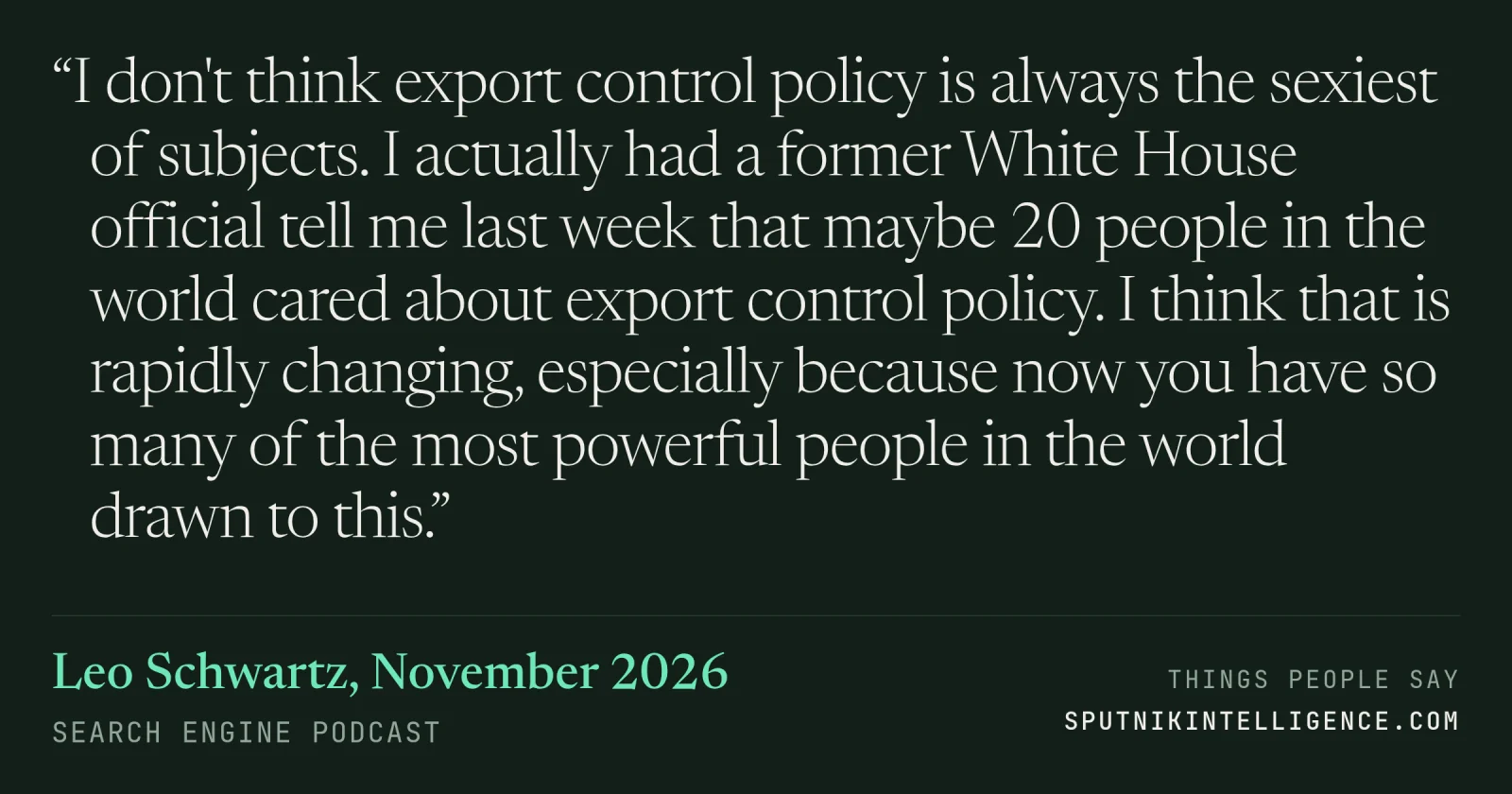
“I don't think export control policy is always the sexiest of subjects. I actually had a former White House official tell me last week that maybe 20 people in the world cared about export control policy. I think that is rapidly changing, especially because now you have so many of the most powerful people in the world drawn to this.”
Search Engine · Tech Strategy & Big Tech · November 2026
Context
PJ Vogt noted that Schwartz, a reporter at The Information who covers export controls, is unused to so many people reading his stories. Schwartz says the beat has gone from niche to central because of the Nvidia scandal.
Transcript
Like you were on a beat. It wasn't sleepy, but you were on a beat that prior to this was like took you had to
do more work to make people interested in it.
Yeah, I don't think export control policy is always the sexiest of subjects. I actually had a former White House official tell me last week that maybe 20 people in the world cared about export control policy. I think that is rapidly changing, especially because now you have so many of the most powerful people in the world drawn to this. Jensen, of course, Trump, who has been one of Jensen's main allies in DC along with David Sachs. And then this question of whether NVIDIA was either motivated by Chinese intelligence or at least was leaking secrets potentially inadvertently through this relationship that just got unearthed.
So to step back, everything that we learned this week, I believe, is a direct consequence of something very boring sounding that happened way back in 2022 during Joe Biden's presidency. An export control rule change. Every other podcast this week is going to tell you this is a story about sex…
It is the latest source of tension between the United States and China. President Joe Biden is accused of weaponizing technology for imposing sweeping controls on sales of semiconductors to Beijing. What's behind this decision and how much is it down to politics? This is inside story.
This was moments before the AI race took off, weeks before ChatGPT 3.5 took the world by storm. And so most Americans at the time could be forgiven for not having strong opinions about semiconductor policy. But Joe Biden's administration really did.
More from Search Engine