 Alex Imas
Professor at UChicago Booth.
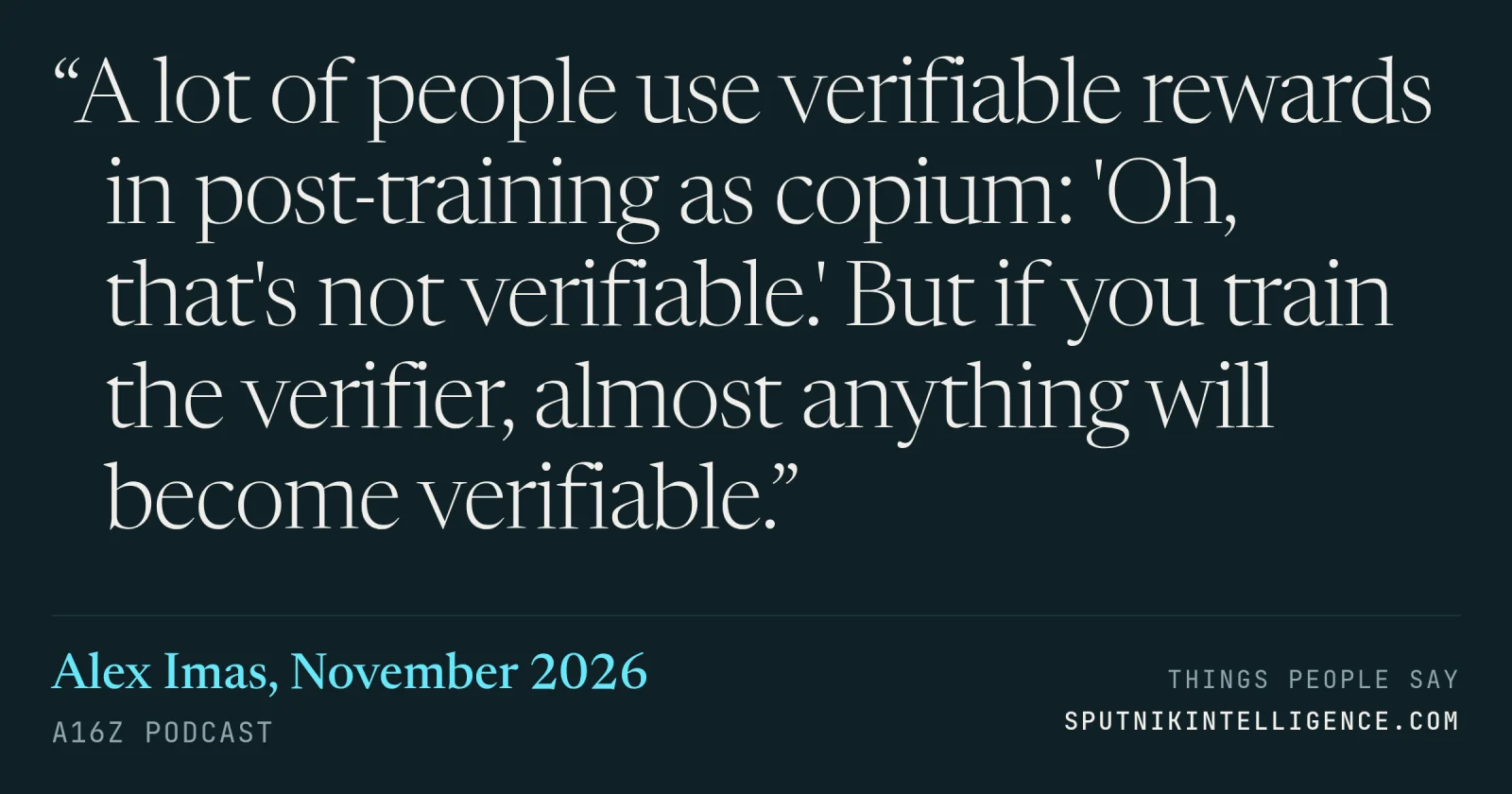
“A lot of people use verifiable rewards in post-training as copium: 'Oh, that's not verifiable.' But if you train the verifier, almost anything will become verifiable.”
a16z Podcast · Startups & Venture · November 2026
Context
Imas and Cowen were discussing why AI will likely master fields people think of as intuition. Imas takes on the common objection that reinforcement learning only works where answers can be checked.
Transcript
And Dennis too.
Demis too, absolutely. Common stories. You see it, you know, kickback by the 1990s, and it beats Kasparov Deep Blue. And Deep Blue is not a great model, but it's like, okay, it can do this. So you're just waiting for it to spread to everything else. But it took a long time, in fact.
Yeah. I think this is like a great example of like, you know, a lot of people would have looked at AI and said, hey, it can't do this. It can't do that. But it's going to be able to do almost everything because, you know, like thinking about like RLVR or something like that, like the verifiable reward part of post-training, a lot of people like use that as like copium, like, oh, that's not verifiable. That's not verifiable. But like, if you train the verifier, almost anything will become verifiable.
The fact that you can criticize it means it's verifiable almost, right?
Yeah, exactly. Exactly. So it's like, it's, it's, and chess is like a really great example. Like you see, if you're a really good chess player, you know exactly how much that that intuition is required and how far that's going to go in the future.
Mayor Corps is working on the poets. I'm not sure how far along they are, but it seems to me it should work.
More from a16z Podcast