 Matthew Sanabria
An engineering leader at Oxide Computer who focuses on building reliable, observable systems, and a member of the Go community group GoBridge.
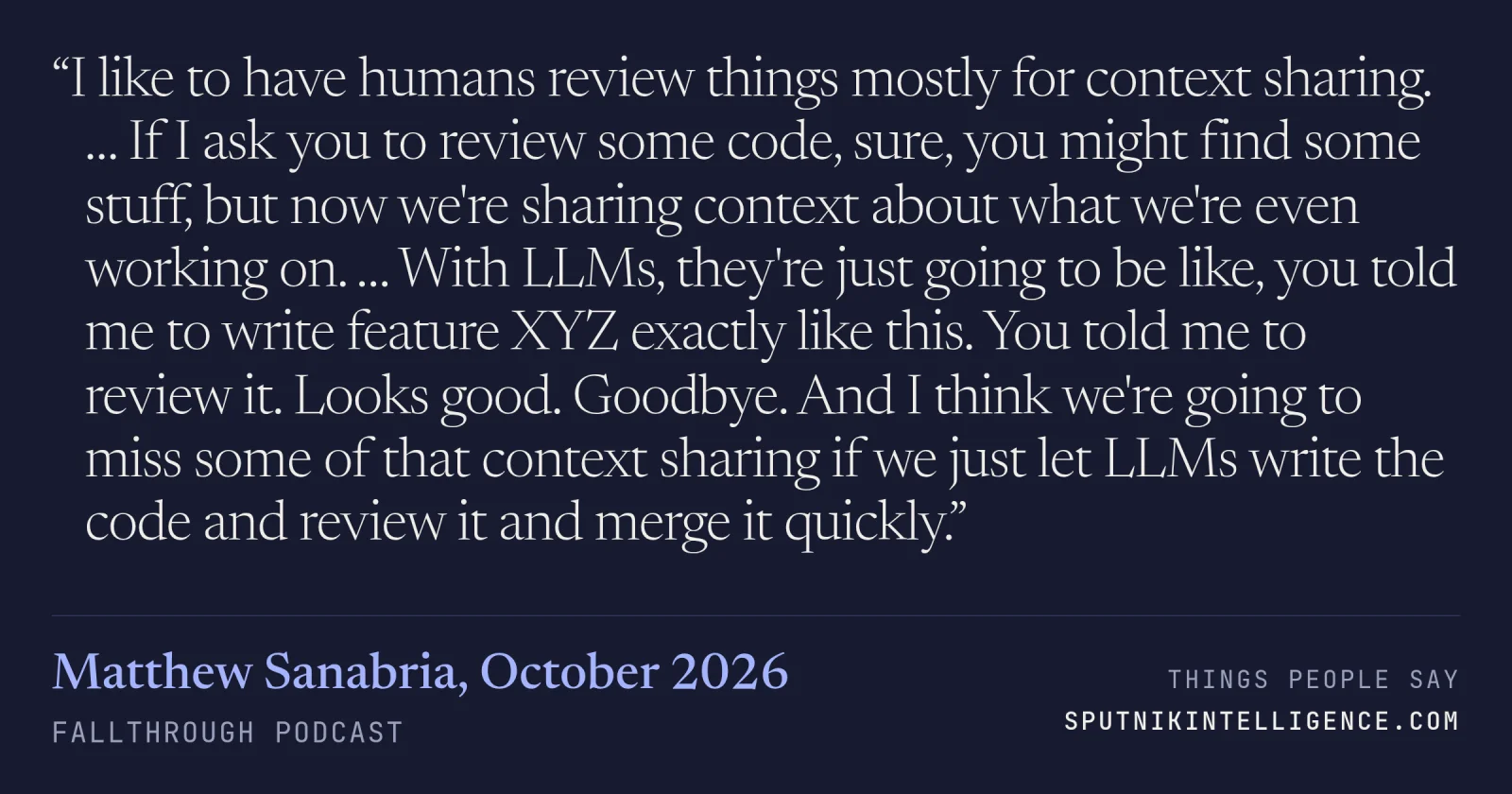
“I like to have humans review things mostly for context sharing. … If I ask you to review some code, sure, you might find some stuff, but now we're sharing context about what we're even working on. … With LLMs, they're just going to be like, you told me to write feature XYZ exactly like this. You told me to review it. Looks good. Goodbye. And I think we're going to miss some of that context sharing if we just let LLMs write the code and review it and merge it quickly.”
Fallthrough · Hands-On Engineering Podcasts · October 2026
Context
Responding to the guest's description of his team's AI policy, Sanabria argues that the main value of human code review is spreading knowledge of what the team is building, more than catching bugs.
Transcript
control with your with your monologues. I like it. I have to do Chris's right.
…write very little code myself. And I have a bunch of guardrails. And you can go to my monorepo on my website. And that has, you can see my whole change log. I'm very public about how I'm using agents right now. And I try to keep those commits well described. But yeah, that's a bit of how we use it.
…in a similar boat. I like to have humans review things mostly for context sharing, right? So that like you're aware that we're building this or that we're making these decisions, not necessarily because they're always going to catch something that the LLM is not going to catch. So, it's weird. I like that because there's a context-sharing aspect that nobody really talks about where it's like, if I ask you to review some code, sure, you might find some stuff, but now we're sharing context about what we're even working on. So, you're like, oh, Matt's working on feature XYZ. Like, yeah, actually, I had a thought about feature XYZ that Matt didn't really understand. And we can have that conversation. But if with LLMs, they're just going to be like, you told me to write feature XYZ exactly like this. You told me to review it. Looks good. Goodbye. And I don't know. I think we're going to miss some of that context…
So, what's interesting is, with a little more nuance, what I was saying earlier, I was letting it write comments and pros for a long time. And this is only like a week-long experiment. And some of the comments that have been suggested in the interactive model with the agents, I'm like, ow, yeah, I…
mine, except for it telling it to call me Mr. Synabria, and it works really well.
Well, and honestly, that's probably better than mine, which is probably way too verbose. But I get mad at something, I try to make sure it doesn't happen again. I use a rules file. And when these agents are, you know, I was talking to Steve Klavnik, and I get, it's funny, in Slack, I vented, it…
More from Fallthrough