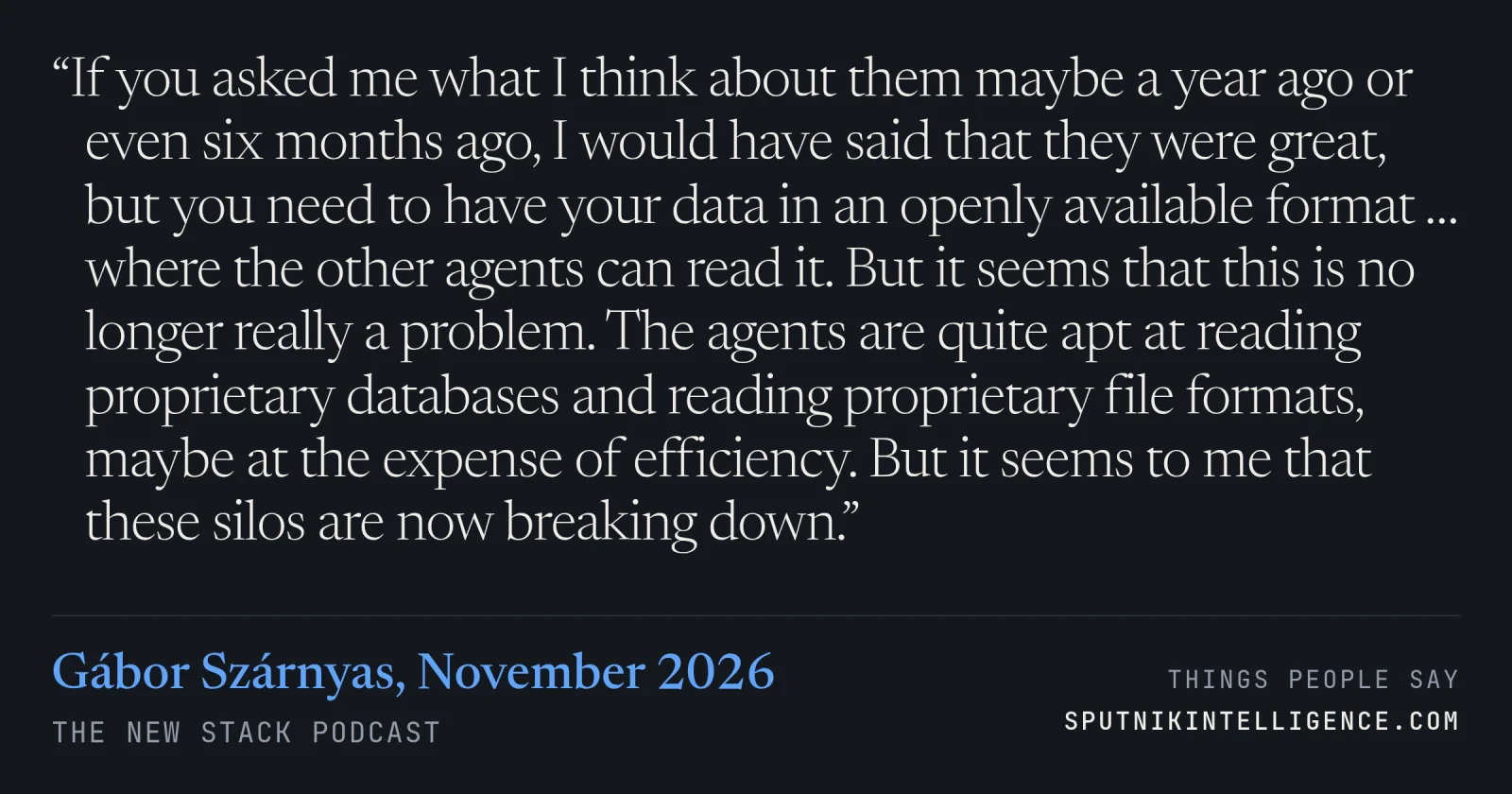
“If you asked me what I think about them maybe a year ago or even six months ago, I would have said that they were great, but you need to have your data in an openly available format … where the other agents can read it. But it seems that this is no longer really a problem. The agents are quite apt at reading proprietary databases and reading proprietary file formats, maybe at the expense of efficiency. But it seems to me that these silos are now breaking down.”
The New Stack Podcast · Hands-On Engineering Podcasts · November 2026
Context
Asked how his view of coding agents and data has changed in a year, he says agents now cope with closed formats that used to push teams toward open ones. It is a claim that data lock-in is weakening.
Transcript
…into your face and says this is not right, and it's usually not very helpful. And we have been working on improving error messages, and this is already in a Git branch of DuckDB, and this will ship with DuckDB 2.1, and this will make that iteration cycle that we already talked about even shorter.
…have always been a problem. So, I think that's a really good idea. And boring use cases is where we want to fix things and where we scale our AI and our human developers for sure. So, on the personal front, how has your view of making data tools usable for coding agents changed over the last year?
So, I think coding agents these days are really impressive. They keep impressing me with what they can do. And I think that they are starting to break down these silos, these data silos to some extent. So, if you asked me what I think about them maybe a year ago or even six months ago, I would have said that they were great, but you need to have your data in an openly available format, maybe in an open lake house format or in an open database where the other agents can read it. But it seems that this is no longer really a problem. The agents are quite apt at reading proprietary databases and reading proprietary file formats, maybe at the expense of efficiency. But it seems to me that these silos are now breaking down.
Which is the best way to then come to fruition on your company data, where you actually, instead of open like a ChatGPT or a Gemini that's not trained on your internal systems, will not be as interesting. Your unique value proposition is on your internal systems and your internal data. So, to safely
bridge those silos, that's a fantastic use case. So, now putting on your prediction fortune teller hat by next November 2027, what do you think will be true about how developers and coding agents work with data? That isn't necessarily true today.
I think with all these breaking down silos, it's already happening among many industries, but it's not really there yet for regulated industries, finances, insurance, healthcare, and so on. And that's because you need to be really precise there. You need to be explainable for what you do and for…
More from The New Stack Podcast