 Mark Chen
On a16z Podcast
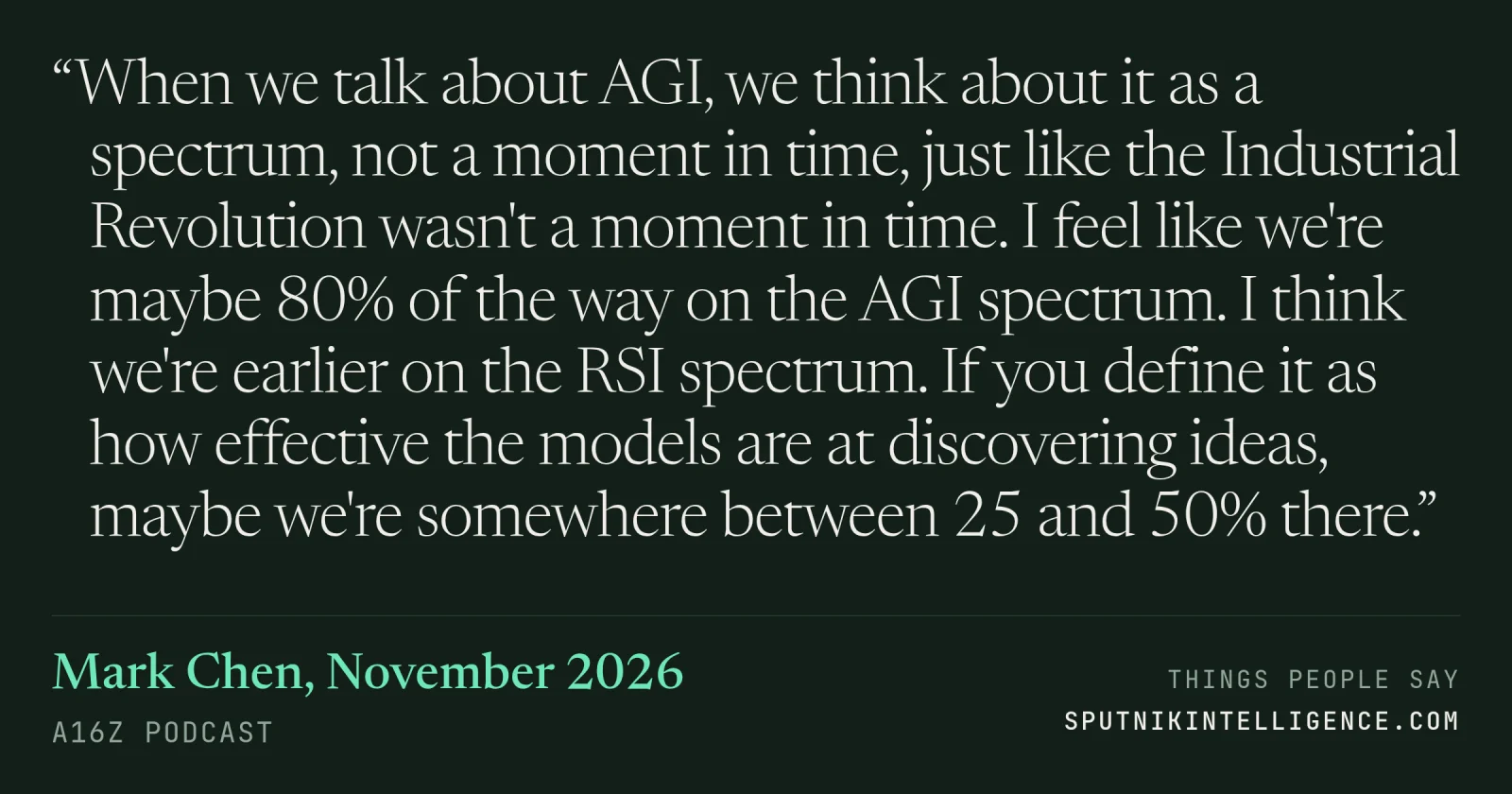
“When we talk about AGI, we think about it as a spectrum, not a moment in time, just like the Industrial Revolution wasn't a moment in time. I feel like we're maybe 80% of the way on the AGI spectrum. I think we're earlier on the RSI spectrum. If you define it as how effective the models are at discovering ideas, maybe we're somewhere between 25 and 50% there.”
a16z Podcast · Startups & Venture · November 2026
Context
Asked how close we are to recursive self-improvement, OpenAI's chief research officer gave rough percentages for AGI and for AI that improves itself. The numbers are his own estimate, not a measurement.
Transcript
John actually gave us a concrete example of this in his own workflow.
…of the results and giving more detailed breakdown of how to carry out the project. We'll get a lot further because I'll build up my understanding as this process is going on and ask a lot of questions that the AI wouldn't have thought to ask and point it in directions that it wouldn't have gone in.
When we talk about AGI, you know, the way we think about it is in terms of this spectrum, right? It's not a moment in time, just like the Industrial Revolution wasn't a moment in time. And when you ask me, I feel like we're maybe 80% of the way when I think about this AGI spectrum. I think we're earlier in the RSI spectrum. If you define it as how effective are the models at feeding back and discovering ideas, I would say maybe we're somewhere between, let's say, like 25 and 50% there. But I do think you can already see the noticeable markers on the downstreams.
On November 5th, Meter published a report on the acceleration of AI research at Anthropic, estimating a roughly 2X speed up in the rate of progress in the last year. But this is still most likely due to human researchers using AI models to accelerate their research. The full automation of AI…
Research taste is about knowing which ideas are important in the long run, which ideas really catch on and end up going beyond whatever paper they first appear in, but being general and being composable with other ideas.
There is kind of the boring run-of-the-mill execution. You know, you have an experiment, you already know what the parameters are, and you just go and carry it out. And then there's taste, which is kind of how you come up with the idea in the first place. The models are still not phenomenally good…
More from a16z Podcast