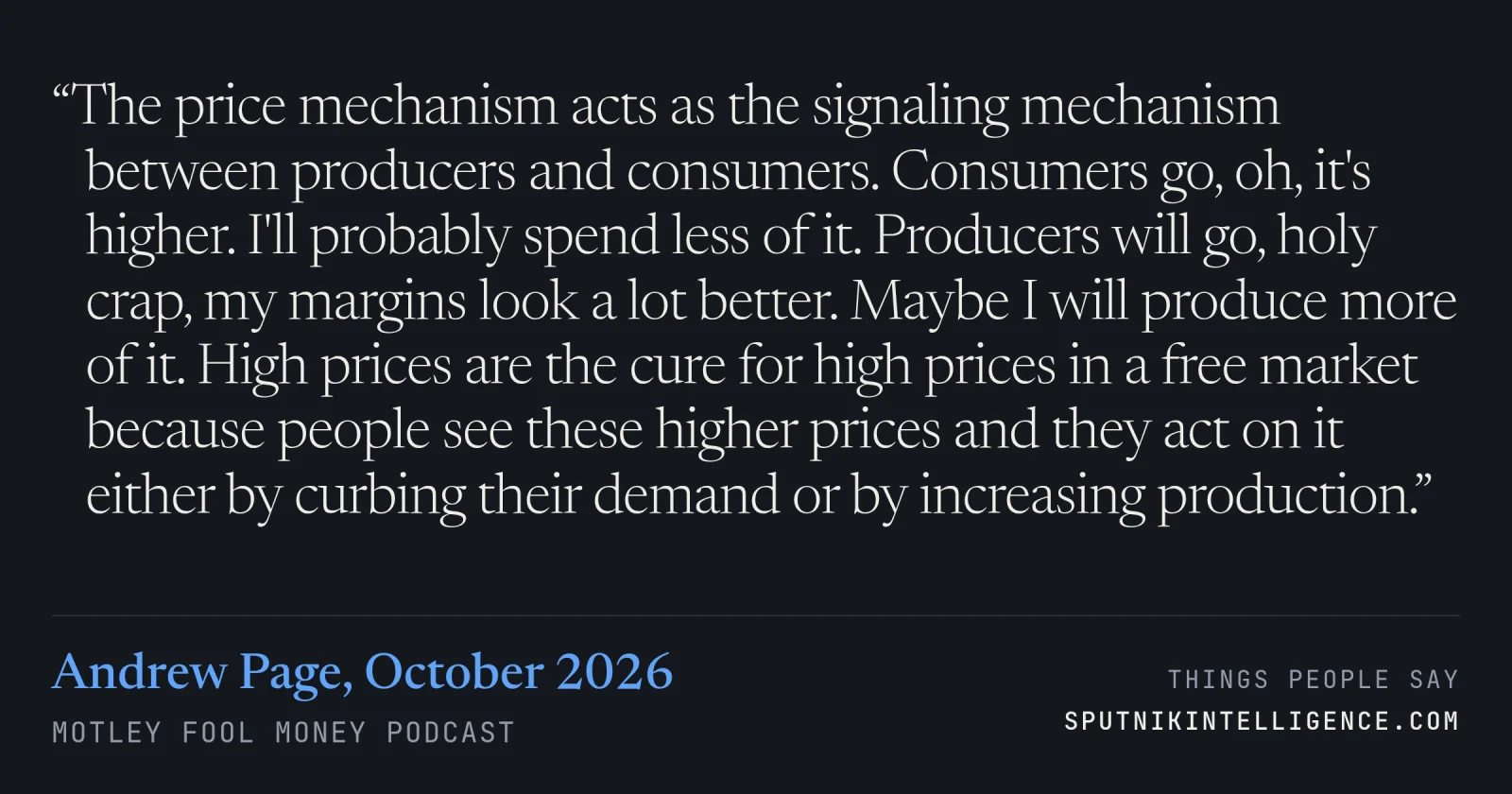
“The price mechanism acts as the signaling mechanism between producers and consumers. Consumers go, oh, it's higher. I'll probably spend less of it. Producers will go, holy crap, my margins look a lot better. Maybe I will produce more of it. High prices are the cure for high prices in a free market because people see these higher prices and they act on it either by curbing their demand or by increasing production.”
Motley Fool Money · October 2026
Context
Discussing an oil-driven price rise, Andrew says he prefers 'supply shock' to 'inflation' for a supply-driven jump, and argues the price signal corrects itself unless governments distort it with subsidies.
Transcript
…inflation. I would say that is a price change that is reflecting the supply-demand reality. What do I mean by that? Well, the demand is what it's always been. Demand actually for oil around the world is actually really consistent, it doesn't change that much day to day. That's why the prices are so
dramatic because you're going, keep going. Yeah, that's why. Yeah,
yeah, but supply can radically change because Donald Trump has a brain fart and decides to like whatever. And then, and so prices go up. Now, it feels crap and it is crap, but it's not a policy setting per se. It's just it is the market saying there is a scarcity here. And in regards, whether it's prawns at the fish market or whether it's oil on the international seaborne trade, you know, it's just like prices go up to reflect the reality of what is happening. What is the reality? There's less oil. Now, well, how do we divide it all up? And how do we think? We don't have to. That is the beautiful thing of the price mechanism. The price mechanism acts as the signaling mechanism between producers and consumers. Consumers go, oh, it's higher. I'll probably spend less of it. Sorry, consume, yeah, consumers will say that. Producers will go, holy crap, my margins look a lot better. Maybe I will produce more of it. High prices are the cure for high prices in a free market because people see these higher prices and they act on it either by curbing their demand or by increasing production. And thereby, particularly in something like oil, which is just in a complete, you know, just fact. Don't, don't…
I don't disagree with you other than we end up semantically talking about the definition of the word inflation rather than the issue which is CPI cost of living, call it what you want, right? So we've got. We end up trying to a little bit of cross-purposes describe or resolve or prescribe a…
with the price. The price is going up.
Correct.
More from Motley Fool Money