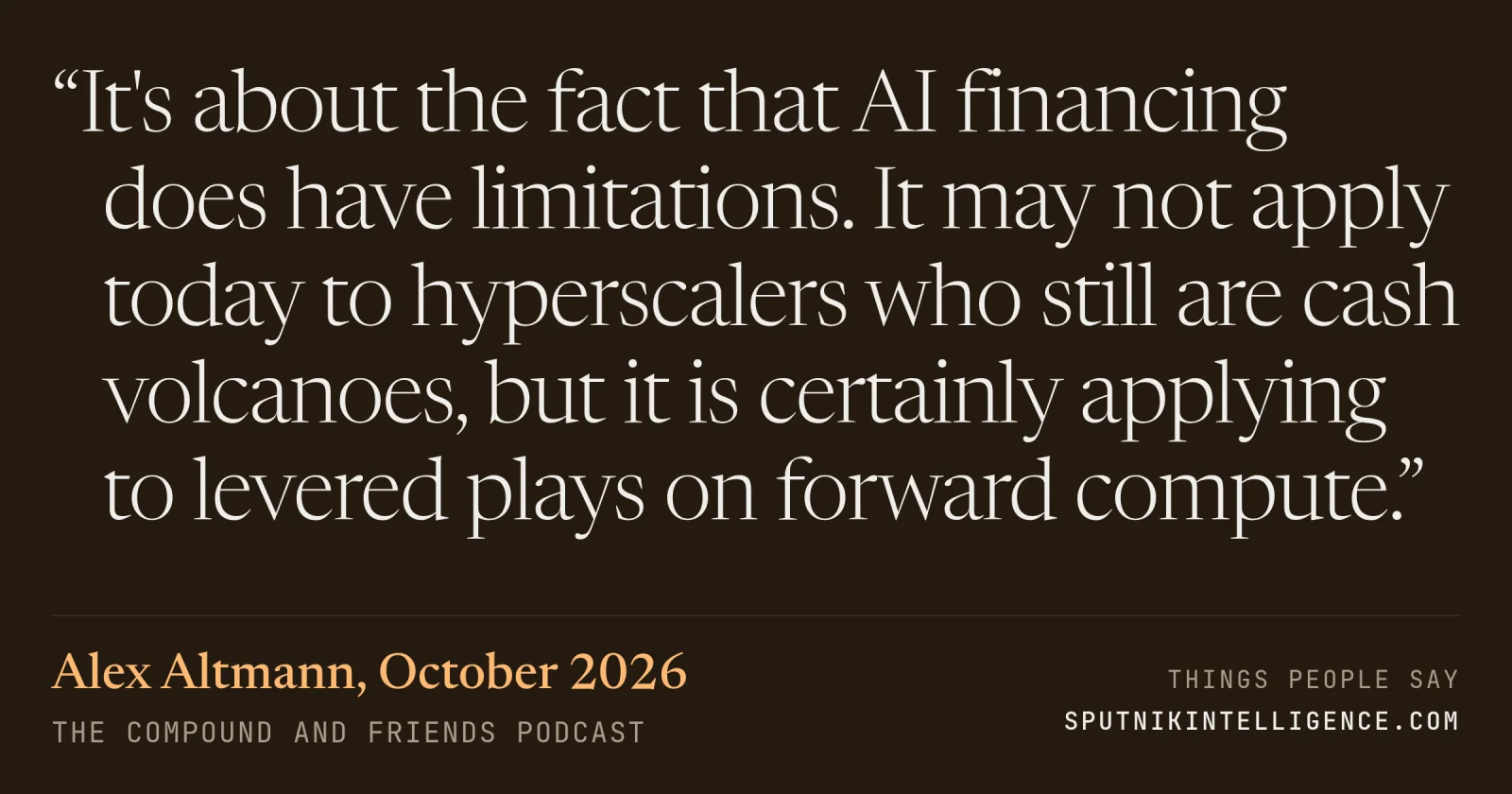
“It's about the fact that AI financing does have limitations. It may not apply today to hyperscalers who still are cash volcanoes, but it is certainly applying to levered plays on forward compute.”
The Compound and Friends · October 2026
Context
After a chart showing that a higher cost of capital usually means less issuance, Altmann argues the AI buildout is behaving as if that rule doesn't apply, and that widening data center bond spreads and neocloud stress are the market pushing back.
Transcript
Good question. So effectively, this chart is telling you that, you know, corporate finance and Econ 101 holds true over a very long period of time. And this goes back to, I think, 1995, if I'm not mistaken.
Meaning higher cost of capital, less issuance. Correct. Kind of makes sense.
But apparently, we've decided, and this is like the AI narrative. AI can ignore that. Right. And the chart before the IG chart of data centers debt is telling you you can't ignore it because spreads are widening. And they're going to continue widening to the point where it's effectively going to either tear. Or break the market. And we're seeing cracks already. That's what Core Weave is about. That's what NeoClouds more holistically about. It's about the fact that actually AI financing does have limitations. It may not apply today to hyperscalers who still are cash volcanoes, but it is certainly applying to levered sort of plays on forward compute. Well,
so the market efficiently is, I guess, like the way to think, the way I would think about this is it's rationality in the market. Yes. It got to Core Weave before it got to Alphabet, which is the way it should work. Okay. Give me 13, guys. You're saying equities are also finally catching up to the…
Yeah, sure. So look, obviously, what we try to do as a team is try to take relatively complex concepts in the market that may or be produced by other parts of the bank or by us and present them in ways that kind of make sense, right? And so equity markets are amazingly efficient below the surface…
is intuitive. If you need to borrow money, money is expensive. You're in much bigger trouble than the companies that have a stronger balance sheet.
More from The Compound and Friends