← Things People Say on Podcasts

Tech Strategy & Big Tech · August 2026
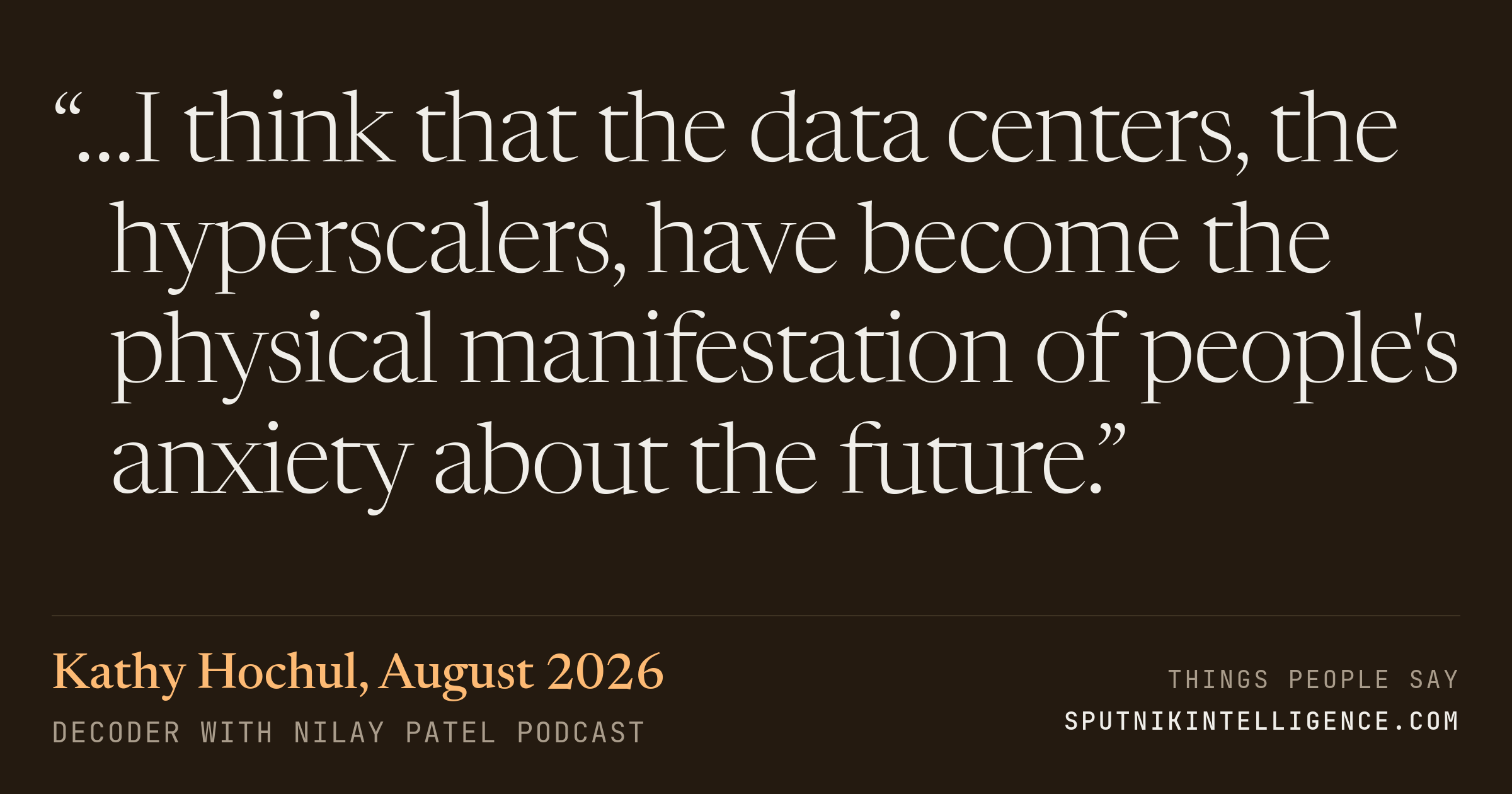
“…I think that the data centers, the hyperscalers, have become the physical manifestation of people's anxiety about the future.” — Kathy Hochul, Decoder with Nilay Patel

Nilay Patel had just argued that the AI labs do not have a marketing problem so much as a product problem. Hochul agreed that people already see the benefits, then located the backlash somewhere else: the buildings. She went on to talk about the STEM and coding careers she spent years urging young people into, which now look like the first jobs to go.

Decoder with Nilay Patel · 2026-08-31 Listen to the episode → More from Kathy Hochul →

Transcript

Decoder with Nilay Patel Around 38:23 into the episode
Kathy Hochul

When it comes to AI, there is what we could do and what we should do. What will we decide? I'm Kimberly Nebola, host of the Pondering AI podcast from SAS. Every episode, I sit down with innovators, researchers, and technologists to consider the questions that come after the AI breakthroughs. Questions that don't have easy answers, but need to be asked. If you're curious or concerned about AI, join me as we challenge assumptions and ponder the issues together. Find Pondering AI wherever you get your podcasts.

Nilay Patel

You're a politician and campaign year. I hear so much from the AI labs that what they have is a marketing problem. That if people could only understand the benefits, if they communicated them more broadly, they would win far more hearts and minds and people would be all behind this buildout. I personally disagree with that. I think everybody sees AI overusing Google all day long. I think a billion people have used ChatGPT. The products are known to people and the capabilities are known to people. And maybe there's some set of very advanced capabilities like the things you've described you've done in government that would unlock even more. But I don't think they have a marketing problem. I think they have it like an attitude problem. I think they, to some extent, they have a product problem. I don't think the products are good enough to support the asks. And these are enormous asks, as you've been describing. How would you handle that for them? How would you say, look, these are big build outs. The potential benefits to humanity are high. And from the government side, here's what you actually need to say and promise to people in order to work on this productively.

Kathy Hochul

It's not that people know the benefits. You know, your kid gets a bite, you're going to take a picture and ask Claude, is this a tick bite or a mosquito bite? Do I need to worry about this? I mean, the way that medicine has even been integrated into people's lives asking questions. So it's already being employed in a positive way for the people who want to use it in a positive way, as you've said. I think that the data centers, the hyperscalers, have become the physical manifestation of people's anxiety about the future. Think about all the young people that I literally spent years myself at go into STEM careers, kids learn science and maths, you'll have a job forever. Oh, yes, study coding and computer science. The jobs are going to be there. Guess what? Those are the jobs that are going first. People are anxious about displacement. They're worried about they're not opposed to advancement in technology in the future, but where do they fit into it? And government has to be addressing that anxiety. And I think that when people see the data centers, they're thinking, oh, geez, that's my job that could be gone. And they have to do a better job addressing the concerns that people have. Don't make a big show about laying off 10,000 people in your company that you said. You literally told them because of AI. I had people who are displaced sitting in my office. They're told they're gone because of AI. I think that was more of a shareholder's play to show your shareholders you're streamlining and saving money, but that's a lot of people's lives you just ruined. And so that's what's going on. That's the conversations that I'm hearing in places where they'll never see a data center here in New York City. And so their challenge is to help people see that this is not, and if they can't prove this proposition, then they're probably going to lose. The battle for the hearts and minds. But show us the jobs that can be created. What other jobs people will be going to? When I'm told that 81% of the jobs likely to be displaced are held by women, women just, what? We took this long to finally make it into the workplace and in significant positions or positions where, you know, where it's administrative or legal secretaries or legal assistants, even new lawyers are, you know, all the jobs that you can think of are held by women. Woman might be the primary breadwinner. If she thinks her job is going to be gone from AI, she's not going to love an AI company. She's going to say, wait a minute, what about me? So they need to figure out what the AI future looks like. Tell us right now the skills that are required. What should I be teaching in schools? What should we say state education department should be teaching? What courses should be taking in college to prepare people, the next generation of workers, so they will not be in that displacement. But we have a whole lot of people who are already in that vulnerable spot. You know, the individuals just getting out of college, those who are mid-career, what are they supposed to do? And I saw this personally. I'm from Buffalo, Buffalo Bills fan. I'll put that right out here now.

Nilay Patel

We haven't talked about the stadium, but we can get there.

Kathy Hochul

We'll get to the stadium. We saved the bills. That's all you need to know. They're not in another state. There are the Buffalo Bills, and they weren't going to be. But right not far from there, my parents used to live in a trailer park near the steel mill. Everybody worked at the steel plant, Bethlehem Steel. It was the best job you could get. My dad worked there. My grandpa worked there. My uncles worked there. 1982, they pick up and leave town. No one thought about the workers, the 20,000 workers in my town that now were just lost their lives. I mean, they had livelihood. They left.

Nilay Patel

Can I connect to you two dots here? My point

Speaker names from our own diarization · position estimated from where the line sits in the episode