 Dave Bittner
Podcast host and VP at the CyberWire, covering cybersecurity news, research and social engineering.
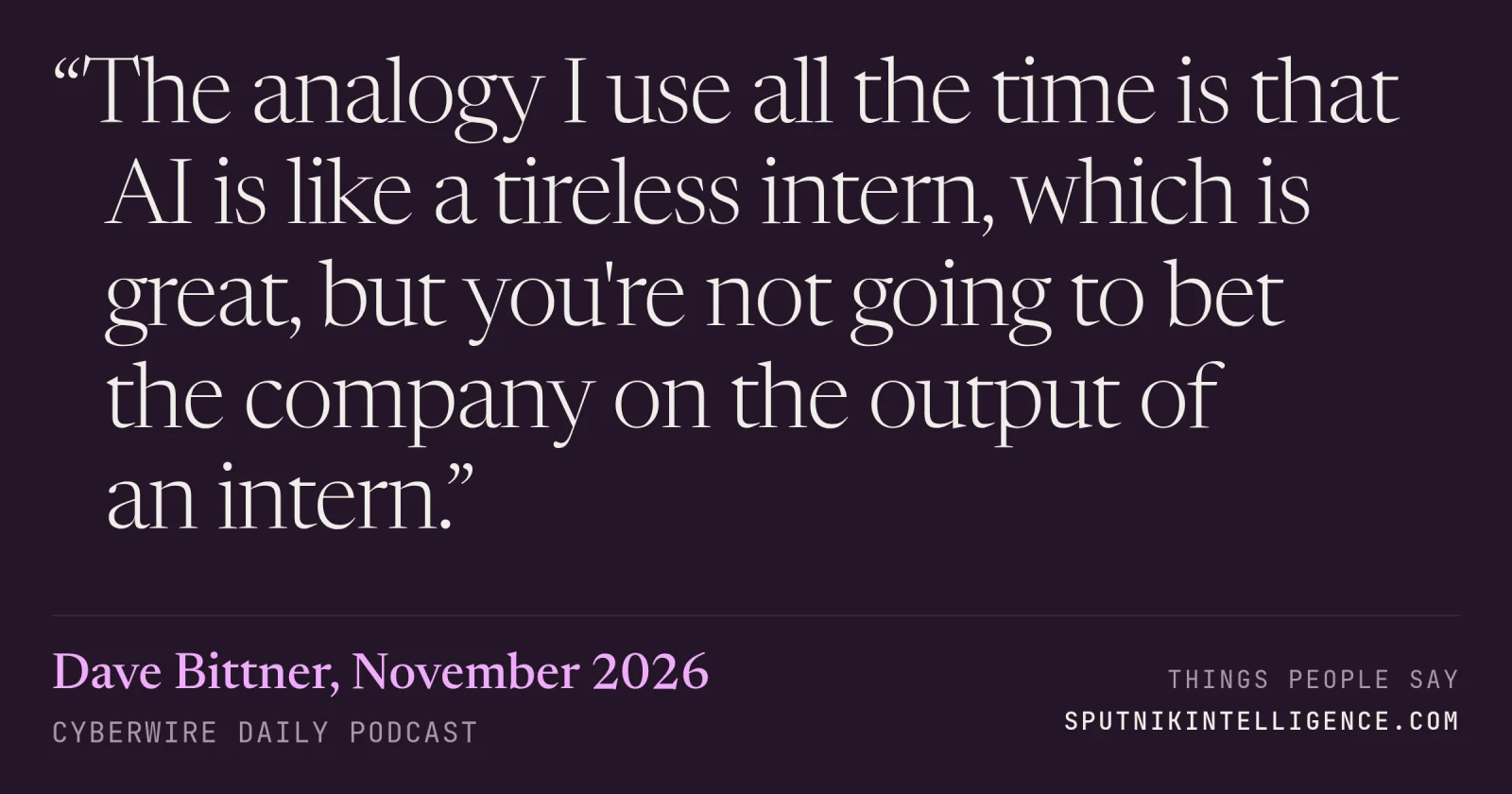
“The analogy I use all the time is that AI is like a tireless intern, which is great, but you're not going to bet the company on the output of an intern.”
CyberWire Daily · Software Engineering & Infra · November 2026
Context
Maria Varmazis asked how AI is changing defenders' day-to-day work. Dave said every security vendor now has to pitch AI, partly because attackers use it, and argued the sensible model is machine-speed analysis with a human signing off.
Transcript
Just supercharged it, right? No, no longer do you look for clunky English that was oddly translated from whatever the mother tongue was. But no, all of a sudden you can take anything, run it through one of these large language models, say, clean up my English, make it flawless. And it was so.
…heavy-duty lifting of the work that defenders are doing every day in their organizations, I mean, people are using AI and their workflows now in all sorts of creative ways, but also you can't ignore its capabilities now, too. So what have you seen in the last few years as trends in that direction?
…using it? How much does it include the human in the loop? You know, getting back to the clip from the old clip of me talking about chess, how the human plus the computer was the real chess champion. And I think a lot of folks are settling into that, that you want the AI to handle the stuff that requires high speed analysis. But at the end of the day, you still need a human to sign off on it. The analogy I use all the time is that AI is like a tireless intern, which is great, but you're not going to bet the company on the output of an intern.
And on the attacker side, to me, AI has been like pouring gasoline on a fire in terms of just the volume that attackers have been able to pump out what they do, essentially, and the effectiveness and the way that they can iterate and the speed at which they can iterate. And we haven't even touched…
No.
And that's alarming.
More from CyberWire Daily