 Jason Calacanis
Angel investor, internet entrepreneur and podcaster focused on startups and venture capital.
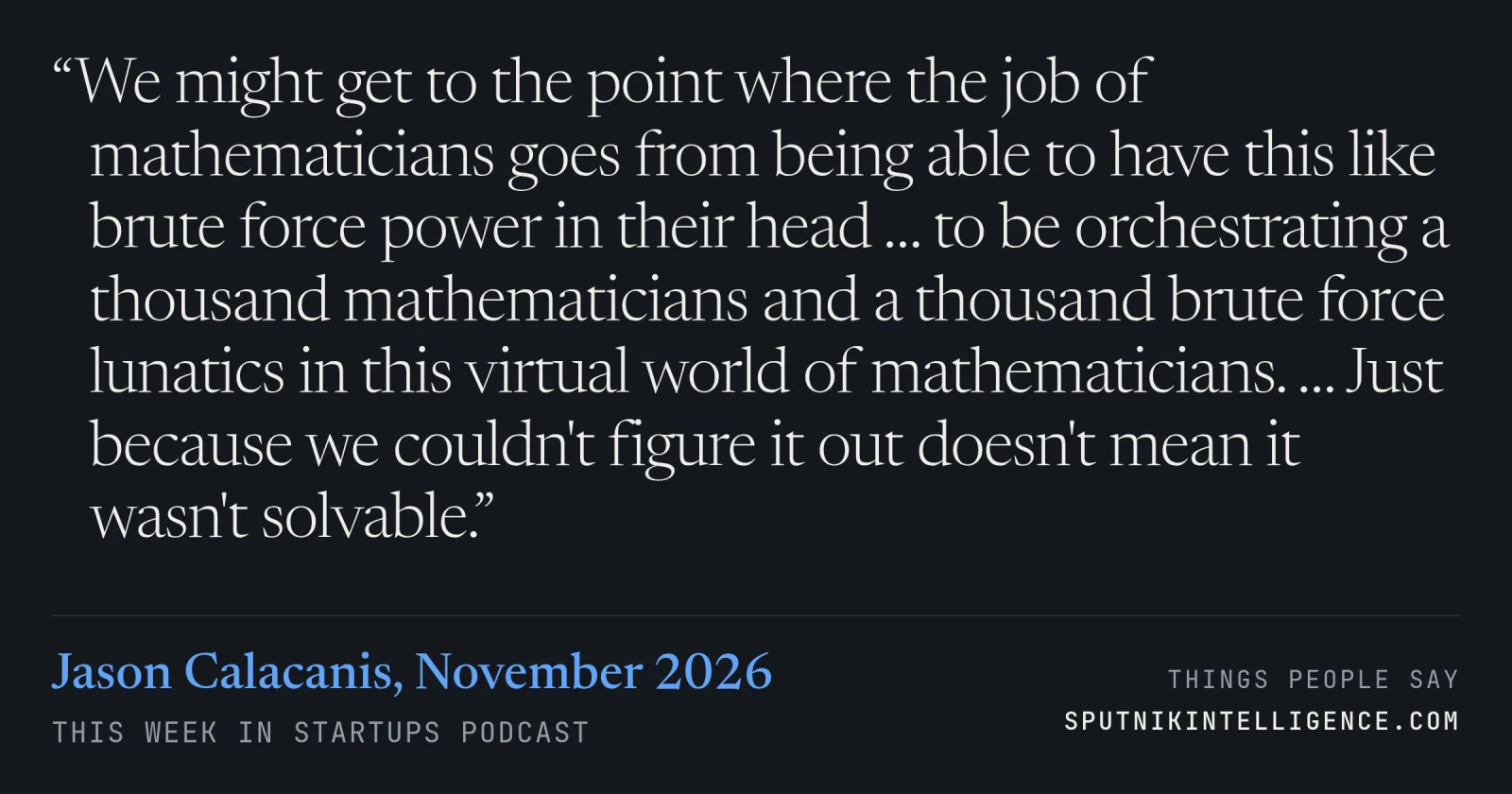
“We might get to the point where the job of mathematicians goes from being able to have this like brute force power in their head … to be orchestrating a thousand mathematicians and a thousand brute force lunatics in this virtual world of mathematicians. … Just because we couldn't figure it out doesn't mean it wasn't solvable.”
This Week in Startups · Startups & Venture · November 2026
Context
The hosts had discussed reports that frontier AI models were claimed to have made progress on a decades-old open problem in theoretical computer science. Asked what it means for mathematicians, Calacanis says their role may become orchestrating swarms of AI.
Transcript
Joan Didian had one. She was known for having a Corvette that she loved, and she was Joan Didian Corvette. She was known for taking a bunch of pictures with the stingray. And it was like kind of a big deal that she was into this car and she made it very popular amongst intellectuals, I believe.
…AI can solve these like theoretical equations? And what do you think this means for the people who work in these fields? Theoretical math, theoretical computer science. Are they more valuable now that they can check the AI's work? Or is AI just about to take over what they do and there's no reason?
…thinking smarter than us, but in aggregate, it's trying so much, i.e., brute force. So, in a way, it's paralleling the debate between AGI and super intelligence. So, if you can solve this with brute force, because you have so many resources in a computer, okay, great. The brute force solves it as quickly, the tic-tac-toe, as like some novel new way of understanding the heuristics of this. Well, we might get to the point where the job of mathematicians goes from being able to have this like brute force power in their head and the ability to focus on things for a long time and meditate on them and try to do unique things to be orchestrating a thousand mathematicians and a thousand brute force lunatics in this virtual world of mathematicians. And you just literally create an army, a swarm to solve these problems. Maybe there's enough edge problems for them to solve, or is it finite? We don't understand these things…
Right. If we have, I mean, we, we're, we're as humans, we're limited by one thing more than anything else, which is just our lifespan. Like, it takes 20, 25 years to get incredibly good at math or computer science. And then you've got, you know, a ticking clock of 40, 50 years to work on everything…
Yeah, absolutely. All right. Another great episode is in the cam. We'll see you next time. Bye-bye. Bye,
everybody.
More from This Week in Startups