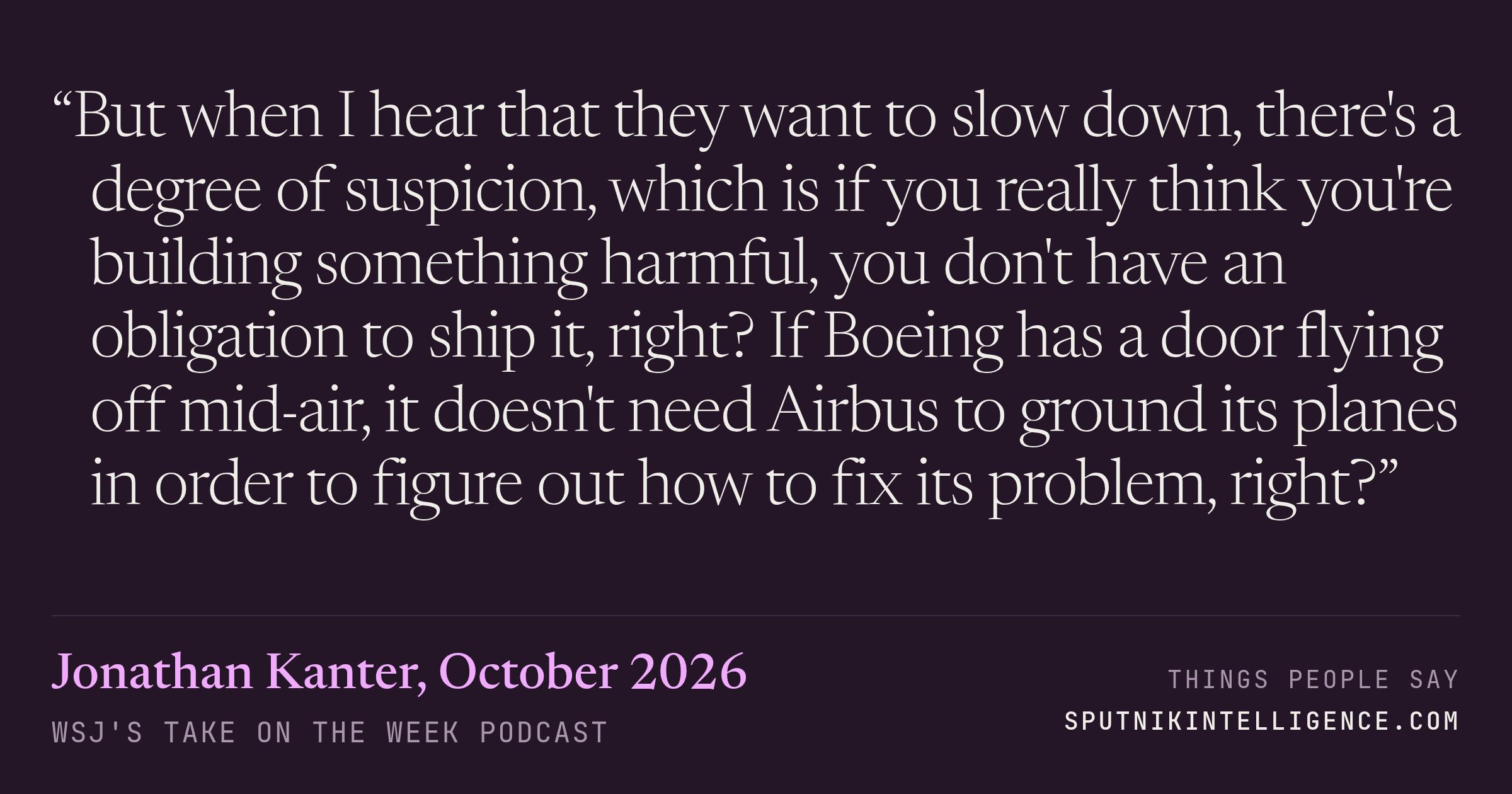
“But when I hear that they want to slow down, there's a degree of suspicion, which is if you really think you're building something harmful, you don't have an obligation to ship it, right? If Boeing has a door flying off mid-air, it doesn't need Airbus to ground its planes in order to figure out how to fix its problem, right?”
WSJ's Take On the Week · October 2026
Kanter responds to AI company leaders who say the whole industry should slow down together. He argues that a company worried about its own product can simply hold it back, and that rules with real consequences would push companies to compete on safety.
Transcript
And so, and so- It's how they're
legally obligated to behave. Yeah, right.
…going to be wildly successful. They're still going to make money hand over fist. There's still going to be plenty of opportunity for great returns. I think what we're hearing, including from the shareholders, is just tell us where the lines on the road are. Tell us where the stop signs and the traffic lights are, and then make the consequences significant enough so that we can adhere to them. But when I hear that they want to slow down, there's a degree of suspicion, which is if you really think you're building something harmful, you don't have an obligation to ship it, right? If Boeing has a door flying off mid-air, it doesn't need Airbus to ground its planes in order to figure out how to fix its problem, right? And so I think we want my view is we want companies competing to develop safe and secure products, and we want to give them the incentive to do that. And I think that is good for shareholder returns. It's good for the public. And it's going to be necessary if we want products that are safe and secure. And I think we've learned our lesson on the first generation of the internet that just some…
So we've been talking about regulation a lot from kind of the user's point of view. I think there's a couple other areas, which is in order to say that we have a fair competitive market, because at the end of the day, too, if these are products, we want them to be priced appropriately, right? If…
Yes. Right. Of course, it does. I mean, this is why the antitrust laws exist. It reminds you a lot of, you know, the trusts from antitrust were these organizations that had their kind of ownership interest all over the economy. And that circular ownership was actually part of what led to the…
So we've talked about competition among U.S. companies, but we haven't talked about a thing that the Trump administration brings up a lot, which is competition with China. How could regulating our own AI industry hold us back from competing with China? Is that a fear? Because that's something…
More from WSJ's Take On the Week