 Dylan Patel
Bridging the gap between business and the worlds most important industry.
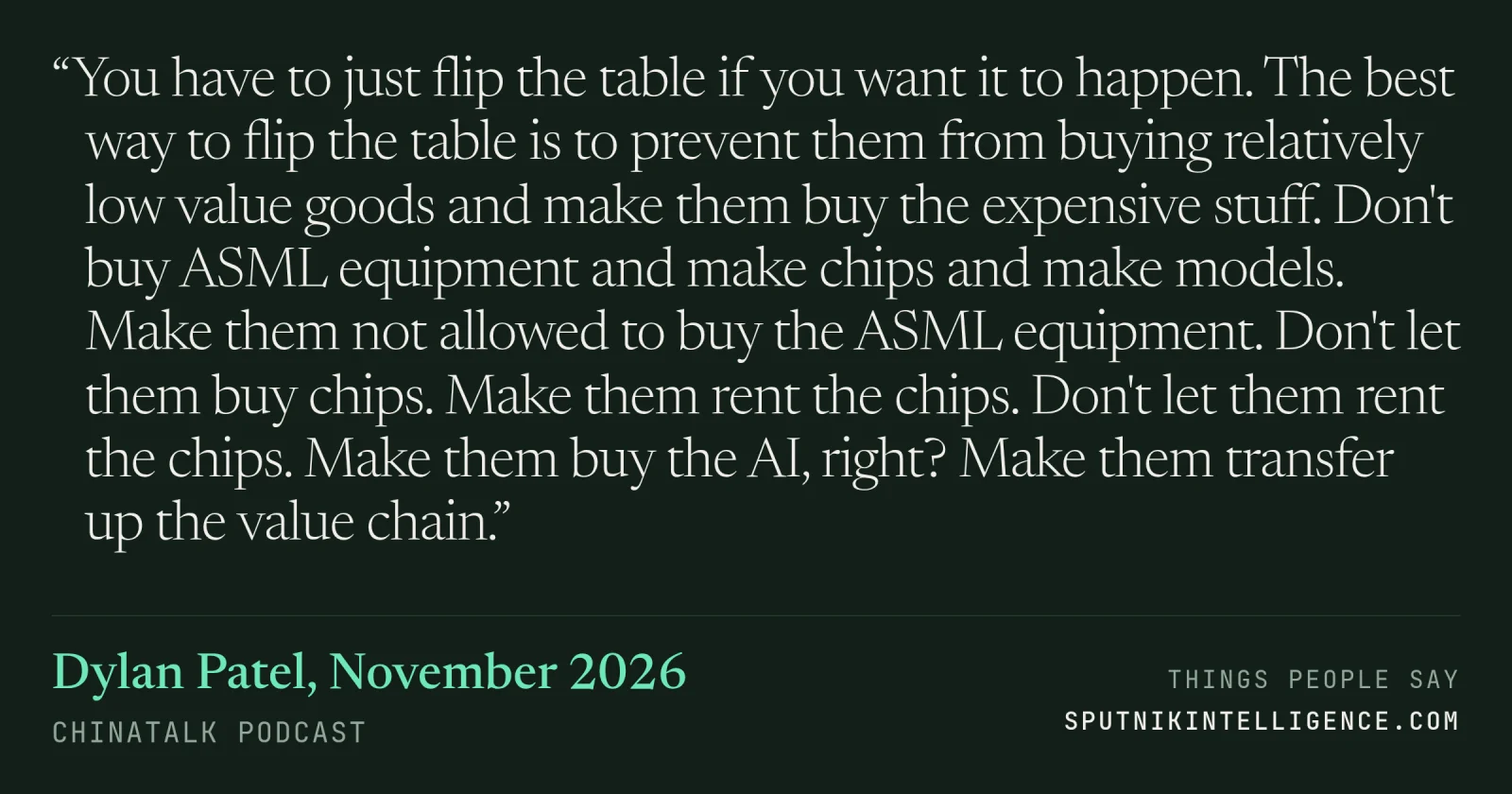
“You have to just flip the table if you want it to happen. The best way to flip the table is to prevent them from buying relatively low value goods and make them buy the expensive stuff. Don't buy ASML equipment and make chips and make models. Make them not allowed to buy the ASML equipment. Don't let them buy chips. Make them rent the chips. Don't let them rent the chips. Make them buy the AI, right? Make them transfer up the value chain.”
ChinaTalk · Geopolitics & World Affairs · November 2026
Context
Responding to the argument that restricting one item in the supply chain just makes China engineer around it, Dylan Patel argues export controls should target chipmaking equipment, the focus of the MATCH Act, and push China to buy finished AI instead.
Transcript
…that we've seen and just like, you know, cognitive dissonance on the part of this policy process is really breathtaking. But anyways, I want to come to Jordan. Jordan, what's your RASA take? Where do you want to put the temperature on just how many chips we should let China have access to remotely?
…Act. Like just expand it beyond EUV, stop them getting access to UV tools too. They need a bunch if they're going to produce any of these chips that go into these data centers and make them build lithography from scratch, right? That's kind of the easiest way to stop them making any progress here.
The main thing I think that people just don't understand is that they think like if you remove one item at the top of the supply chain, they won't do everything. And I've used this analogy a hundred times, but it's the jigsaw puzzle, right? You remove one piece, they'll fucking engineer the one piece. If you blow up the board, it's harder. At the end of the day, this is an economic war. If you think you can get away with something without much blow, you know, without huge ramifications across supply chains, you're not going to be able to solve the issue. You have to just flip the table if you want it to happen. The best way to flip the table is to prevent them from buying relatively low value or low total market cap value goods and make them buy the expensive stuff. Don't buy ASML equipment and make chips and make models. Make them not allowed to buy the ASML equipment. Don't let them buy chips. Make them rent the chips. Don't let them rent the chips. Make them buy the AI, right? You know, make them transfer up the value chain. Where the value chain is much larger and larger and larger. And if you do that, then China has an economic disadvantage massively so. And this is a scale game. And therefore, the West will win. And…
Yeah, I think it's also a tight new thing. Like we're kind of watching China on the rise. And I think that in response to a lot of these actions, they don't want to escalate because the longer that they wait in these intelligence wards, the more time they have to catch up. And there's a lot of…
the question is not just like capability, it's also scale, right? And that's where it comes back to the equipment. Like, yes, it sucks, or it's not ideal that, you know, China has been able to break through the sort of 14 nanometer line, which we like kind of sort of tried to draw in the sand in…
I guess that was supposed to be talent, man. Like, you know, like all of the most talented people primarily work at major anthropic OpenAI, DeepMind, and Meta TBD, right? And then, you know, those who don't are split across a hundred different startups. There's no startup. I mean, like, yes…
More from ChinaTalk