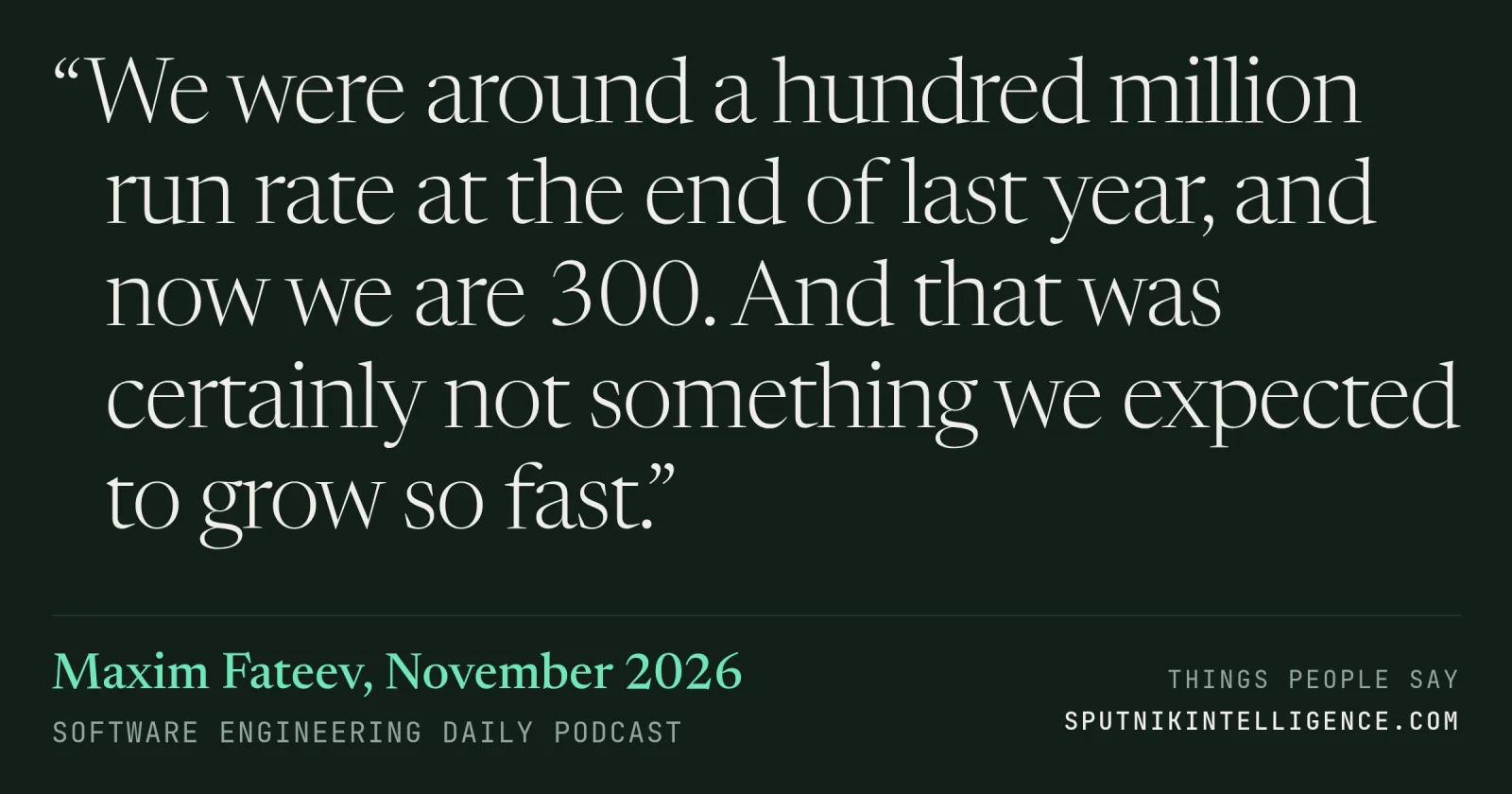
“We were around a hundred million run rate at the end of last year, and now we are 300. And that was certainly not something we expected to grow so fast.”
Software Engineering Daily · Hands-On Engineering Podcasts · November 2026
Context
Asked what changed to explain two funding rounds in about six months, Fateev credits years of open-source growth plus the explosion of AI agent development. The revenue figure is his own claim.
Transcript
…can reinvent this wheel every time and again, spend 90% of their time doing all of that, but their business logic. With Temporal, just implement the business logic and we take care of the rest. And it's 10 years in production at tens of thousands of companies. So, it just battle-tested for a while.
…the funding appetite for this? As you mentioned, like a lot of teams start out building something and that before they ever go out and reach for temporal as a solution. So, has something changed in the market that has made this more top of mind for companies and led to a lot of growth on your end?
Actually, there are two answers there. One is it's a result of a lot of years of compounding. We've been growing, like our open source, for example, was growing around like 8% months over months since we started tracking six years ago. So, that compounds over time pretty well. Then, also, our go-to-market was always based on a learner and expand strategy. So, we try to sign up as many enterprises and the customers as possible, even without practically, because we're a consumption-based service. So, practically without any commits, just we want to make sure people start experiencing the platform. And usually, it takes years for people to get really comfortable to start putting big production kind of mission-critical workloads in the platform. So, that started to compound, and now general business always was growing pretty well. But also, AI Agents, and AI, just the amount of new development in new companies and also traditional companies…
Yeah, I mean, that's amazing growth. And again, congratulations. I guess, like, if you take the OpenAI example, and I'm just using this example, so you don't have to get into specifics of things that maybe you can't disclose about it. But what causes that team to think, like, I guess, like, durable…
I think one thing which happened in OpenAI is that the OpenAI kind of sucked a lot of practically the best people from the valley and also acquired a few companies. And a lot of those people already knew Temporal from their previous companies. So they already knew this new durable execution…
Yeah, I mean, I think that everything's accelerated in terms of scale from probably anything we can imagine with how fast people are producing code, how fast these systems are being spun out. And I can only imagine how fast a company like OpenAI is potentially moving and consuming all these…
More from Software Engineering Daily