 Steve Gibson
Software developer and security researcher who founded Gibson Research Corporation, maker of the SpinRite disk maintenance and recovery utility and the ShieldsU...
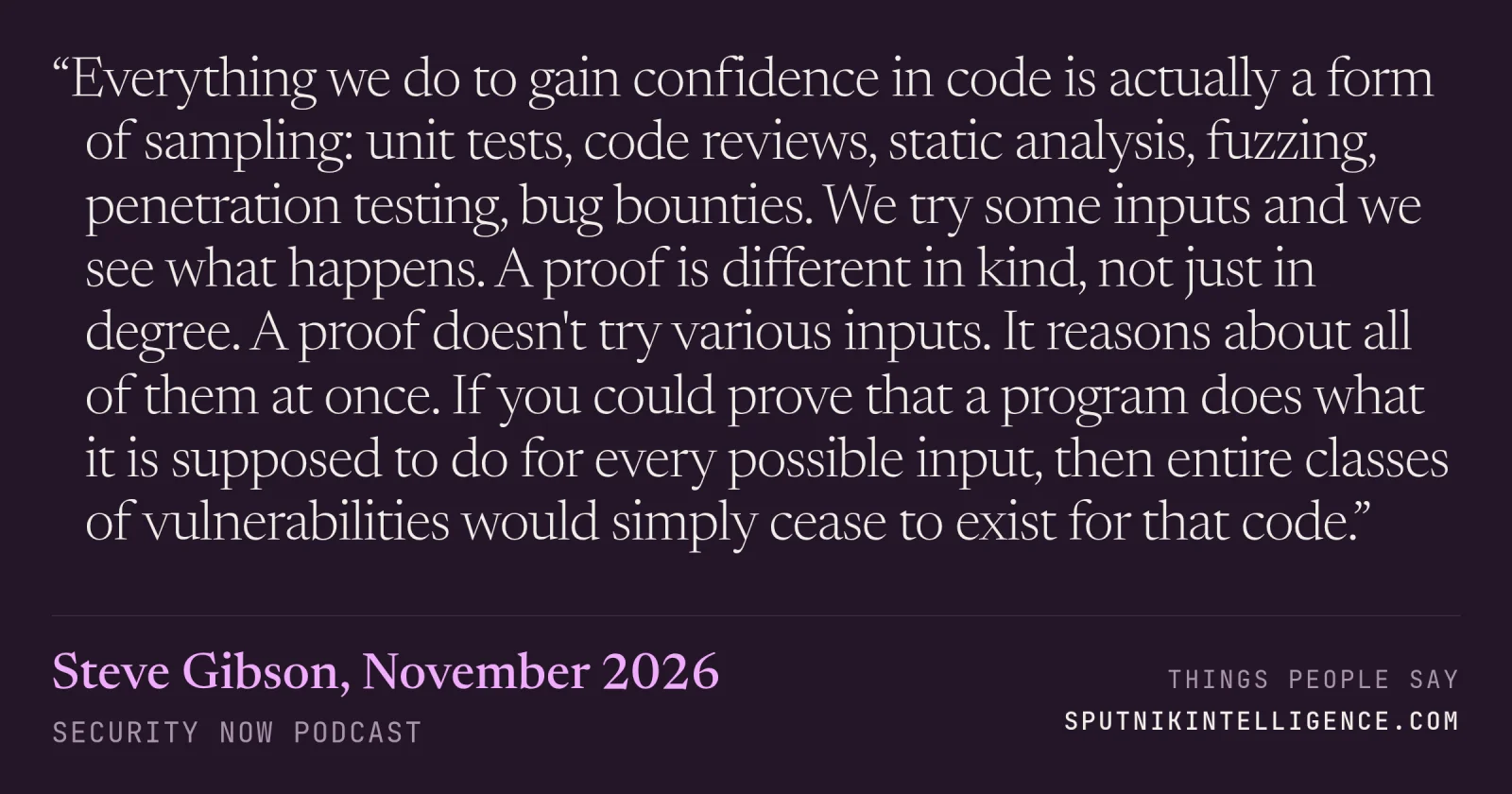
“Everything we do to gain confidence in code is actually a form of sampling: unit tests, code reviews, static analysis, fuzzing, penetration testing, bug bounties. We try some inputs and we see what happens. A proof is different in kind, not just in degree. A proof doesn't try various inputs. It reasons about all of them at once. If you could prove that a program does what it is supposed to do for every possible input, then entire classes of vulnerabilities would simply cease to exist for that code.”
Security Now · Software Engineering & Infra · November 2026
Context
Steve was explaining why a mathematical proof of code is a different thing from testing: the defender has to get every case right, the attacker needs one untried input. It sets up why Google's AI-generated proof of Signal's code matters.
Transcript
…And then we're going to dig into something. I mean, another, we already talked about AI and this potentially groundbreaking innovation from MIT. Here's another one. The idea that we could actually, finally prove to a mathematical certainty that code is correct and bug-free and does what we want.
…about January 8th. Just some of the things coming up. twit.tv slash clubtwit. Help us help you by joining the club. We appreciate everything you do to keep us on the air. Now we continue on, ladies and gentlemen. Join the club, one of us with Security Now. And wow, the case of the provable code.
So, yes. Last Tuesday, a week ago, November 10th, Google DeepMind published a research post titled Introducing Alpha Proof Code, a breakthrough in verifying complex software at depth. Okay, so a little bit of background. And this is, I warn you, going to kind of be a conceptual thinking piece here. For anyone who has spent their career around software, what Google is claiming reads almost like science fiction. AI agents, guided by a small team of human experts, produced a true mathematical proof that the actual compiled machine code, because that's what it used, it didn't use source. It used the machine code of Signal's core cryptographic library delivers four specific security guarantees, forward secrecy, authentication, post-compromise security, and handshake secrecy. These were implemented in two parts of Live Signal, the PQXDH handshake, which we talked about previously when Signal added quantum to their existing Diffie-Hellman, and the triple ratchet. And again, as I said, this was all done. This was validated at the compiled machine code level. I'm not going to get into the details of those four security principles, since even though it's terrific that what was believed to be true and correct of them has now been proven to a mathematical certainty, the real story here is that…
Yeah. Very interesting. Very interesting. And do you think ultimately it'll mean better code?
It's going to mean better code where it matters.
Yeah.
More from Security Now