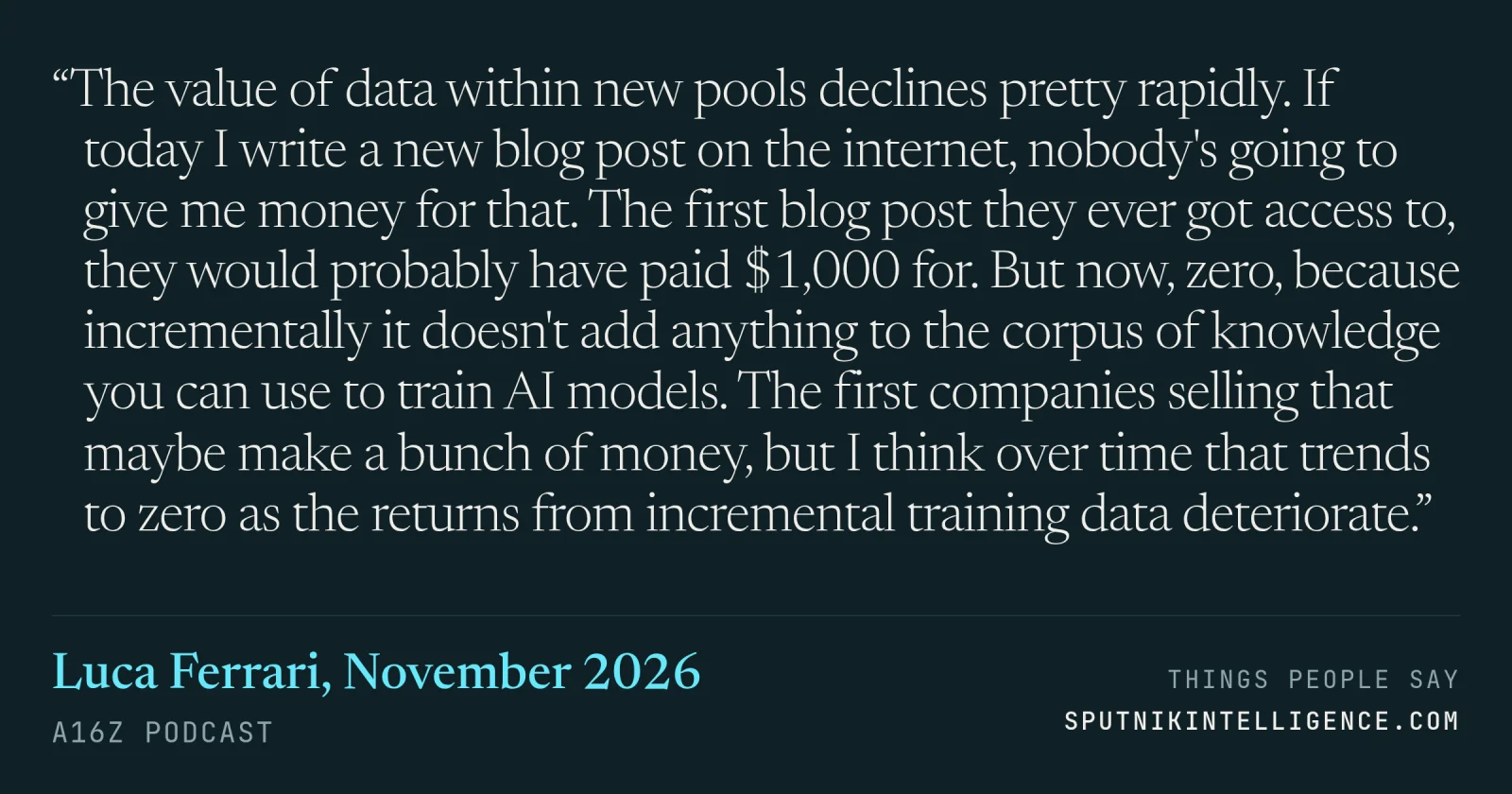
“The value of data within new pools declines pretty rapidly. If today I write a new blog post on the internet, nobody's going to give me money for that. The first blog post they ever got access to, they would probably have paid $1,000 for. But now, zero, because incrementally it doesn't add anything to the corpus of knowledge you can use to train AI models. The first companies selling that maybe make a bunch of money, but I think over time that trends to zero as the returns from incremental training data deteriorate.”
a16z Podcast · Startups & Venture · November 2026
Context
Asked about the quip that many companies trade for less than their data would be worth as AI training material, Luca (after saying he hasn't thought about it enough) argues that each additional piece of data loses value quickly. A skeptical view of selling data to model labs.
Transcript
So I agree.
…everything happening in models. There's a quip that. Many companies are sort of trading for less than the value of their tokens, which is the value that they would have if they were simply acquired for training data by models. Do you think that's true? Do you think proprietary data has changed?
So I haven't thought enough about this, and I don't know enough about it, but I will say that claim strikes me as potentially a little bit misleading. Meaning, the value of data within new pools declines pretty rapidly. It's like if today I write a new blog post on the internet, nobody's going to give me money for that. It's private and I'll go to OpenAI. I'm about to, you know, I may publish it. I may not. Do you want it? Do you give me it on top? The first blog post they ever got access to or could ever access, they would probably have paid $1,000 for. But now, zero, because incrementally doesn't add anything to the corpus of knowledge that you can train AI models. So yes, maybe there's now a need for plenty of data on how people do project management or whatnot. The first companies selling that maybe make a bunch of money, but I think over time that trends to zero as the quality of incremental training returns a deteriorate for incremental training. But I'm in no position to determine whether companies could sell data for more of their enterprise value. I'm not certain about that.
Interesting. Let's double-click on the kind of operating system you use within Bending Spoons to help improve and optimize all the companies. Can you talk about some of the key components of it? And which of the components do you think would have been most useful to you as a single product founder…
So there's pretty much everything that you need to run a digital business. We built in-house with the exception of highly, I think, universal tools like Gmail or Slack, this sort of thing for you. Or Google Drive, we're happy to use those that others build. We don't have highly specific or…
That sounds really powerful. As you think about the way models get deployed within the company, do you think there are any job functions where the model will be doing 100% of the work in the near future? Or do you imagine it being a kind of lever for individual productivity, as you just described?
More from a16z Podcast