 Eric Smith
On The Trajectory
“So you'll often hear that plants are autotrophs. Plants are not autotrophs. Plants don't fix nitrogen. So they only exist in soils where the nitrogen fixing remains being done by bacteria that are neither endosymbionts nor multicellulars.”
The Trajectory · AI Research & Frontier Labs · October 2026
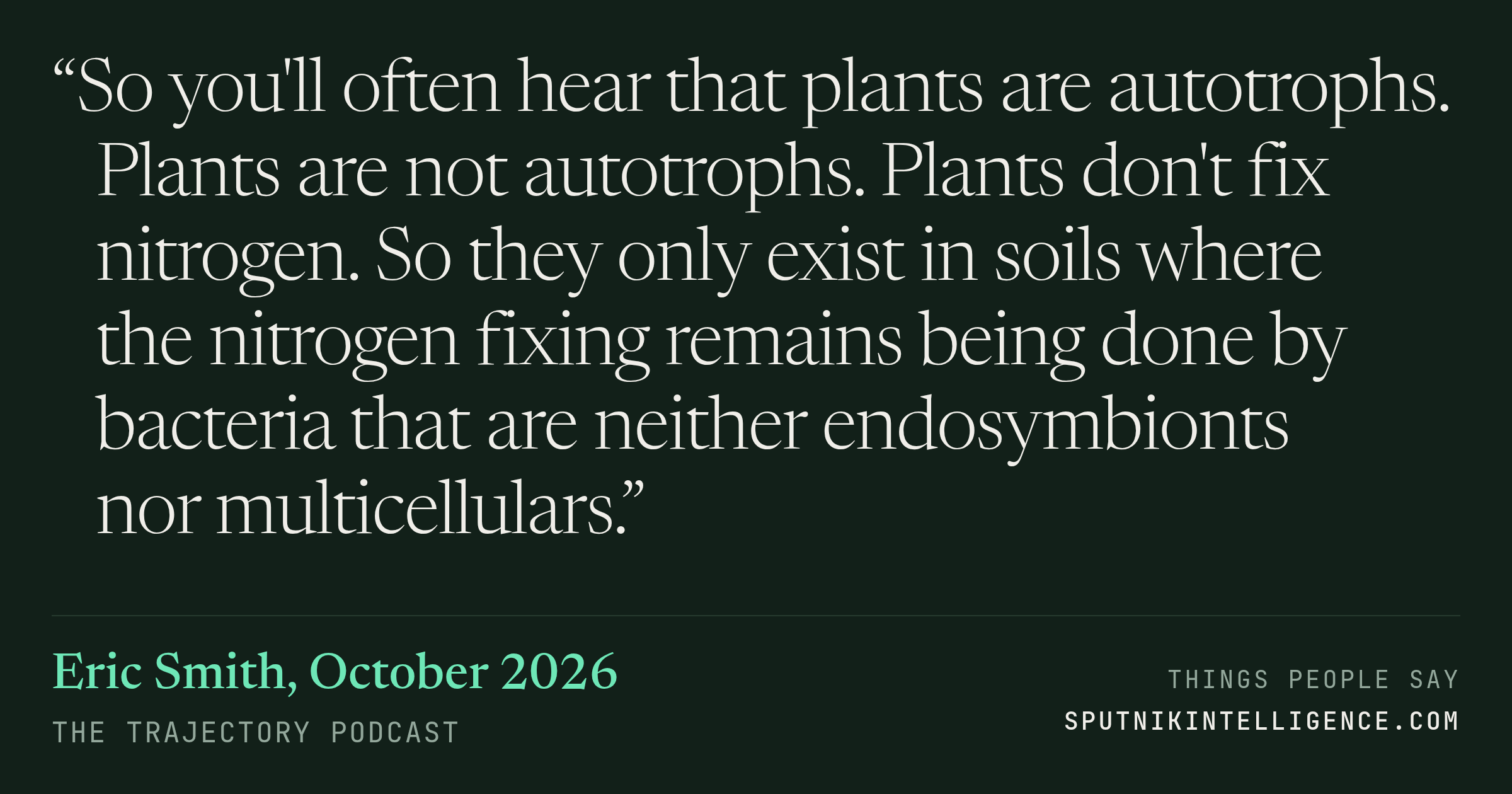
Smith on what happens when bigger forms of organization emerge, in a conversation about AI's place in the living world. His speculation is that new architectures settle in alongside the older, smaller ones they depend on rather than displacing them, so ecological stability may require that what's superseded isn't eliminated.
Transcript
…thoughtful, that there's the popular saying that those who don't know history are condemned to repeat it. And he says, my reading of history is that those who do know history are condemned to repeat it too. And so then the question is why? And what do we have to say that will do better than that?
…we see this. It seems like in the biosphere we see this. I sort of wonder if, in the grand sweep, of course, you and I can't go forwards. But in the grand sweep, if this isn't part of the hierarchical dynamics and wrestling struggles of the living process doing whatever it is that it's doing.
…bit more autonomous than the other somatic cells, but still not as autonomous as bacteria. But here, I would make a caution. I have a speculation. I don't know how to make it into a proper science question. You will notice that when new subordinations of autonomy came into existence, they wound up fitting in alongside the other things that had not lost autonomy. They did not displace them. So you'll often hear that plants are autotrophs. Plants are not autotrophs. Plants don't fix nitrogen. So they only exist in soils where the nitrogen fixing remains being done by bacteria that are neither endosymbionts nor multicellulars. So if we think on the long term of where genetic diversity comes from and where ecological task sharing and division of labor comes from, it is not clear that big new architectures do everything better than the smaller architectures that were doing them before, even if they can do some new things. So it may turn out to be a requirement of ecological organization. This is the thing where I can…
Yes.
And so I think this potential for rebuilding and the idea that the branches of the tree are the most likely. Things to get trimmed when something happens that you didn't plan for is something we can probably think about in an orderly way as we think about bet hedging. What does bet hedging look…
Yeah, and it reminds me of Wimstadt's generative entrenchment and things along those lines where you eventually have things that just don't work. They clashingly don't work. They wildly don't work. They fall apart at whatever level. And then, but there was something working up until this level that…
More from The Trajectory