 Leah Stokes
Writing "Notes from the Electric Era". Prof of Climate + Energy Policy @ UCSB. Author of The Carbon Wave (out 9/1) and Short Circuiting Policy.
Leah Stokes
Writing "Notes from the Electric Era". Prof of Climate + Energy Policy @ UCSB. Author of The Carbon Wave (out 9/1) and Short Circuiting Policy.
“Sometimes, especially in progressive spaces, we can sort of lionize process. Like, oh, process, so great. And forget that process can be weaponized by our opponents to slow down justice, right? ... And so speed is a progressive value in my book.”
Volts · Climate & Energy · October 2026
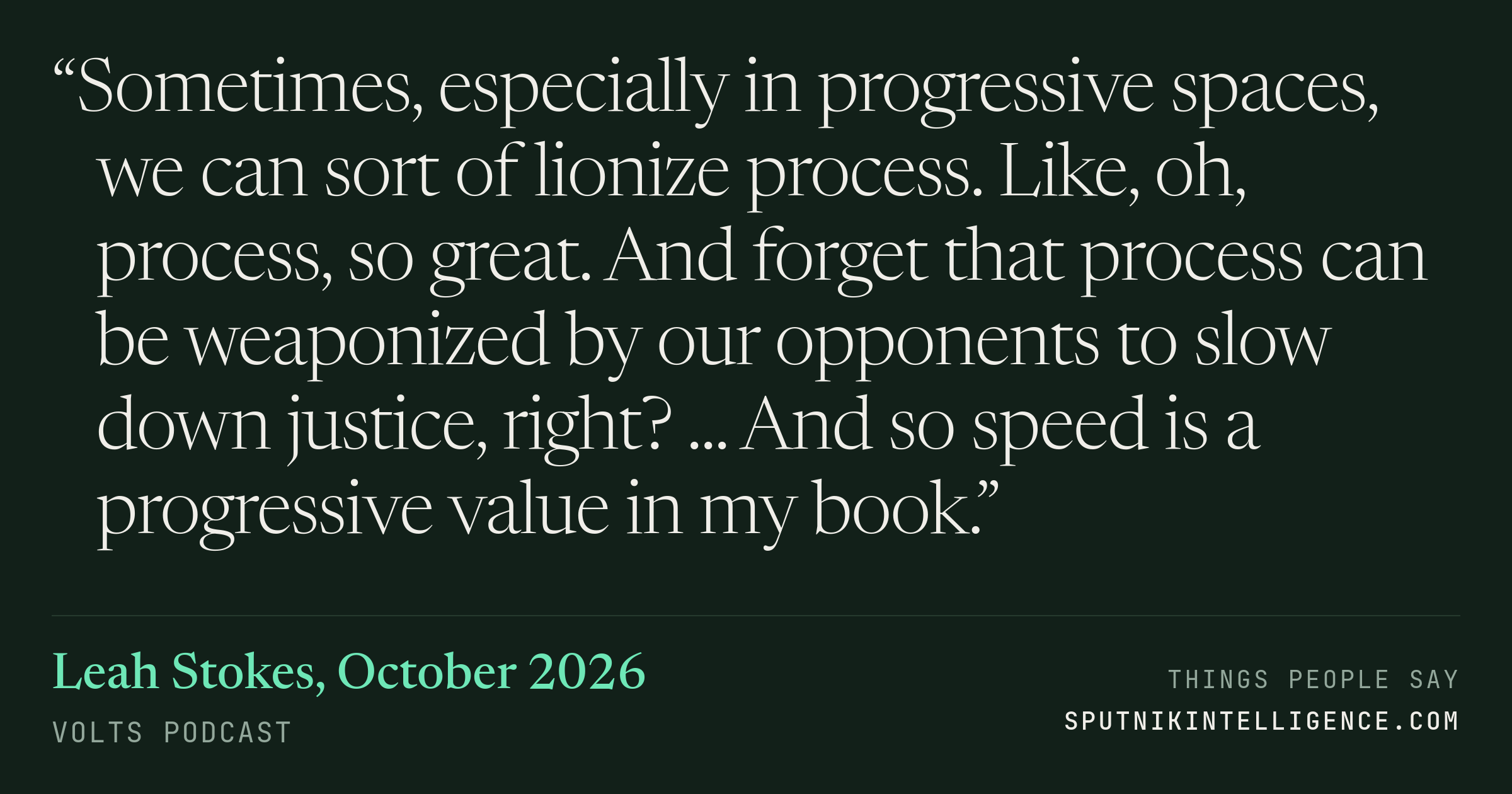
At a live event for her book on the Inflation Reduction Act, Stokes is asked what lessons the fight left for building lasting institutions. She says some of the law's grant money took too long to get out the door, and that projects further along would have been harder to take back. She credits people in the abundance movement for the lesson about moving faster.
Transcript
Hey, Jason Huff with Pacific Northwest Climate Week. Thanks for the book in advance. And this is a super good teaser. Zoom out and forward. Ezra Klein just had this fantastic podcast Friday talking about hyperpolitics, how easy it is for people to get so passionate about different things, but all those passions, all these movements in the current moment oftentimes aren't tied to institutions that bring about longer
change. Talk a little bit about some of the organizational institutional lessons that you've learned from, you know, both such of these bills in the current moment as far as like how do we organize better for longer-term change that gets past the whipsaw of the politics.
Well, two things. I think it's really important when we talk about a carbon wave to talk about joining groups. Like you are not going to be able to change policies and do all these things by yourself. You need to be networked. And there's a bunch of folks who advertise this event and are here. And there's amazing organizations in your community. You should be part of them. You should support them. That's not second-order work. It's really first-order work. And the second thing I'll say, a really big lesson, which I write about in the end of the book, is that some of the money in the Inflation Reduction Act was in the form of grants. And it took too long to get that money out the door. And that's a real tragedy because a lot of that money was to help disadvantaged communities, indigenous communities, you know, places that have been on the front lines of fossil fuel pollution. And had that money just been a little bit further along in the implementation stage, so that Speaker Johnson, who had an award in his district, that had broken ground, we would have been able to hold on to that money more. And so I think a lot of the ideas that folks in the abundance movement talk about about moving faster and speeding things up are very important lessons because sometimes, especially in progressive spaces, we can sort of lionize process. Like, oh, process, so great. And forget that process can be weaponized by our opponents to slow down justice, right? And every year that we chill and wait and don't remove pollution from communities, that is costing people in their lives. And so speed is a progressive value in my book. And so I think we have to build institutions that can move a lot faster.
Amen. And I'll add one thing, taking a step even further back. A lot of the reasons the bill got squeezed into the weird shapes it got squeezed into has to do with structural features of how our government work the people that have been around so long that people stop thinking about them like the filibuster yeah you can't write a normal bill because you need 60 votes in the senate now and you're not going to get 60 votes for anything so this had to be a reconciliation bill and a lot of weird policy choices were downstream of that and you can go down the line gerrymandering malapportionment of the senate money in politics on and on court a lot of these structural features of our government that have strangled our ability to do anything and we find ourselves wiggling around in the tiny space left we need to think about how to break some of those barriers and the only way like all those barriers serve inaction and so they all serve conservatives and the only way you're going to change any of those barriers is democratic supermajorities
yeah or getting rid of the filibuster and packing the supreme court it's another idea just another idea
you'll never get that without democratic supermajorities i'll just well
More from Volts