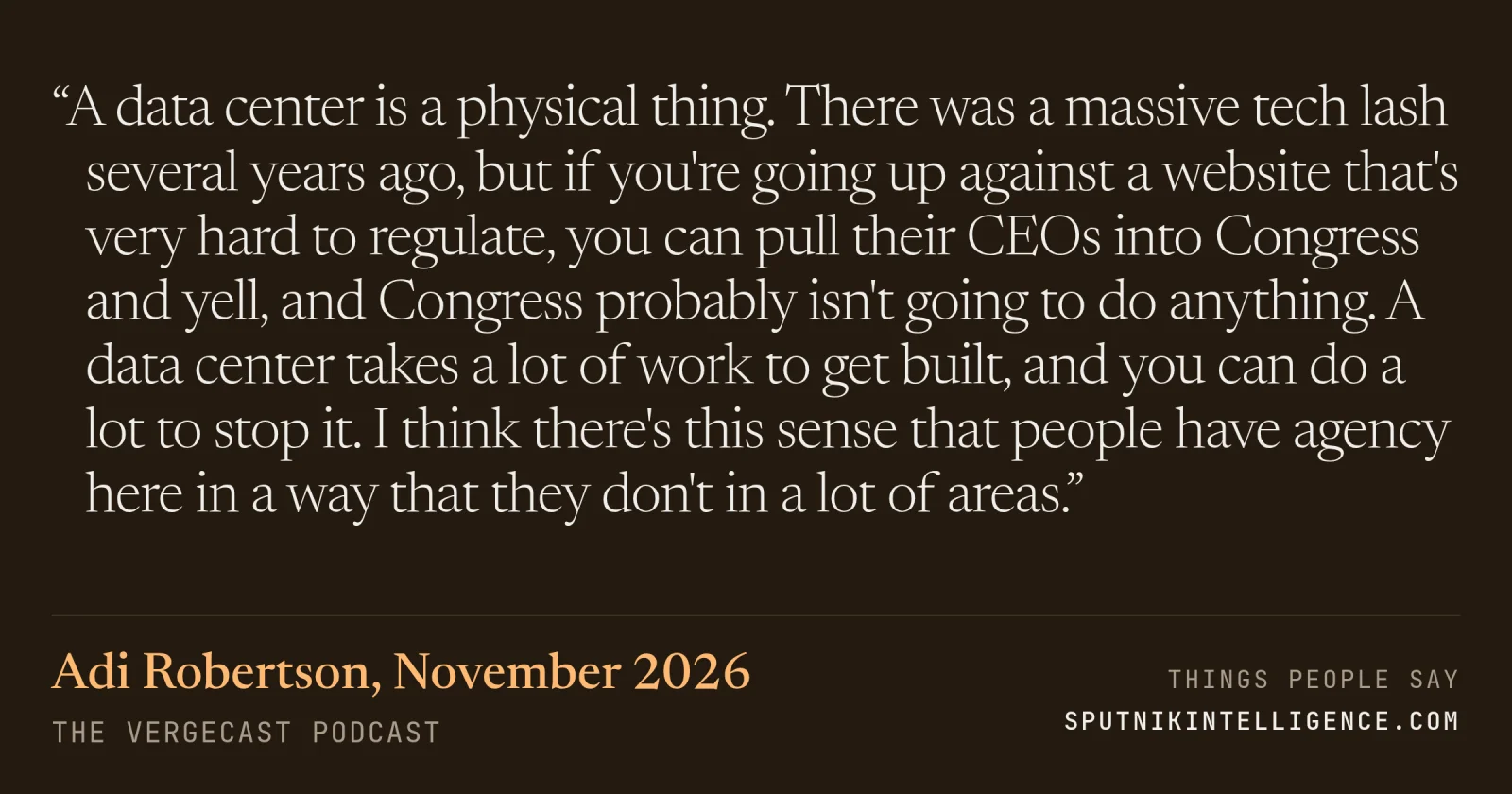
“A data center is a physical thing. There was a massive tech lash several years ago, but if you're going up against a website that's very hard to regulate, you can pull their CEOs into Congress and yell, and Congress probably isn't going to do anything. A data center takes a lot of work to get built, and you can do a lot to stop it. I think there's this sense that people have agency here in a way that they don't in a lot of areas.”
The Vergecast · Tech Strategy & Big Tech · November 2026
Context
The hosts were discussing why data centers became such a big issue in the midterms. Robertson argues that, unlike online platforms, data centers are something local voters can actually stop.
Transcript
Hey.
…to what extent do you think these midterms in the United States are actually about data centers? It's obviously a thing we talk about, but we are set up in prime to talk about this a lot. There's a lot going on in the world. Do you think this is in some real way an election about data centers?
I mean, I think in some ways we're not going to know that until afterward. But I honestly like, I know that I should not say this as we are the verge, we are the technology site. I think mostly no. Like I think that large part when you look at polls, if you ask people what are their top issues, they're sort of broadly economic issues. There's Iran. There are a lot of things that people say before data centers. The thing that we do know is that people, when they are asked about data centers and AI, are like, no, actually, that thing is important though. And I don't like that this is happening. So I don't think these are the data center elections, but it does seem like they're happening while data centers are prominent and people feel strongly about them.
Well, and the thing that I struggle with is I think all of those things are really connected, right? Like I was reading over a lot of our coverage and a lot of what folks have been saying. And we have a lot of records from town hall meetings and stuff. And all this stuff is just so tied up in…
I think it's that. And I think we have said this on earlier podcasts and people have written about it, but it's also that it's something that you can stop. Like I think that there was a massive tech lash several years ago. And I think the thing people found out is if you're going up against a…
That's really interesting. That makes a lot of sense. It is physical and understandable in a way that so much about technology is not. And even, you know, you've been on the show many times being like, what are we supposed to do about privacy? And you're right. In this case, the answer is just…
More from The Vergecast