 Niall Ferguson
Milbank Family Senior Fellow at the Hoover Institution, Stanford.
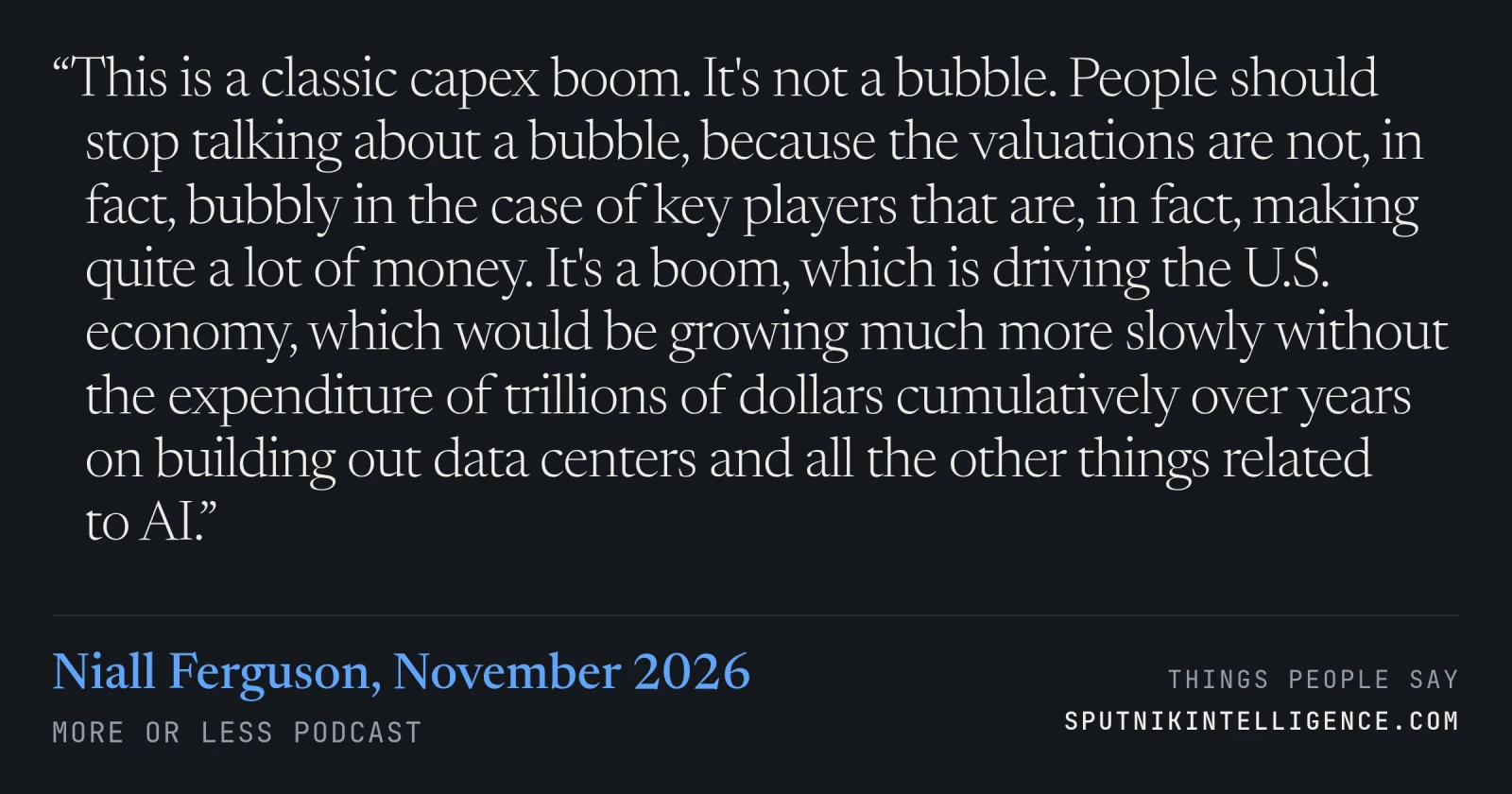
“This is a classic capex boom. It's not a bubble. People should stop talking about a bubble, because the valuations are not, in fact, bubbly in the case of key players that are, in fact, making quite a lot of money. It's a boom, which is driving the U.S. economy, which would be growing much more slowly without the expenditure of trillions of dollars cumulatively over years on building out data centers and all the other things related to AI.”
More or Less · Startups & Venture · November 2026
Context
Asked why he thinks the AI boom is in its final stretch, he first rejects the word "bubble," before explaining, through the railroads, how capex booms end.
Transcript
That's a more interesting question than the one about the press, because I mean, I think with all due respect to journalists, the debate about how reliable the New York Times and Wall Street Journal sources are about whether Alice Wang is a spy is not that interesting.
No, but I was going to zoom out two levels from that, but we can take the AI first. Yeah.
But the only interesting question is, you know, which member of the administration was supplying the information. That's very like leaking as much a part of American life as Thanksgiving. And this was just a very orchestrated and pretty successful leaking campaign. I think the more interesting question is the one that you ask second. The way I try to think about this whole story is that we need to resist our very human desire to exaggerate human agency and have heroic figures. So the story is more interesting if it's about Jensen, the superhero with the character flaw, little weakness for polygamy or adultery, if you prefer. That's an interesting story because it appeals to our fundamental prurience. We kind of want to know more details about the serial shagger. But that's to me much less interesting than how CapEx booms end. So this is a classic CAPEX boom. It's not a bubble. People should stop talking about a bubble because it's not really a bubble. The valuations are not, in fact, bubbly in the case of key players that are, in fact, making quite a lot of money. It's a boom, which is driving the U.S. economy, which would be growing much more slowly without the expenditure of trillions of dollars cumulatively over years…
That's my point. I always make this point. Like,
it's super cheap. And so was Google. And so was Amazon. By comparison with this, this is the railroads. That's the rice analogy, which is why I keep going back to the Gilded Age, because in building of the railroads, the United States, as well as Europe, undertook a huge, comparably large in…
Neil, can I ask you two questions that are related to that? Like, one is what I've been repeating over and over, and you can tell me I'm totally wrong, is what's unique this time in the U.S. about this versus the railroads is you effectively have what I keep calling only half-jokingly to make a…
More from More or Less