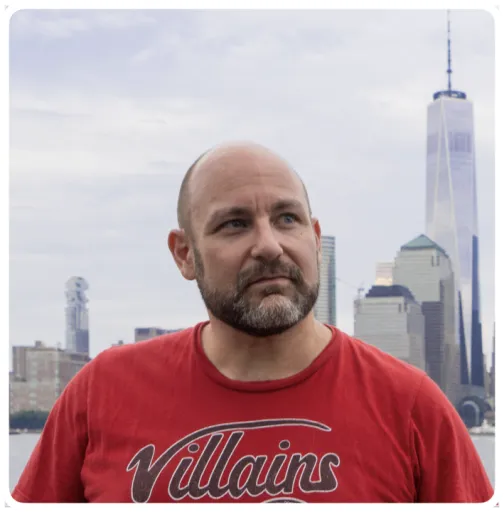
 Alex Goldman
Reporter and audio producer who co-founded the podcast Reply All in 2014 and earlier produced for WNYC's On the Media.
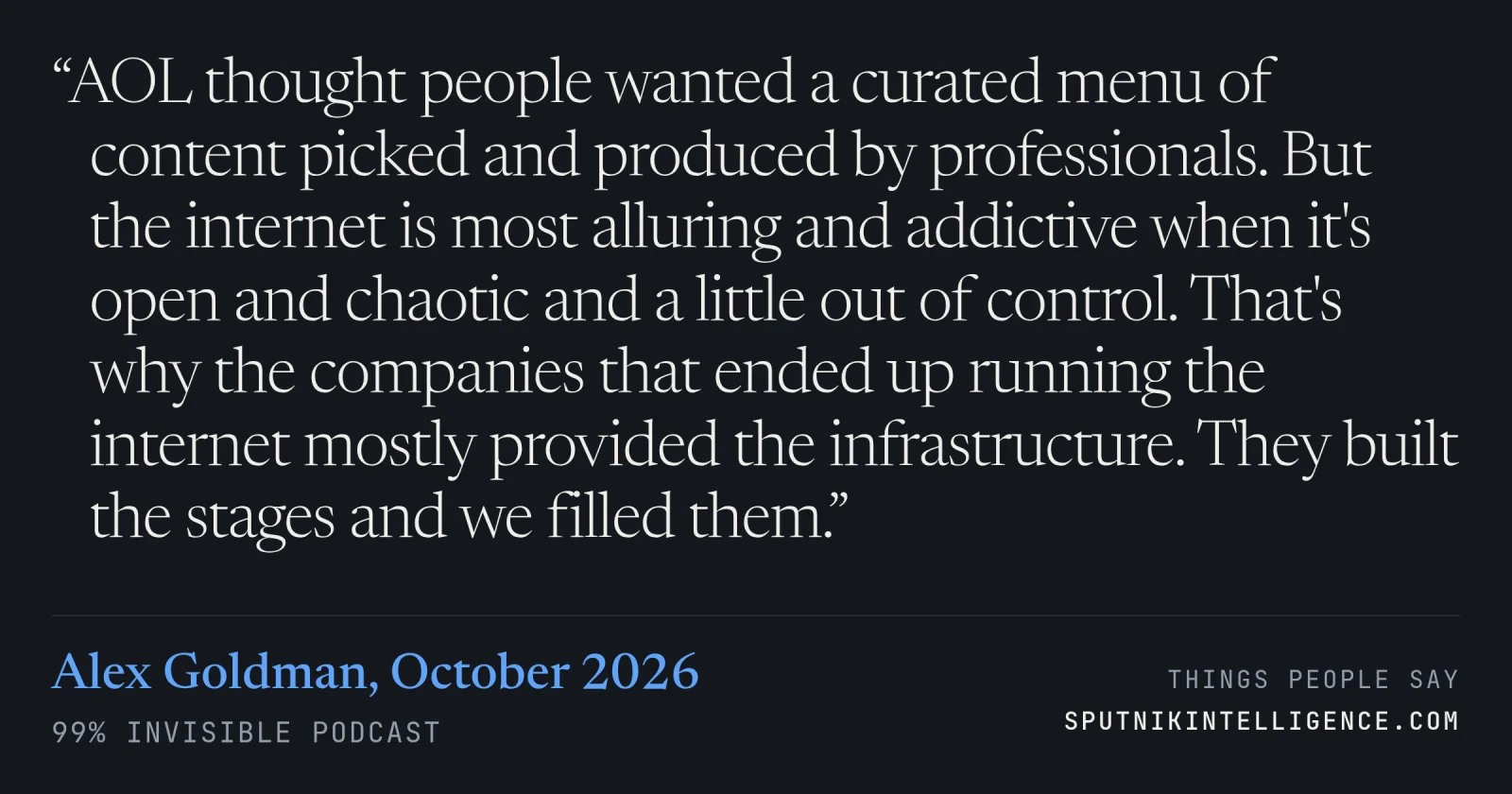
“AOL thought people wanted a curated menu of content picked and produced by professionals. But the internet is most alluring and addictive when it's open and chaotic and a little out of control. That's why the companies that ended up running the internet mostly provided the infrastructure. They built the stages and we filled them.”
99% Invisible · Product & Design · October 2026
Context
This is from the narrator's closing analysis of the AOL free-trial disc, after the story of the Time Warner merger and AOL's decline. Having credited AOL for seeing that the internet was social, he says its curated, walled-garden model was the mistake.
Transcript
So not quite a thousand.
…this upstart coming in, but I think that there was hostility, and I think it was also different personality types. Just think, you know, you're this big company, New York City-based, suit and tie, etc., expensive artwork all over the place. And, you know, we come in in jeans and sneakers, you know?
…meant for just one person. AOL bet that the internet was essentially social, and they were right. You can still feel this in the architecture of the internet today. Reddit is just a large-scale version of forums. Discord is just a private chat room. 30 years later, the thing that keeps us online is the thing that AOL Disc sold us, the ability to find each other. The other half they got wrong. AOL thought people wanted a curated menu of content picked and produced by professionals. But the internet is most alluring and addictive when it's open and chaotic and a little out of control. That's why the companies that ended up running the internet mostly provided the infrastructure. They built the stages and we filled them. As I was writing the story, another massive corporate merger is front page news. And again, in this case, one half of the merger is Warner Brothers, this time being consumed by Paramount Skydance, an $81 billion merger that's owned in part by the Ellisons and American Business Dynasty and the sovereign wealth funds of Saudi Arabia, Qatar, and Abu Dhabi. What we do know are deal dollar amounts…
The great Alex Goldman was the co-host of the award-winning Reply All podcast. He now hosts a new show called Hyperfixed, where he solves problems that listeners write to him about. You can find it online where you get
your podcasts or at hyperfixpod.com. They're also on social media everywhere at HyperFixPod. A History of the United States in 100 Objects is a production of 99% Invisible and BBC Studios. It's hosted and curated by me, Roman Mars. This episode was produced by Alex Goldman. Our
series producers are Priscilla Alabi,
More from 99% Invisible