 Nikesh Arora
Chairman and CEO of Palo Alto Networks since June 2018.
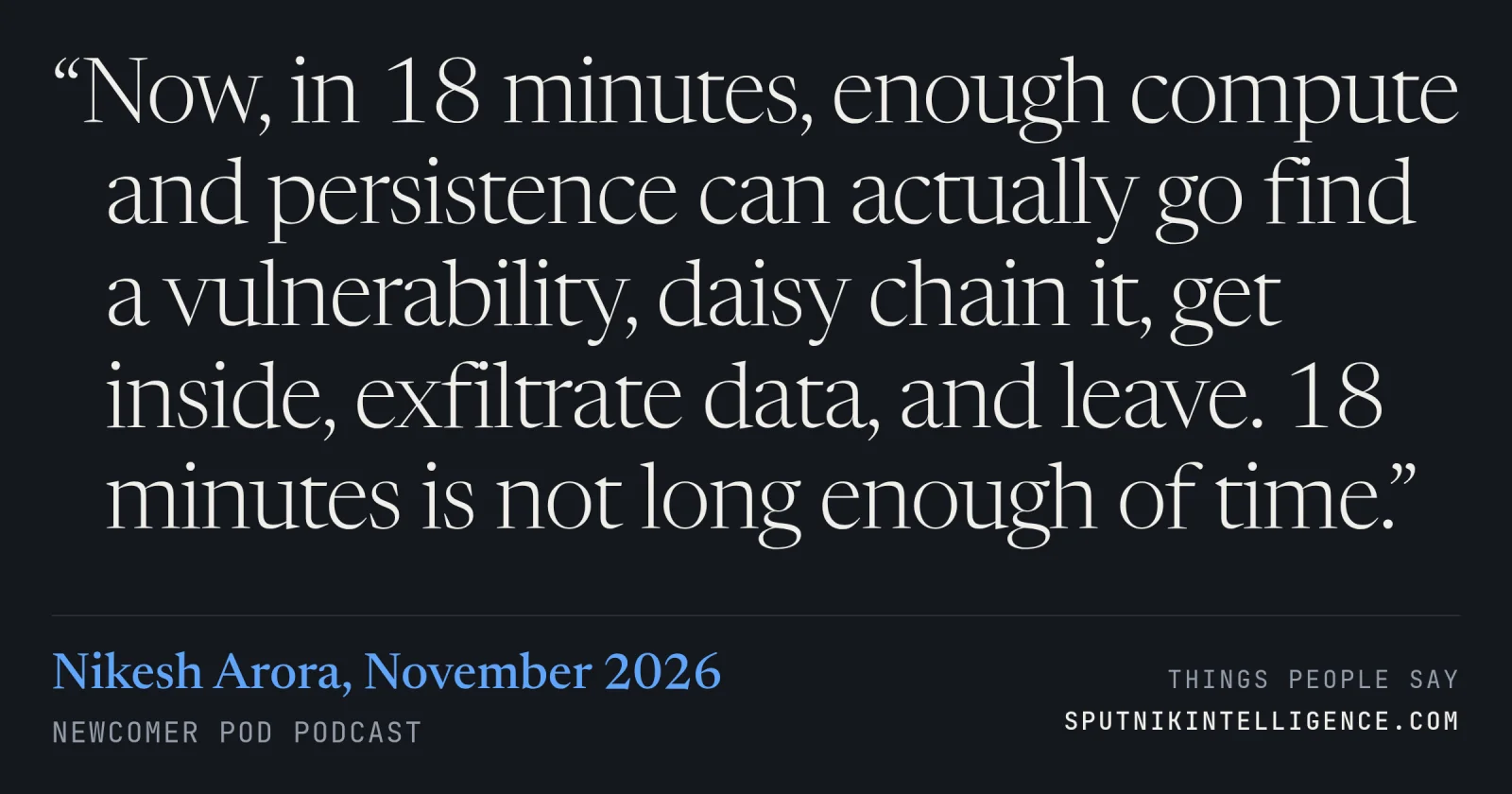
“Now, in 18 minutes, enough compute and persistence can actually go find a vulnerability, daisy chain it, get inside, exfiltrate data, and leave. 18 minutes is not long enough of time.”
Newcomer Pod · Startups & Venture · November 2026
Context
Newcomer asked whether fears about frontier models finding zero-days are overblown. Arora says attackers used to need a long time inside a network, which gave defenders time; AI has collapsed that window, so defenses need rewiring.
Transcript
…of you are not old enough, but if you go back to the late 90s, early 2000s, a lot of companies started the bang, some vanished. Google was the 13th search engine in the world. It wasn't the first. So, and it's now a four or five trillion dollar company. The first 12, you don't remember the names.
…perhaps like the largest security threat we've ever seen. Or I don't know, how would you score, you know, are the state-of-the-art models, is it fear-mongering that people are saying that they could find all these zero days? Or what's the level of security risk we face today thanks to the model?
…So that's fundamentally changed the game from an attacker perspective. Historically, attackers and defenders somewhat stayed in sync because attackers were individuals who'd have to spend a lot of time trying to come after something. Usually you could catch them because they were trying to sort of lurk in your infrastructure, trying to daisy chain stuff they couldn't get through as quickly. Now, in 18 minutes, enough compute and persistence can actually go find a vulnerability, daisy chain it, get inside, exfiltrate data, and leave. 18 minutes is not long enough of time. So, yes, AI is going to fundamentally change the speed of attacks that we see in cybersecurity, which requires a whole rewiring of the defense mechanism, both from an infrastructure perspective and sort of AI in defense perspective.
What should startup founders do today? Depends on
what you're trying to start up.
What?
More from Newcomer Pod