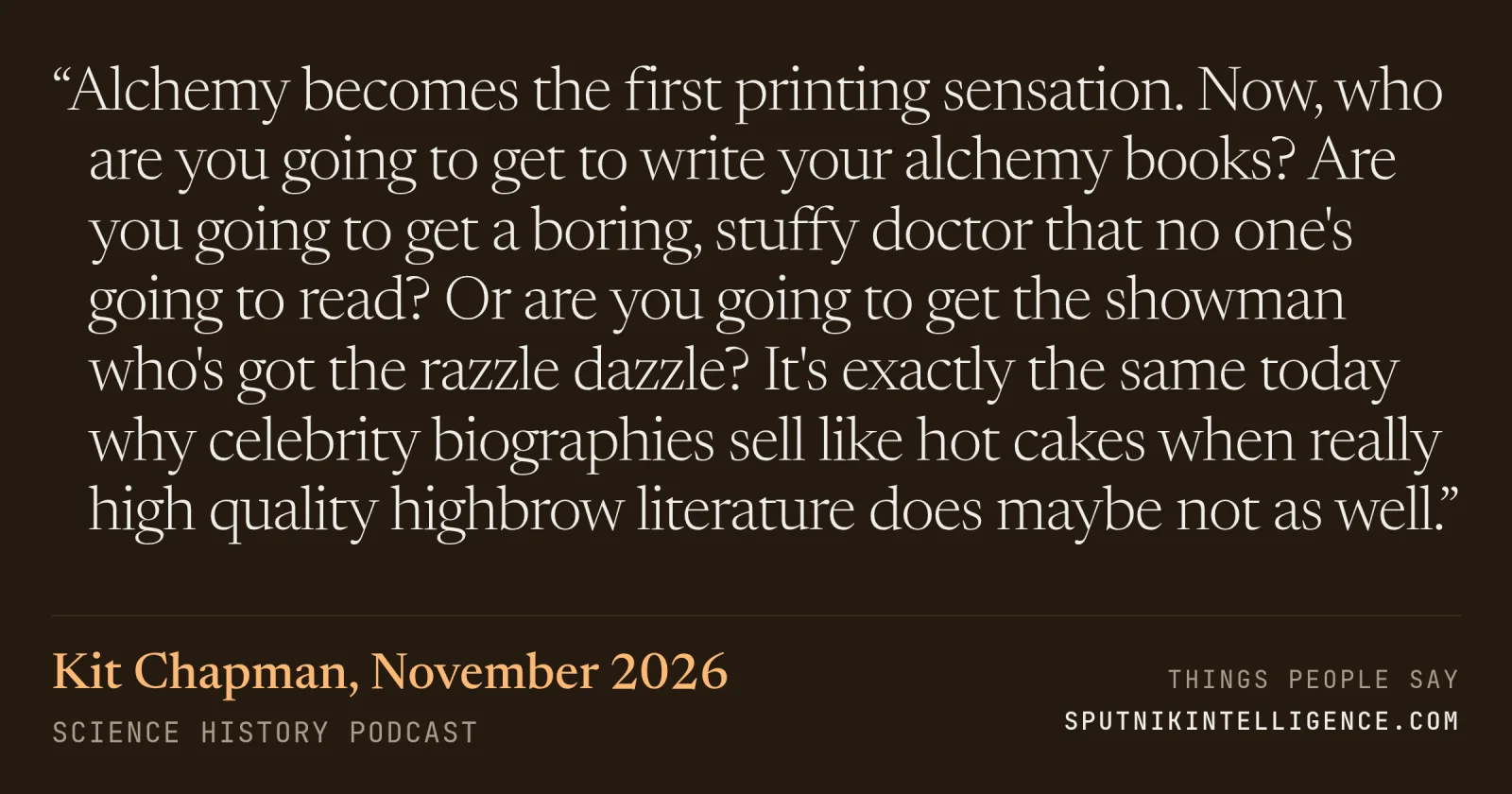
“Alchemy becomes the first printing sensation. Now, who are you going to get to write your alchemy books? Are you going to get a boring, stuffy doctor that no one's going to read? Or are you going to get the showman who's got the razzle dazzle? It's exactly the same today why celebrity biographies sell like hot cakes when really high quality highbrow literature does maybe not as well.”
Science History Podcast · Ideas & Essays · November 2026
Context
Asked about the role of swindlers in the shift from alchemy to chemistry, Kit Chapman explains how street-corner medicine sellers used the new printing press to sell "books of secrets". Showmanship, not rigour, drove the first mass-market science publishing.
Transcript
…look at, for example, the Baghdad battery. There is this cell. It resembles a battery. There is certainly acid in there. It could have been used as such to give someone a bit of an electric shock. If people had realized they could do that, Alessandro Volta would have been written out of history.
That's very interesting. In the third part of your book, you traced how alchemy evolved into modern chemistry. So to understand that history, let's go back to Europe and perhaps start with the question, what role did swindlers play in this story?
I love this little fact. And so I didn't know the etymology of the words charlatan, mountbank, and quack. And as I was researching the book, I stumbled. There is some fantastic research that's been done in this area. Julian Martins is a classic example, fantastic researcher, about the origins of what I mentioned, iatrachemistry. In Italy, people would go around selling medicines, medicines with fantastically ridiculous names, cures, and this is again the idea that actually we're moving away from the idea that you just have to rely on God and balancing humours. You can actually use medicines now. Because prior to that, medicine was essentially three different paths. You had your wise women and your cunning men who would make potions and herbs for the local villages. You had the barber surgeons who were very good at bleeding you or cutting off limbs or stitching up limbs. And then you had doctors. And doctors had completely misunderstood the Hippocratic oath at that point and believed that it was very bad to even touch a patient, let alone cut them open, and would just stare at them and try and guess what was wrong and what they should take to balance the humours. And…
yeah that's right i'm actually an environmental toxicologist and and one of the categories in that field are looking at at personal care products including makeup and things like that which often have all kinds of endocrine disrupting compounds in them so i think this this trend still does continue…
Well, it is a fantastic name. I mean, how can you avoid a name with bombastis in it? But for science historians, we just call him Paracelsus. That's what he called himself. You would give yourself this grandiose title to attract people. You know, Paracelsus better than Celsus, who was an ancient…
Yeah, that example you gave about what was the word for when things are revealed by God by how they look for... The doctrine of signs. Okay. So, you know, that kind of thing also you see it in traditional Chinese medicine. You look at the Materia Medica from China and there's treatments for…
More from Science History Podcast