 Allan Jude
Works on FreeBSD and ZFS storage systems and has co-written books on ZFS administration, including FreeBSD Mastery: Advanced ZFS. Hosts BSD Now and 2.5 Admins,...
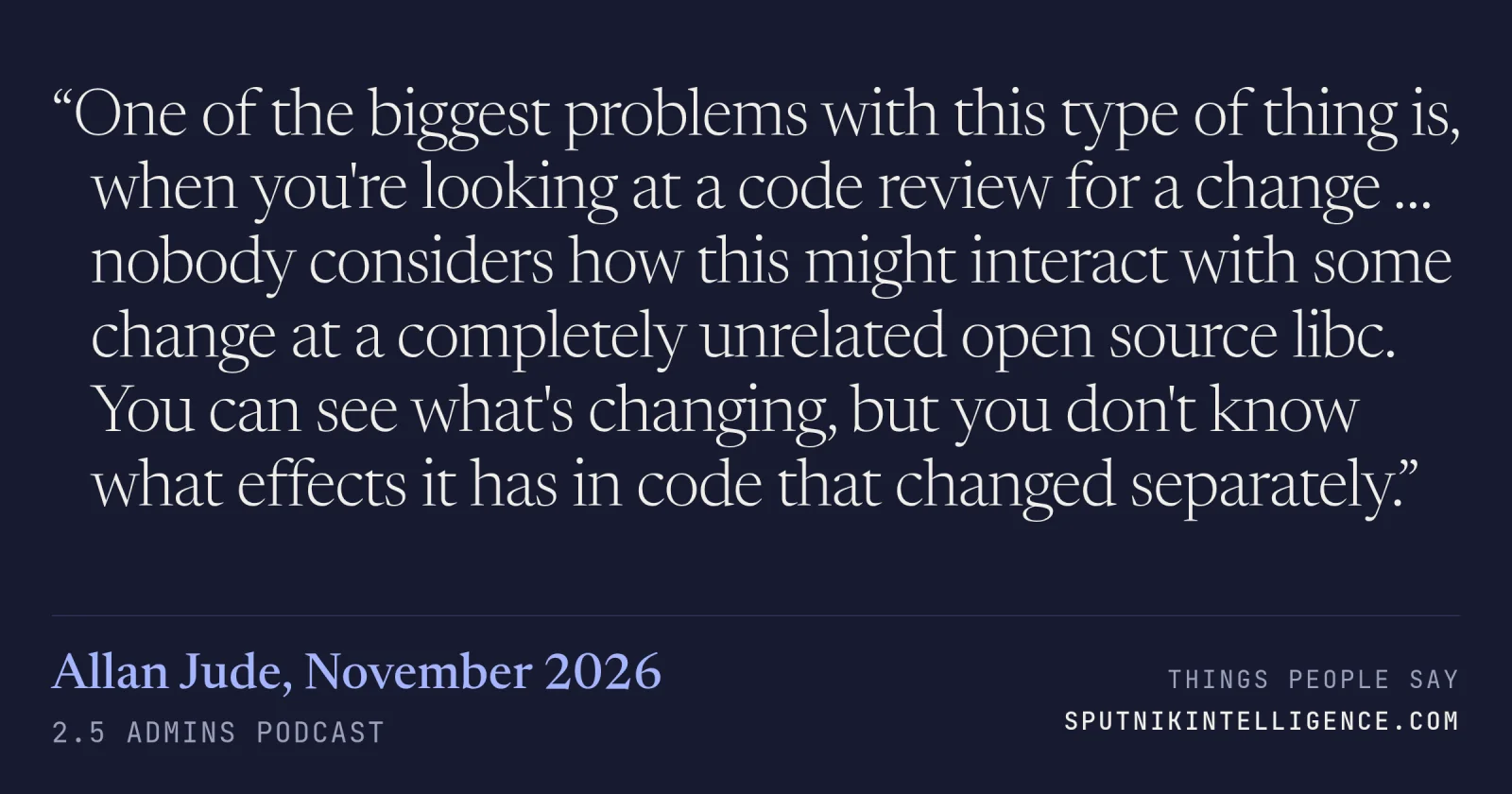
“One of the biggest problems with this type of thing is, when you're looking at a code review for a change … nobody considers how this might interact with some change at a completely unrelated open source libc. You can see what's changing, but you don't know what effects it has in code that changed separately.”
2.5 Admins · Hands-On Engineering Podcasts · November 2026
Context
Allan Jude was explaining an ssh vulnerability that came from two unrelated decisions years apart, one in a C library and one in OpenSSH. Neither was exploitable alone, and the combination went unnoticed for about a decade.
Transcript
…which usernames are valid and which are not valid based on how long it took to tell if the password was right. Because you normally have to go and run it through SHA-256 thousands and thousands of times. If you have low latency connections, you could tell if you were getting a real result or not.
And we're only talking milliseconds there.
Most likely, yes, but enough to tell the difference. And so SSH decided the best thing to do was grab the hash of some other user on the system to compare against so that even if it matched, it wouldn't matter because it wasn't a valid username. But this way, the amount of time it took would emulate the amount of time. Of time it takes for a real password. And so with that, it allowed it to basically have a timing-safe comparison. Whether the user you were trying to log in with was valid or not, the amount of time it took to check if you had the right password would be the same amount, and so you wouldn't be leaking any information. But when you combine these couple of different things together, the muscle libc that people don't always use, mostly used by smaller Linux distros and so on that are trying to have a less bloated image than you get with glibc, and SSH that's comparing it with the random hash and so on, it meant that all these things stacked up together and resulted in a vulnerability. So while it was criticized back in 2012 for being a bad idea, it wasn't exploitable at the time.…
This is the part where I speak up and I say, why the hell didn't this get caught in a routine unit test a decade ago? Why is SSH not getting tested with a password fuzzer that will try more than eight-bit length passwords? Eight byte length. Yeah, it'd be a point.
But because this doesn't happen on Linux's glibc or FreeBSD's libc. This only happens with Muscle Libc. But probably the unit test should try all those combinations now.
I would argue that any distro should be fuzzing its own remote control tools. It's not entirely SSH from upstream because as you pointed out, there are so many different pieces that go together. And this is such basic, basic, you know, Infosec stuff that I would argue that, again, like I said, if…
More from 2.5 Admins