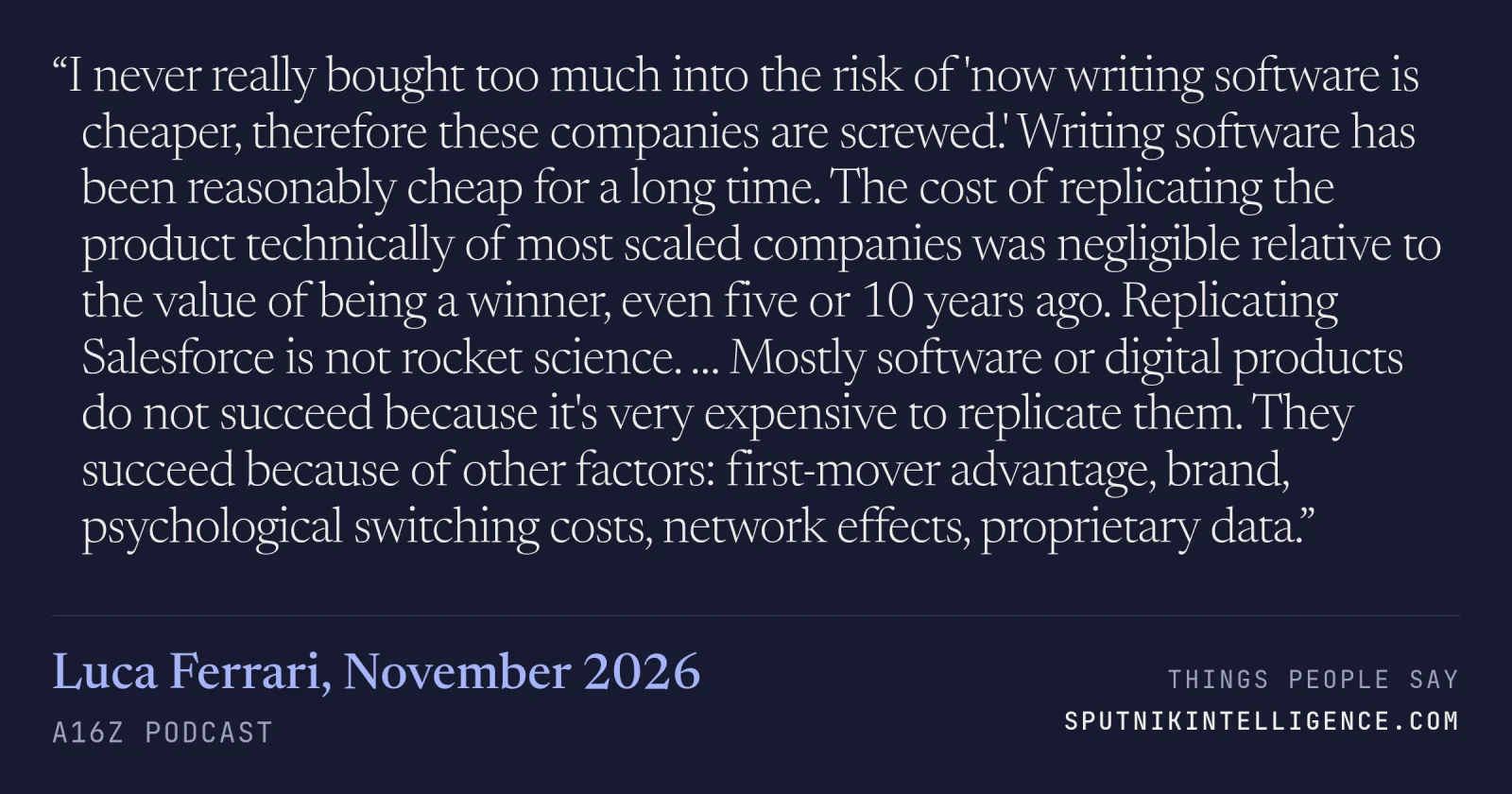
“I never really bought too much into the risk of 'now writing software is cheaper, therefore these companies are screwed.' Writing software has been reasonably cheap for a long time. The cost of replicating the product technically of most scaled companies was negligible relative to the value of being a winner, even five or 10 years ago. Replicating Salesforce is not rocket science. … Mostly software or digital products do not succeed because it's very expensive to replicate them. They succeed because of other factors: first-mover advantage, brand, psychological switching costs, network effects, proprietary data.”
a16z Podcast · Startups & Venture · November 2026
Context
Asked where moats lie now that AI can create software trivially, after the recent sell-off in SaaS stocks, Luca argues that cloning software was always cheap, so AI changes margins but doesn't make established products collapse. A direct counterpoint to the 'SaaS is dead' story.
Transcript
I tend to agree. I mean, but not necessarily to the same extent. That's
…those names traded down 40% in backup. So I don't know what folks accomplished with the SAS apocalypse. It seems like it was a little overblown, but it has brought about this discussion of where durability lies in a world where you can trivially create software with AI. How do you think about it?
I never fully. So I think the valuations for SaaS historically were, for the most part, absurdly high, but not because AI was not a risk, because they didn't make any sense from, at least from the perspective of someone, going back to what we were talking about earlier, someone who values assets based on reasonable expectations of free cash flows in the long run. In most cases, I think you could only justify those valuations based on the speculation that you'd be able to sell them to someone for, say, the same multiple down the line, but in the meantime, you've grown 50% or something, right? Because they were based often on assuming that the current 12% organic growth would last for 15 years. And it's like, sure, but the world changes so quickly, that's insane, right? Organic growth almost never goes up, by the way. I mean, very rarely. Again, going back to. Marks, it typically goes down, and so those assumptions made no sense. No, I think AI gave people an excuse to go back to their models and say, maybe I don't fully believe in those assumptions, let me be more cautious. And the reset valuations were, I think, broadly speaking, reasonable. I mean, you could always argue plus, minus 20%, but they were more in the range of reasonable in my view. Now, I never really bought too much into the risk of now writing software is cheaper, therefore these companies are screwed. I do buy in the idea of…
but ultimately you're not going to do it rationally. It's dumb. So
there are all sorts of reasons why I think most, not all,
but most digital products
More from a16z Podcast