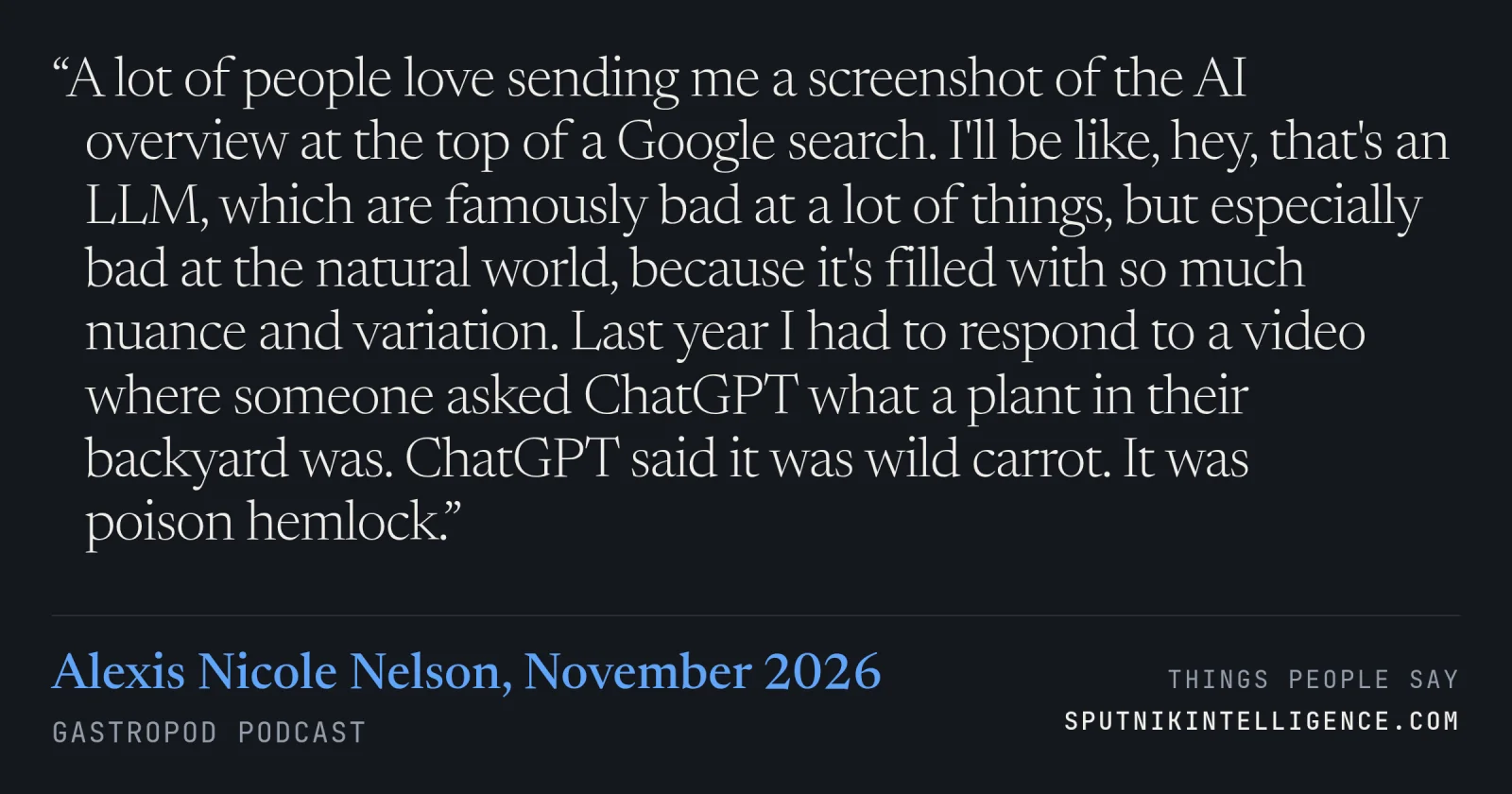
“A lot of people love sending me a screenshot of the AI overview at the top of a Google search. I'll be like, hey, that's an LLM, which are famously bad at a lot of things, but especially bad at the natural world, because it's filled with so much nuance and variation. Last year I had to respond to a video where someone asked ChatGPT what a plant in their backyard was. ChatGPT said it was wild carrot. It was poison hemlock.”
Gastropod · Food & Beverage · November 2026
Context
The hosts asked why you shouldn't just identify wild plants with a phone. The forager singles out chatbots and AI search summaries, with a near-miss poisoning as her example.
Transcript
None of them are accurate. Please do not rely on an app. They're not there yet. And some of them are scarily not close.
Alexa says, especially don't ask ChatGPT or Claude or any of those for help.
A lot of people love sending me that AI over a screenshot of that AI overview at the top of a Google search. And I'll be like, hey, so that's an LLM, which are famously bad at a lot of things, but especially bad at the natural world. Because why? It's filled with so much nuance and so much variation, which LLMs are even worse at than the other things that they are bad at. Last year, I had to respond to a video where someone asked ChatGPT what a plant in their backyard was. ChatGPT said it was a wild carrot. It was poison health. Hemlock, don't pull a Socrates internet, please. It's not worth it.
To be fair, although Socrates did die from drinking hemlock, it was actually his plan, not a chat-GBT mix-up. Back in his day in ancient Greece, folks generally took the time to learn what their local plants were. Today, Diana says one of the best ways to do that is using that old school technology…
Anytime I go out, I have a field guide with me, one or two, just in case I run into something new that I don't know. I also instantly take pictures of anything I encounter, and I take multiple angles, and I really try to kind of spend time with that plant to understand it a little bit better. Or
get to know another forager who lives close to you so you can learn this information from another person, get to see these plants in all three dimensions, and learn much more effectively and much more correctly, and not run the risk of poisoning yourself.
More from Gastropod