Startups & Venture · August 2026
Weisburd had asked for the best economic reason to invest in defense tech. Chapman gives the patriotic answer first and then the mercenary one, having spent the previous stretch describing how procurement split into two organisations that did not talk to each other. His pitch is not that the sector is growing but that it is dysfunctional, and that the dysfunction is where the returns live.
it used to be one organization, and then it was split between research and development, RDTE, so research development, testing, and evaluation. So, all of the work that goes into early stage prototyping and then the organization that is designed to acquire stuff at scale. So, it used to be one organization, now it's two. Five years ago, the research and development organizations often did not talk to the acquisitions organizations, and vice versa. And so, you might have a lab, we'll say a lab that's working on Alt PNT, which is positioning, navigation, and timing. So, I think GPS. What do you do when GPS is being jammed or denied? You need a new technology that helps you figure out where you are and what time it is. So, there might be a government lab working on that that is funding 10 companies, RD for 10 companies, working in different modalities. And then you've got one program office on the acquisition side for the Air Force who is supposed to be acquiring new alt PT technologies. That acquisition arm might not have been talking to the lab. And so, you might have companies that for five years are working with the lab and taking government money, perfecting a product, and then they go to the acquisition side and they say, Hey, we're ready for you to acquire us at scale. And the acquisition side says, I don't have any idea who you are. I'm going to go buy this other product from Lockheed, who wasn't doing any work with the RD side of the house. And that leaves a bad taste in everybody's mouth. It's wasted money. It makes the founders of those businesses feel like the government doesn't care. There's a lot of dysfunction. That is starting to break down. So, there's still two different organizations. But, like, the Army, for instance, created this program called Fuse this year, which takes a lot of older, sort of disparate army programs, and rather than having them run independently, has sort of like stacked them in serial. And so companies can enter at gate one. There's one team that's then managing them from gate one to gate two to gate three. And so you're not having that sort of disorganization happen in the army in quite the same way as it used to. And I think we're starting to see that across the other services. So I'm cautiously optimistic.
What's the best economic reason to invest into defense tech?
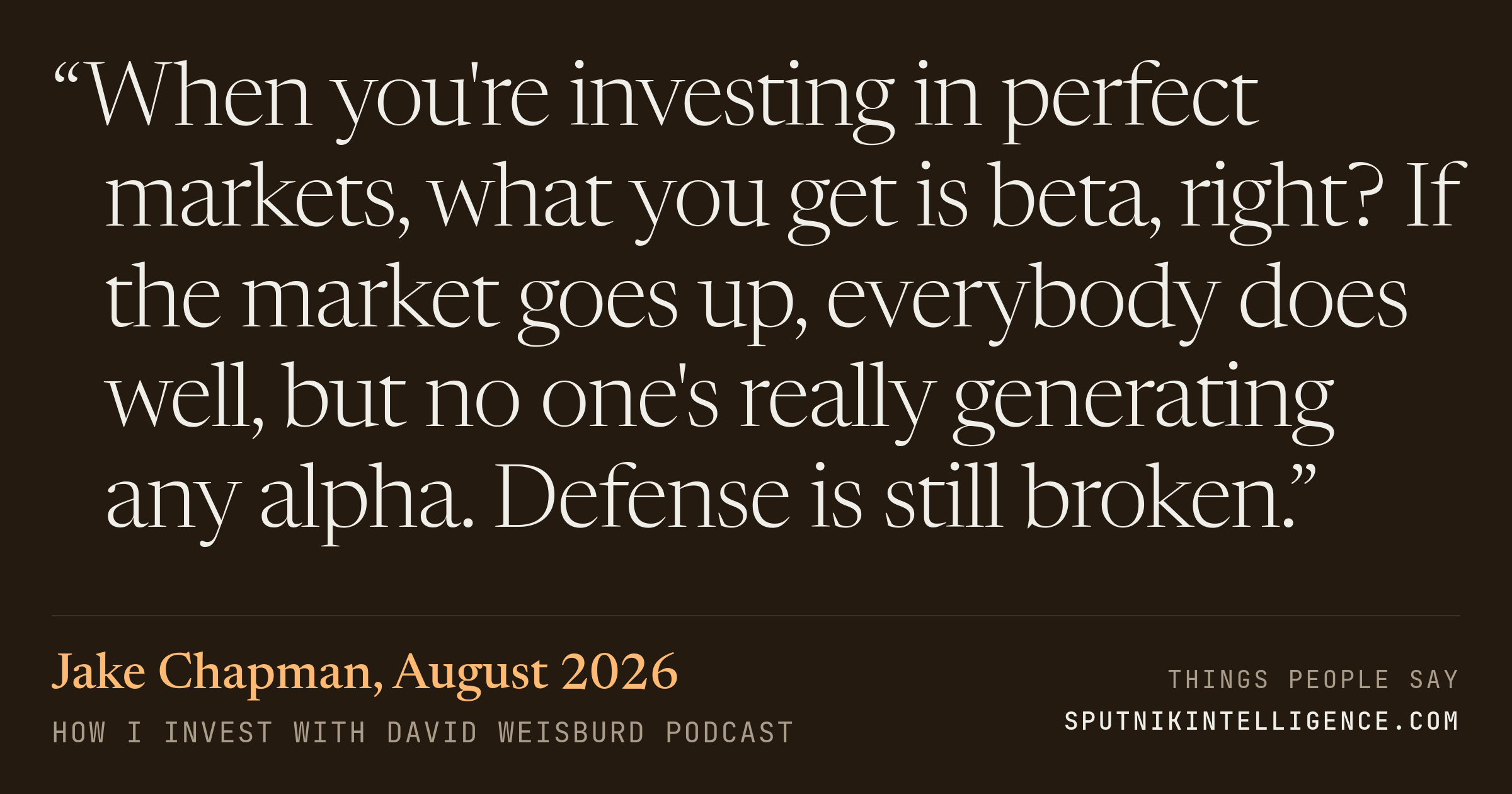
I'll table your question for a second and say I think as an American, it makes a lot of sense to be investing in defense and national security right now. As we talked about, sort of the world order is changing dramatically. And if you want the outcome of that process to be positive for yourself and your kids as an American, I think it makes sense to be putting money to work in this space right now. It doesn't hurt that there's a lot of alpha to be had here. So talk about all the reasons why this market is broken. When you're investing in perfect markets, what you get is beta, right? If the market goes up, everybody does well, but no one's really generating any alpha. Defense is still broken. I mean, it's not as broken as it was five years ago, but that means if you understand how to navigate it, there's still real alpha to be found in this market. So that's one of the reasons to be investing in this space. If you understand it, there's real money to be made. The other reason is the market size, right? So $2 trillion, roughly, let's say, between U.S. allies and partners, defense and intelligence, larger market than most, and a lot more money flowing to it today. And then you look at the macro trends. So you say, we've got potentially a conflict over Taiwan in the next few years with China. We have the war in Iran. You've got the war in Ukraine, which everyone thought I think would have wound down by now, but clearly hasn't. All the terror organizations sort of reconstituting themselves in Northern Africa. There's a lot going on in the world, and that is going to drive a lot of demand in the future. Moreover, that demand isn't going to look like what it looked like 10 years ago. It's not aircraft carriers anymore. It's new technology, right? So there's a lot to be optimistic about from a financial perspective over the next 10, 20 years.
No one that I've talked to, whether in the space or outside of the space, believes that defense budgets are going down over the next decade. I've never heard anyone take thunder. It's
crazy to say we might have a $1.5 trillion defense budget, but I think to put that in perspective, I want to say that'll be like 3.5%, 4% of GDP. I mean, during the Cold War, I think we topped out at like 9% of GDP for defense spending. Towards the end of the Cold War, it was like 6% or 7%. So we're nowhere near historic highs, but the world is sort of in a historic bad spot right now. So there's still a lot of room to run, despite the sort of debt problems we have. And then if you are one of the defense bears and you think that the defense budgets aren't sustainable, what I would say to you is even if that is true, even if it's true that we can't have $1.5 trillion defense budget every year for the next five years, we can't afford it. The world isn't going to get any safer and America's security commitments aren't going away. And so the only way to address that, if you're going to cut the budgets, is to cut the programs where you get less bang for your buck. And that is cutting from the programs that are things that we're not investing in. So that's cutting from aircraft carriers and traditional shipbuilding programs. It's cutting from the traditional cruise missile programs and moving more of that budget to things like Mandrel's cruise missile replacement, the Barracuda. So I think budgets are going to go up. Even if they come down, more money is going to end up going into the sorts of things we're investing in.
Old warfare versus new warfare and new technologies. That's right. What's the strongest ethical argument for investing in defense tech?