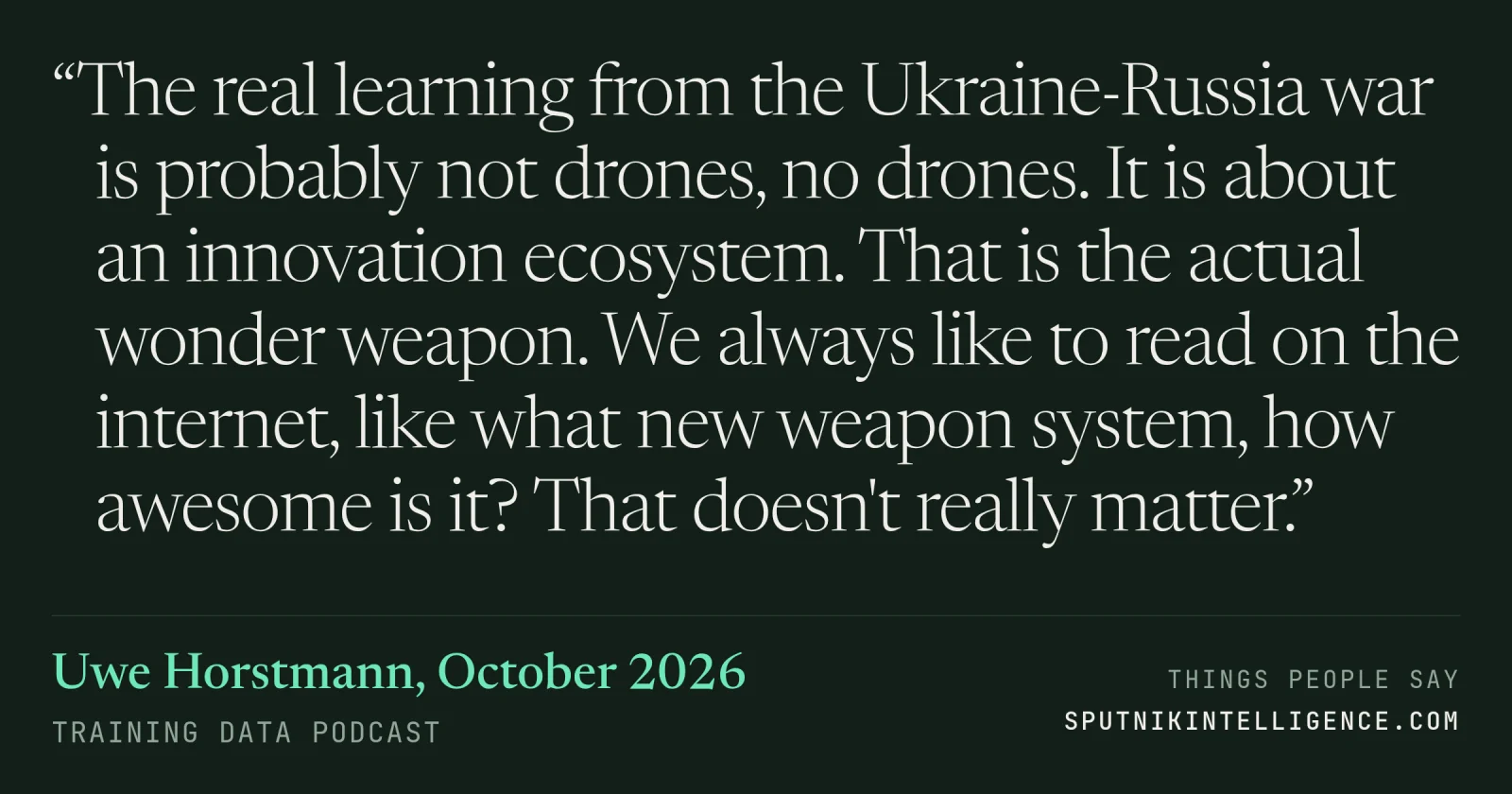
“The real learning from the Ukraine-Russia war is probably not drones, no drones. It is about an innovation ecosystem. That is the actual wonder weapon. We always like to read on the internet, like what new weapon system, how awesome is it? That doesn't really matter.”
Training Data · AI Research & Frontier Labs · October 2026
Context
Asked whether Europe's faster defense procurement will last, the Stark co-founder said yes, because European change comes from "reality kicking in" rather than a charismatic leader. What matters, he argues, is whether Western societies can innovate in defense continuously, with talent, capital and feedback from soldiers.
Transcript
…that time and for me you kind of mentioned my biography things really came together uh two big streams like a interest in military and security international you know relations things like that and then the technology part so it was quite a clear moment for me to say like okay i need to step in
you think that the procurement process changes are sustainable or do you think this is a moment in time for europe for germany And other European countries.
…because they are based on actual structural fundamental changes. And, you know, now we are in a new world. And that's what gives me hope that we change the procurement processes that took years to months. And that includes the certification, which is a big, big part of what we do. It's a very boring topic in a way, but it's very, very important. I think those changes are there to last because the real learning from the Ukraine-Russia war is probably not drones, no drones. It is about an innovation ecosystem. That is the actual wonder weapon. We always like to read on the internet, like what new weapon system, how awesome is it? That doesn't really matter. The whole point is, how do we as Western societies set up ourselves so that we can continuously innovate in defense with all the different ingredients? We already talked about the input from fighting soldiers. There's a talent aspect of it. Our smartest minds should be willing to work in defense. There's a capital aspect to it and all that stuff. And I think that is there to last. I'm quite…
What advantages do you guys have as a two-year-old company selling into the defense apparatus that a 70-year-old company selling into the same customer might not have?
In that field, that segment of the market, the inexpensive, the AI-driven, the mass-scalable systems, our strike drones come to mind, but also, for example, unmanned boats, and things like that. It is, we have a startup DNA. Like we build the prototypes like you would prototype in a startup, pretty…
Johannes Schaback you say a word about the product engineering organization? And as Uve was saying, like, how do you execute on kind of the rapid innovation close to the customer? You know, it's not the thing we typically associated with hardware companies selling into defense. So say a bit about…
More from Training Data