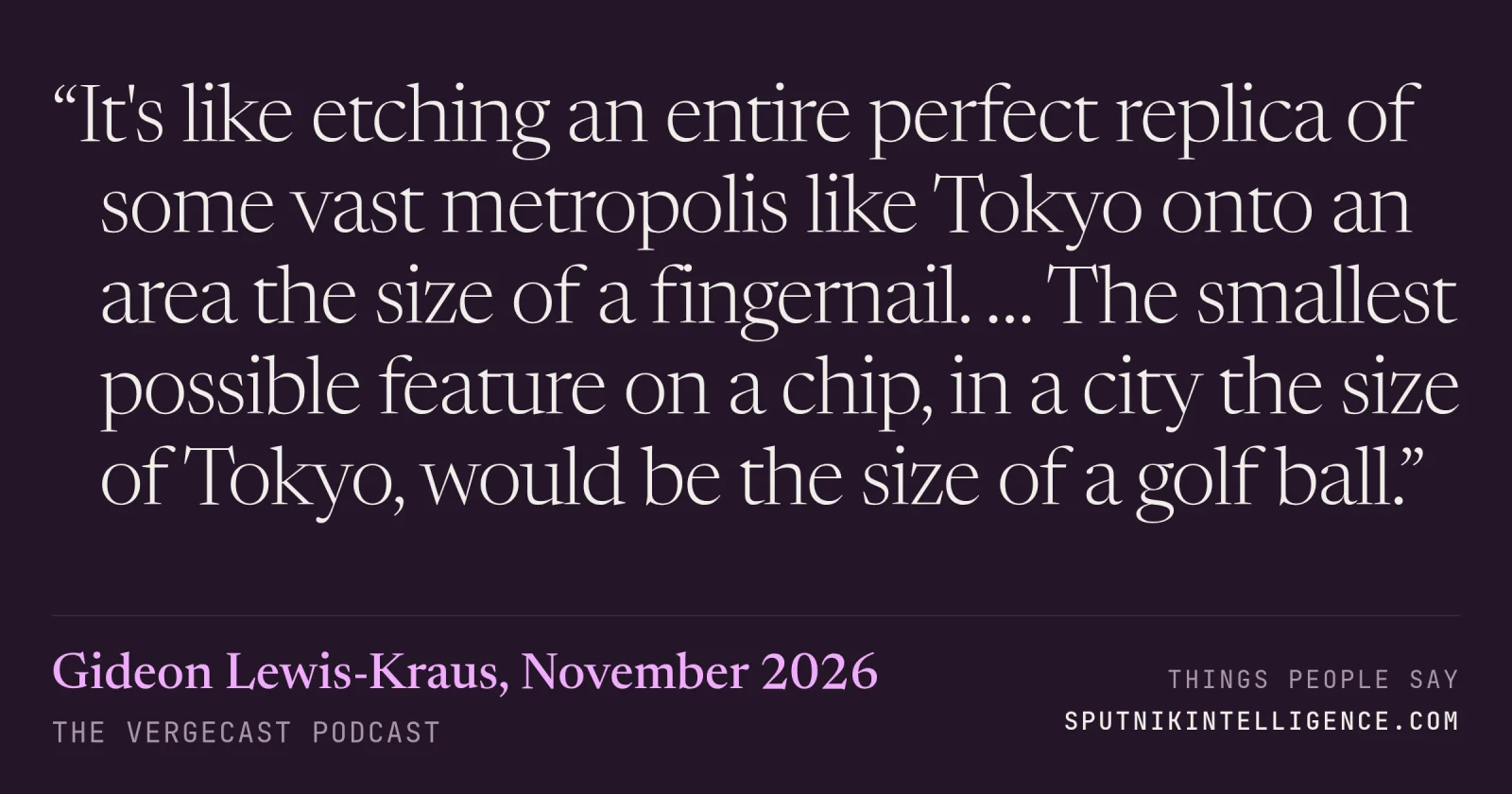
“It's like etching an entire perfect replica of some vast metropolis like Tokyo onto an area the size of a fingernail. … The smallest possible feature on a chip, in a city the size of Tokyo, would be the size of a golf ball.”
The Vergecast · Tech Strategy & Big Tech · November 2026
Context
Asked for his favourite metaphor for how tiny and intricate chips are, Lewis-Kraus says he worked out the scale himself: transistors are the building footprints and the wiring is the infrastructure layered above them.
Transcript
…China has made progress in being able to do DUV, but like the reports are that, you know, China can do like these prototypes that print, I don't know, 30 or 50 wafers an hour. And that's still a very far cry from like having an actual cost-productive system or cost-effective system, rather. Yeah.
…building an entire city skyline story by story, which I really liked as a way of thinking about the printing. But just in terms of trying to think about the scale, do you have a favorite metaphor for how remarkably tiny and remarkably intricate these things actually are that you've come up with?
I really like the idea of a cityscape because a cityscape really is actually pretty accurate where you have a kind of like base layer of the transistors. That's kind of like the footprint of all of the buildings in the city. And then you have all of these layers of infrastructure on top of that, the interconnections and the wiring. And so I started to think like it really is, and I'm certainly not the first person who's used this metaphor, but that like occasionally you would see something like it's like printing an entire city on a chip. And then I went down, me and my buddy Claude, went down like a really like deep rabbit hole about like exactly how this would translate if you were trying to like, you know, work across these 20 orders of magnitude or whatever. And I mean, it turns out actually like the math wasn't that hard, but that basically you like, if you want, it's like etching an entire perfect replica of some vast metropolis like Tokyo onto an area the size of a fingernail with the detail that you…
Wow. Good lord. Okay. That's that's so yeah, that's that's pretty that's pretty astonishing actually. Well,
because you know, so much of this chip world stuff, like, you know, I certainly don't have to tell you is like working with the like describing these units that are just like completely meaningless units of abstraction to most people when you talk about like the like, you know, two nanometer node…
Totally. And especially at this moment, like, I think the metaphors are so interesting because we are at this point now where the gap from impossibly small to the point where you can't even fathom that as a person to slightly smaller than that is like a step change in how technology works. Right.…
More from The Vergecast