 Jordi Visser
Macro investor with three decades on Wall Street, formerly president and chief investment officer of Weiss Multi-Strategy Advisers; now runs Visser Labs, advisi...
Jordi Visser
Macro investor with three decades on Wall Street, formerly president and chief investment officer of Weiss Multi-Strategy Advisers; now runs Visser Labs, advisi...
“…If you listen to economists, you are going to lose money.”
The Pomp Podcast · September 2026
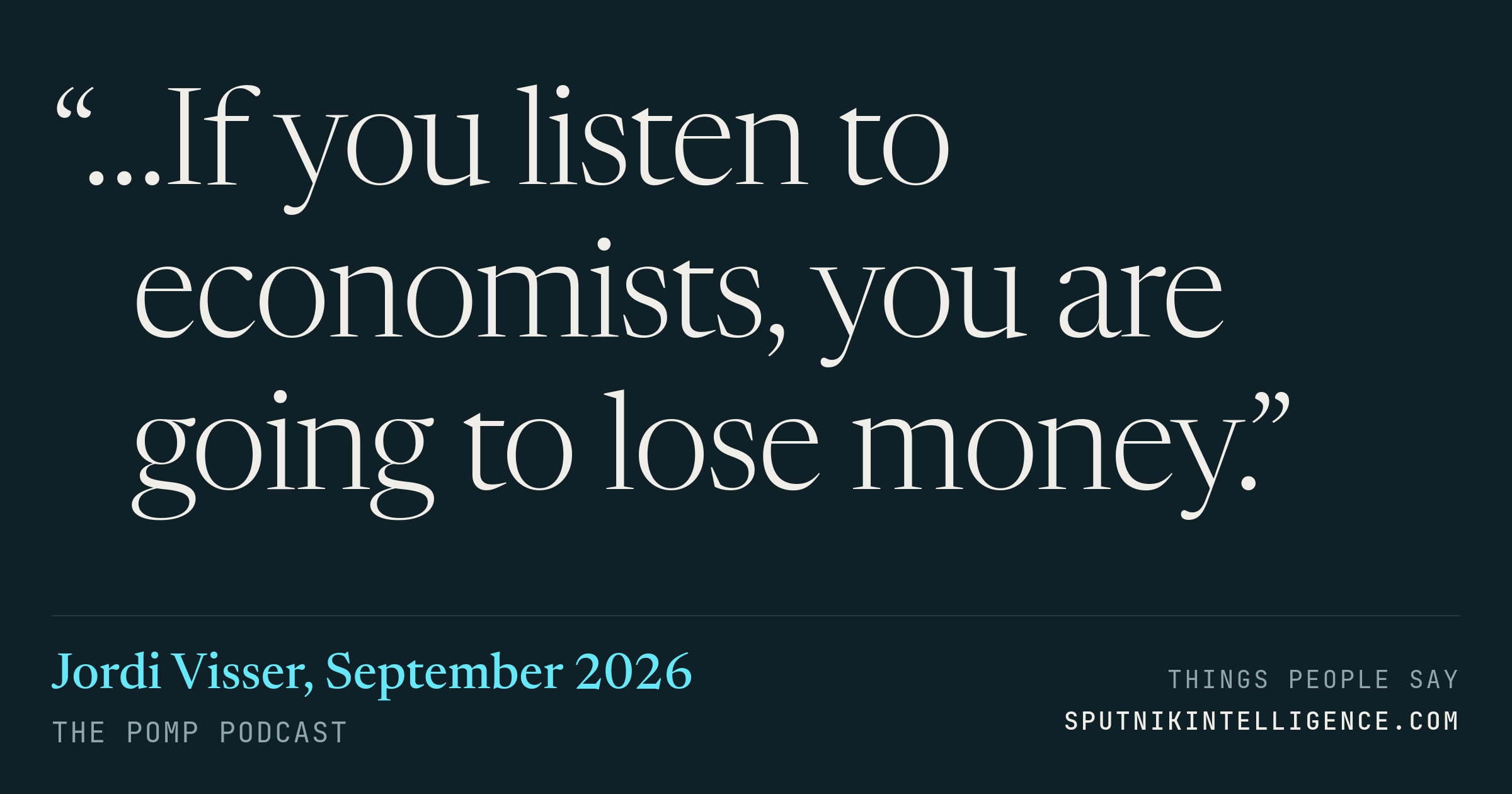
Visser drops this near the end of a long answer on why rising rates will not damage the AI trade the way they once damaged a housing-and-autos economy. He frames it as something he has said repeatedly, and immediately explains what he means: the error is extrapolating past cycles into a period where demand and margins do not behave the way the models assume.
Transcript
I believe from an Elliott Wave perspective, we're entering a third wave, a big, the most powerful wave in crypto. For that to happen and the reasons behind it, we need this kind of doubt when it starts to go up because the energy that should be associated should be real. For this to be a third wave, I also need the silent IPO thing to be there. I needed to see.
What's going on, guys? Today we have a great conversation with Jordy Visser. In it, we talk about interest rates, why everyone's worried about them going higher, but maybe it's not actually going to affect the economy or your portfolio as much as you think. We talk about Bitcoin and whether it's going higher, lower, or going to stay the same, why people are so bearish, but Jordy is so bullish. And then we talk about AI agents and what's going on changing in the way we work, the way that we live our lives, and how it is going to impact everything around us. This conversation has a ton of impact on what is actually going to occur in your portfolio and the U.S. economy over the coming years. I highly suggest that you listen to this very carefully, and I think that you'll get a lot of value out of it. Here's my latest conversation with Jordy Visser. All right, Jordy, we're back in studio. You got a Hawaiian shirt on. I got a Yankees hat. We're ready to rock and roll. Everyone has one big question. Are interest rates going to go up or are they not? Scott Bessant this week gave an interview and he said, I have more information than the market has, obviously. How are you analyzing whether rates will go up or not? And then what is the impact of them changing?
All right. First of all, and I did post some stuff in X and I'm going to do some stuff in the video for the weekend. Your question aligns with the way people are freaking out. Personally, I'm shocked for, let's just use tenure rates. For the most part, they've been stuck in a 50 basis point range for the last almost four years since the peak in 2022 or the peak since they started to range trade. Rates should be going higher because nominal GDP is over 6% and nominal GDP is over 6% because of the AI trade, which is all related to the build out of the AI trade. I don't think people should be focused on whether rates are going up or not. I think the question is, will rates do anything to the economy? And number two, and most importantly, the administration and Scott Besson have shown their hands that they don't want rates to go higher. And regardless of the reasons, he's not going to publicly go out and say, well, we're really focused on the fact that the deficit's big. And if we let rates go higher, then our interest expense is going to be higher and we're going to be in worse of a debt situation. I think the more important thing for people to think about again is will rates of this magnitude, this is not a big move. So will rates making this scary 20-year high, which is the chart that everyone shows around and that all the people that believe in the end game that Druck and Miller wrote about, which is you're manipulating a yield to where it should be and it should be higher. So I agree with that. What I don't agree with is that people should sell stocks because of that or that they should be thinking that something bad is going to happen. And the reason is there is no sensitivity to rates with inside the AI build out. And I'm going to show that this weekend too. The margins for the frontier models, which are Anthropic and OpenAI, which are really the drivers of the entire thing at this point. So users are using ChatGPT and Anthropic. They've become a duopoly. And yes, you have open source, but these are the companies that the enterprises are using. These are the ones that are able to charge the prices they're charging. Their margins are enormous and interest rates have almost no impact. So I'm going to show with the work of Claude and ChatGPT with Gemini as my fact checker and then using them all as my fact checker that a 200 basis point rise in 10 year yields doesn't change the margins for Anthropic or OpenAI by very much. It's about from, let's say, 70% to 69%, 200 basis points. This is the first time that this has gone on. So part of this fear over rates is the history of an economy that was driven by housing and was driven by autos and the great financial crisis. So again, I've said this repeatedly. If you listen to economists, you are going to lose money. If you listen to people who take the past and extrapolate it into a time with exponential demand where margins are infinite, I mean, they're as high as they can be. And the demand side is never ending because we barely have started. And the advancements in Grockbot mean more usage. Astra, which hasn't been released to us yet, but you read through X, like everything is going to continue. And I'll leave it with one more thing. I was listening to a podcast today, and basically the way they're talking about it at Open AI and Anthropic is in the next year, we will basically have about four years of model capability improvements. Now, the reason that's important is so everyone realizes that four years is equating to going from Chat GPT's original launch to Astra. And now we're talking about next year that's going to happen. So this is all about AI agents. This is all about consumer agents. This is all about enterprise adoption. This is all about profit margins. And rates are just not going to be as important as they've been in the past. So that's my angle on rates at this point.
All right. So let's say that you are right, which I do, I do believe that you are correct in that if rates go up 200 basis points, you're not going to see a significant change in the profit margins of the large AI companies. Great. The AI companies maybe employ tens of thousands of people. Maybe we get to 100,000 if you kind of expand the definition of the large language models. There are 300 plus million Americans. There's still the housing market. There's still, you know, business loans and RD and growth of all these other economies, et cetera. Why do you think that the only thing that really matters is the AI companies, as if rates go up, then AI companies aren't affected and therefore the economy isn't kind of held back.
So when I say the only thing that matters, again, I'm saying you're not going to take nominal GDP to go down far if rates go from four and three quarters to five and a quarter. Now, again, the administration doesn't want that to happen. Do I think investors could freak out? Sure. And I think we've already seen that. I think we've seen the SP 500 multiple come down this year.
So just to make sure that maybe let me repeat this back. What you're saying is if rates go up 150, 200 basis points, asset prices could fall. Other parts of the economy could slow down or feel pain. But the main driver of GDP growth right now is the AI companies. And if the AI companies are insulated from the rate increase, then you're saying GDP basically is going to be untouched by increases in rates, unlike how it has been in the past.
More from The Pomp Podcast