 Michael Kofman
Defense analyst
“Usually, when the military first deploys something in the battlefield, they just duct tape it to the way they fight. They're like, there's a new thing, and we're gonna add it as a plus-up to how we fight now. And then somebody else might come along later and say, that's interesting, but it's actually much more interesting if you build more of the force around that technology instead of having that technology just be an add-in.”
ChinaTalk · Geopolitics & World Affairs · October 2026
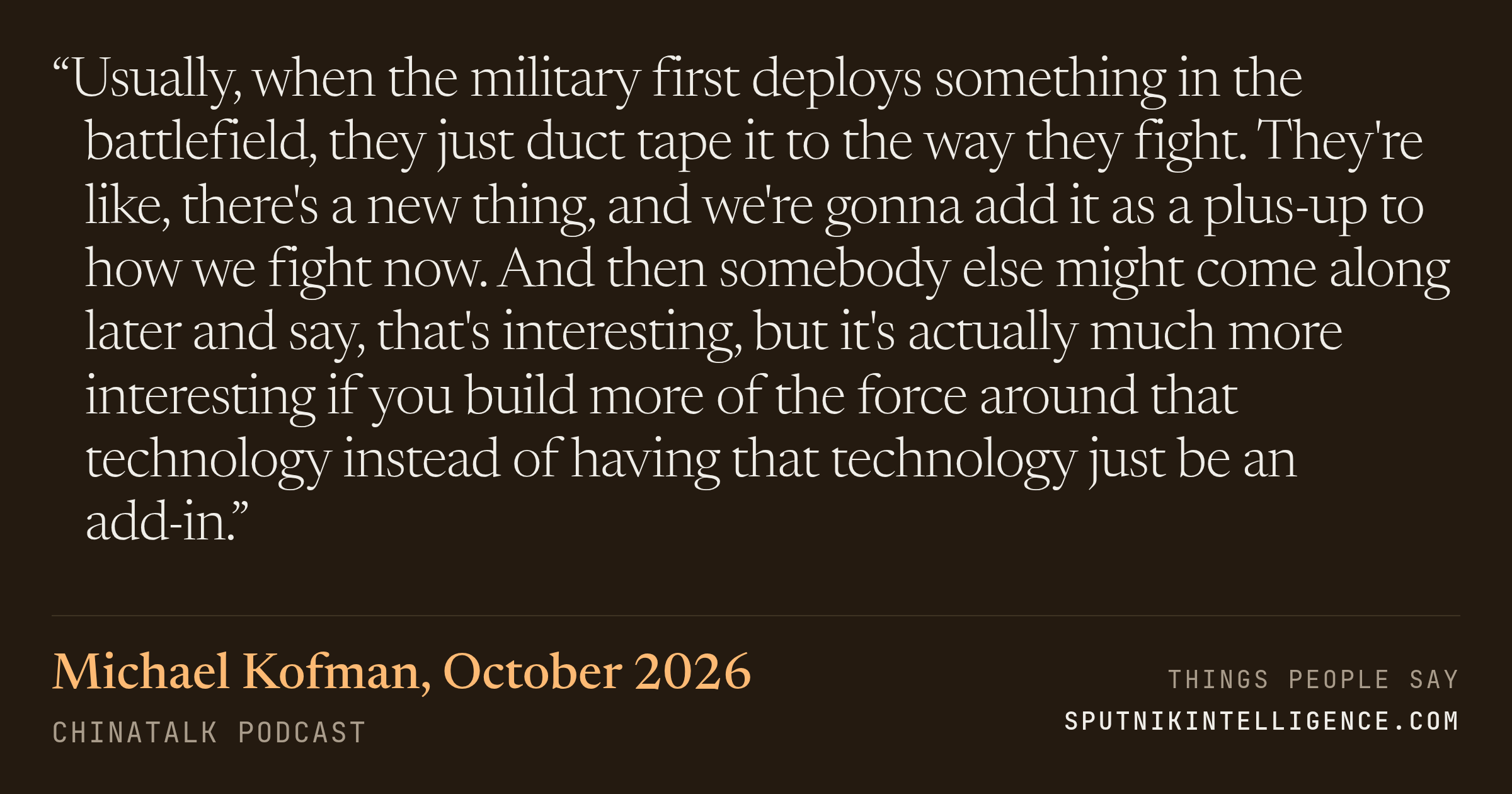
Asked whether the US and Europe can absorb the lessons of the Ukraine war, Kofman points to the tank and the aircraft carrier. The army that first fields a technology is often not the one that works out how to use it. He worries the US is treating drones as an add-on.
Transcript
…salt formations to try to bring that back to the battlefield. So neither side accepts those dynamics. So that's why I'm saying we should be following this closely because you're seeing still both sides experiment and try to evolve out of the positional dynamic they first helped establish.
…that got them to the ability to be able to do that. That's not accounting what's happened in Crimea and kind of a whole of society operation and whole of society effort to be able to do that. Where is the European US capability to replicate that without that same level of effort or does it exist?
I mean, look, I think the U.S. point of view is like, this is not how we would fight, how we would prefer to fight, right? I've heard this a lot. Because like the monster of U.S. forces, this is not how we would fight. And I was seeing, I'm like, oh, really? Tell me, how would we fight? And also, it is true. We wouldn't fight this way. We are very different as a force in terms of how we operate. That's true. Uh, but it doesn't mean that the way we do plan to fight doesn't have problems, right? People often say that as though there's no problem with the way we plan to fight. Um, and they're supposed to say, if not problems, at the very least, there are interesting questions to be asked about how is it that we plan to fight. Now, we know a couple things for certain. We do have a good sense of how our opponent plans to fight Russia. With one big caveat, is that unlike the way they are forced to fight now in Ukraine? They want to be able to return the force to large-scale offensive maneuver. They basically optimize themselves for small-scale combat operations, primarily using fire teams or infiltration to individual infantry. But that's not the way they would idealize the fight. But we already have a decent sense…
from what I see, the way we see
drones and all this, we are taking the traditional conservative approach of that is just an add-in. So, we should find a way to somehow add that to the way we fight. Sorry if this is an incomplete answer, but I think, yeah, I think for us, the lessons learned is a work in progress and active…
Can we? So, to that point, can we talk about wet gap crossings for a second? Because I think one of the sorry, this is like one of my like, you know, pet issues. I don't know where that came from, but
More from ChinaTalk