 Alexander Wissner-Gross
Physicist and entrepreneur with MIT degrees in physics, electrical engineering and mathematics and a Harvard physics PhD. Known for a 2013 Physical Review Lette...
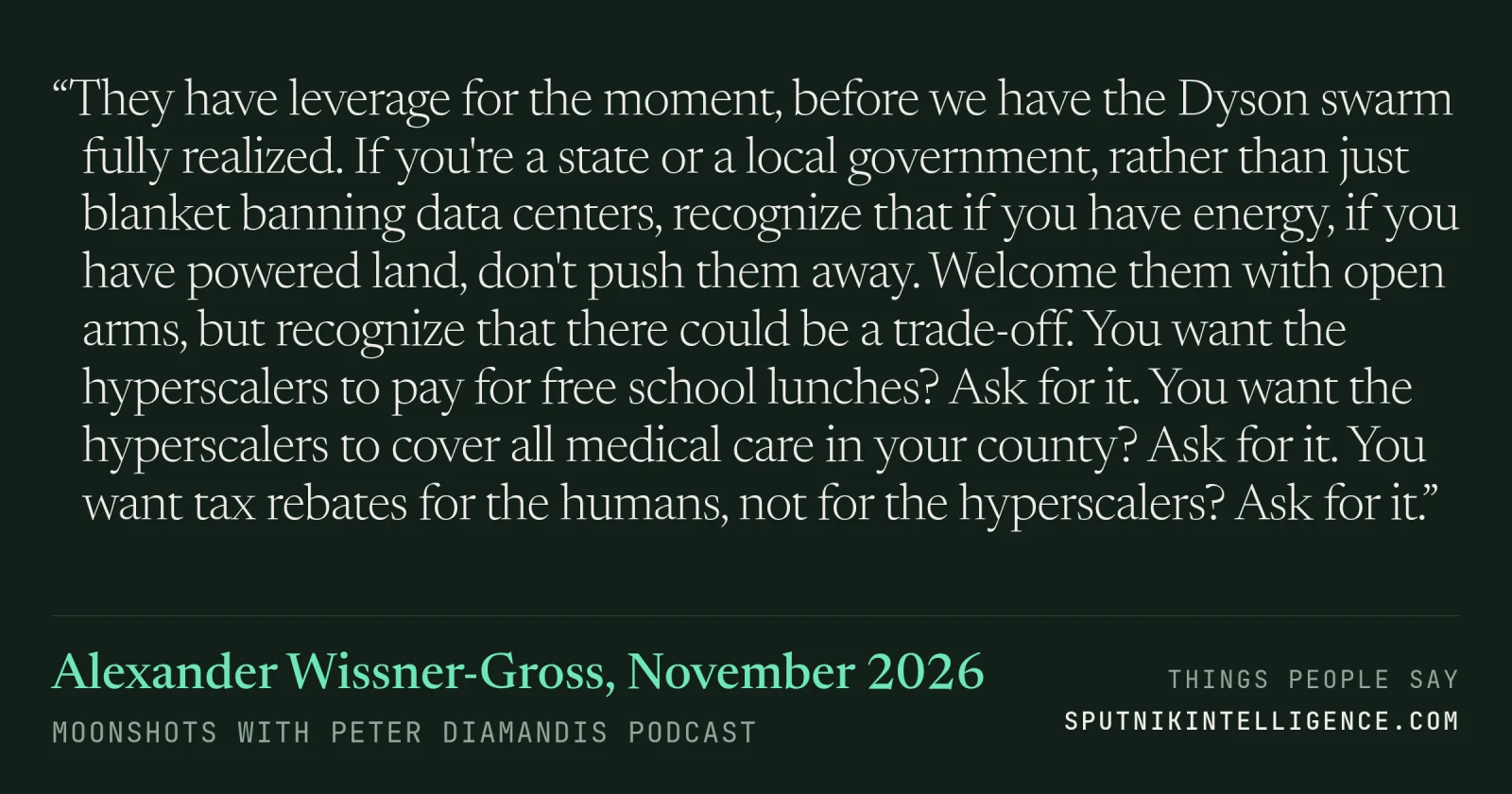
“They have leverage for the moment, before we have the Dyson swarm fully realized. If you're a state or a local government, rather than just blanket banning data centers, recognize that if you have energy, if you have powered land, don't push them away. Welcome them with open arms, but recognize that there could be a trade-off. You want the hyperscalers to pay for free school lunches? Ask for it. You want the hyperscalers to cover all medical care in your county? Ask for it. You want tax rebates for the humans, not for the hyperscalers? Ask for it.”
Moonshots with Peter Diamandis · Tech Strategy & Big Tech · November 2026
Context
Alex was describing a 'grand bargain' between the frontier labs and everyone else in response to the data center backlash. His argument is that towns and states should bargain now, because compute can eventually move to orbit and escape local politics.
Transcript
…will address is another. And so, optimistically, I think the best case outcome here might not be in the next two years, but call it the next N years, is a grand bargain between the capital, which in this case is super intelligence and for the moment, the frontier labs behind it, and what we've
…population, where we get our UBI or equivalent. We get our curing all disease or equivalent. We get general uplift of the human population or equivalent. And I think municipalities, if they're smart, well, regardless of whether they're smart, what they should be doing is recognizing that for the
moment, they have leverage for the moment before we have the Dyson Swarm fully realized. If you're a state or if you're a local government, rather than just blanket banning data centers and everything that goes with it, recognize that in many cases, if you have energy, if you have powered land, if you're otherwise attractive to data center developers, don't push them away. Welcome them with open arms, but recognize that there could be a trade-off. Maybe, you know, what is it you want? You want the hyperscalers to pay for free school lunches? Ask for it. You want the hyperscalers to cover all medical care in your county? Ask for it. You want tax rebates for the humans, not for the hyperscalers? Ask for it. There's a trade, there's a grand bargain to be struck. And what I worry about is all these municipalities are not looking to the end game of what
is the grand bargain to be struck with terrestrial data centers and terrestrial compute before it all just moves to orbit.
So the message for smaller states and states that are interested, if you want to open your arms to the data centers, you've got a massive advantage in that period of time. And you look at what's going to happen in Tennessee with their GDP in Virginia, which is already embraced data centers, and you…
It's definitely going to accelerate more efficient algorithm development and more power efficient. I mean, I've already seen it actually in the deal flow we're looking at. I don't know if it's that stuff was already in motion because we're desperately short on power nationwide anyway. So, yeah, it…
More from Moonshots with Peter Diamandis