 Koray Kavukcuoglu
SVP of Google DeepMind and Chief AI Architect at Google, running the organization day to day and overseeing Gemini model development, frontier AI research, and...
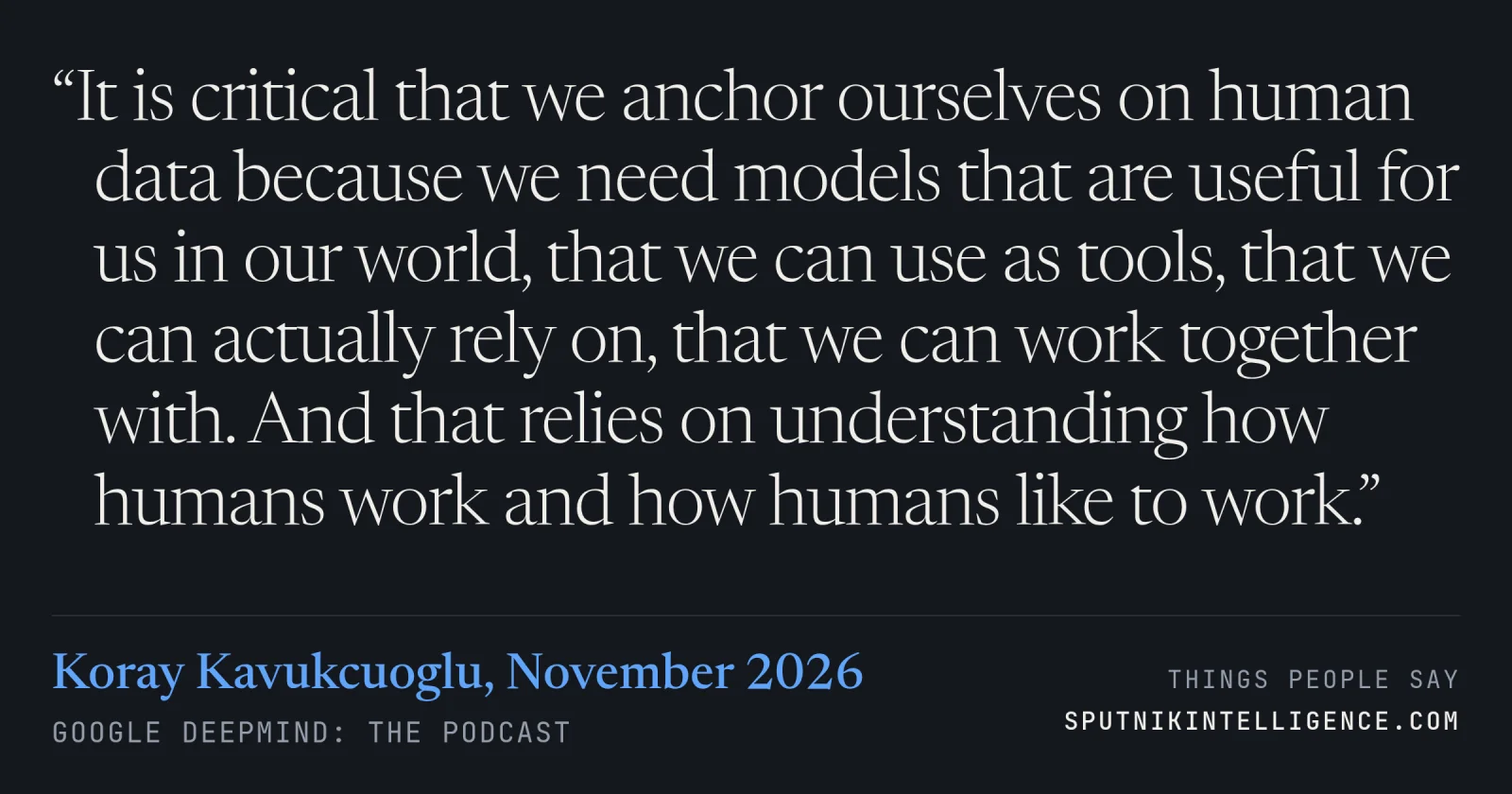
“It is critical that we anchor ourselves on human data because we need models that are useful for us in our world, that we can use as tools, that we can actually rely on, that we can work together with. And that relies on understanding how humans work and how humans like to work.”
Google DeepMind: The Podcast · AI Research & Frontier Labs · November 2026
Context
Fry brought up Richard Sutton's bitter lesson and asked whether progress takes off once systems leave human data behind, as AlphaZero did. He says models should generate and explore their own data, but not stop anchoring on human data.
Transcript
For those two events alone.
…between AlphaGo and AlphaZero, once you take away that human data, you can end up with a system that can accelerate beyond what it was previously capable of. I want to get your take on this. Do you think that there will be a point when we step away from human data and really see things take off?
Yes, and no. I wouldn't categorize it as a step away, but there's a lot of data that the model needs to generate itself and explore by itself. And through that, it can figure out strategies in the human data that you don't have. So that's real, right? And you can exactly see this in an environment which is fully observable and constrained, like Go. The model can explore things that the humans did not, because still that search space is a big search space. It's small compared to the general language of exploration space. But by enabling the model to explore by itself, you are giving it more opportunity. But I don't think it has anything to do with moving away from human data. Especially, again, if our goal is to build intelligence, I think it is critical that we anchor ourselves on human data because we need models that are useful for us in our world, that we can use as tools, that we can actually rely on, that we can work together with. And that relies on understanding how humans work and humans like to work.
I think it's a really persuasive argument, the way that you put it. That why would you possibly not want to put the human at the center of it? This other thing that everyone's getting excited about at the moment is recursive self-improvement. How do you define that?
When we think about recursive self-improvement, we think about a system that can train itself, which means that if you think about the whole loop of researching a model, that whole loop Loop that a model can do by itself, that it can explore new data, that it can explore new architectures, that it…
I think you're right that sometimes the way that it's spoken about is almost as though you go in and you hit a button and it says, give me the new version of Gemini, like Gemini 13, then 14, then 15, then that is sort of how it's I
More from Google DeepMind: The Podcast