 CJ Reynolds
Senior creator at Syntax and host of Coding Garden, covering web development, JavaScript tooling and AI coding tools.
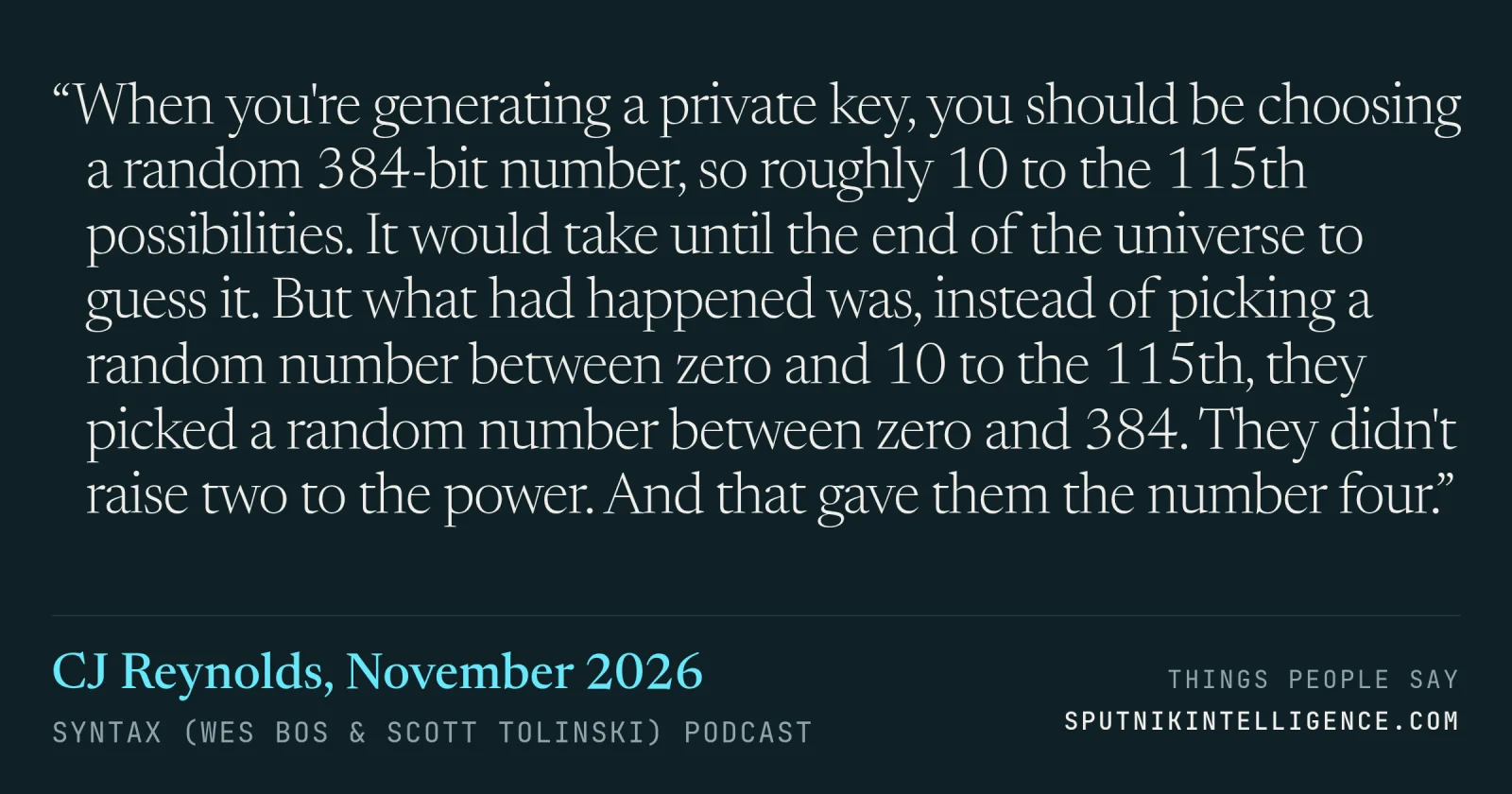
“When you're generating a private key, you should be choosing a random 384-bit number, so roughly 10 to the 115th possibilities. It would take until the end of the universe to guess it. But what had happened was, instead of picking a random number between zero and 10 to the 115th, they picked a random number between zero and 384. They didn't raise two to the power. And that gave them the number four.”
Syntax (Wes Bos & Scott Tolinski) · Hands-On Engineering Podcasts · November 2026
Context
Reynolds explains how a certificate authority ended up with a private key that was the number four, meaning anyone who knew could sign certificates trusted by browsers. It is a vivid example of how one basic bug can break HTTPS trust.
Transcript
have used that, you know? Maybe we're in for a whole new thing of hardware hacking of like loading custom firmware on. Because often that's how these firmwares will work. They'll only trust certain URLs. And if you can't do that, I saw people talking
directly about that in regards to the TV hacking stuff, whether or not it's just people talking and saying they did it. I did hear people claiming that they used the for certificate as a hack.
Yeah, I'll talk about it for a second. So, and again, there's a little bit of back information here. When you use the web and you see that little lock in the browser, that's because your web browser trusts a certain set of certificate authorities. A certificate authority is a company that will issue certificates, but they have the secret keys. They are the only ones that can issue keys from their certificate authority. And the entire internet is based on this trust. Operating system has those certificate authority public keys that can be used to verify their private key, like installed in the operating system. It's in Linux, it's in macOS, it's on Android, it's iOS, it's everywhere. And it's literally just a set of certificates that say we trust these people that work at these companies. And so one of those certificate authorities was eMudra. They were based in India. And they generated a private key that was the number four. And someone figured this out. And what that means is, like, if you know what the private key is, that means you can sign certificates as that company. And so because the eMudra was trusted in every single web browser and every single operating system for a…
Did nobody just try four until now? Like, how long ago did this happen?
I'm trying to find exactly when it was released, but I will say the reason someone had suspected it was because you can see it in the entropy of the key. And so they noticed that the entropy was a little bit off. And so they, I think they just brute forced it with starting at zero and instantly…
They backed out.
More from Syntax (Wes Bos & Scott Tolinski)