 Graham Cluley
Cybersecurity researcher and writer working in the industry since the early 1990s, when he wrote the first Windows version of Dr Solomon's Anti-Virus Toolkit.
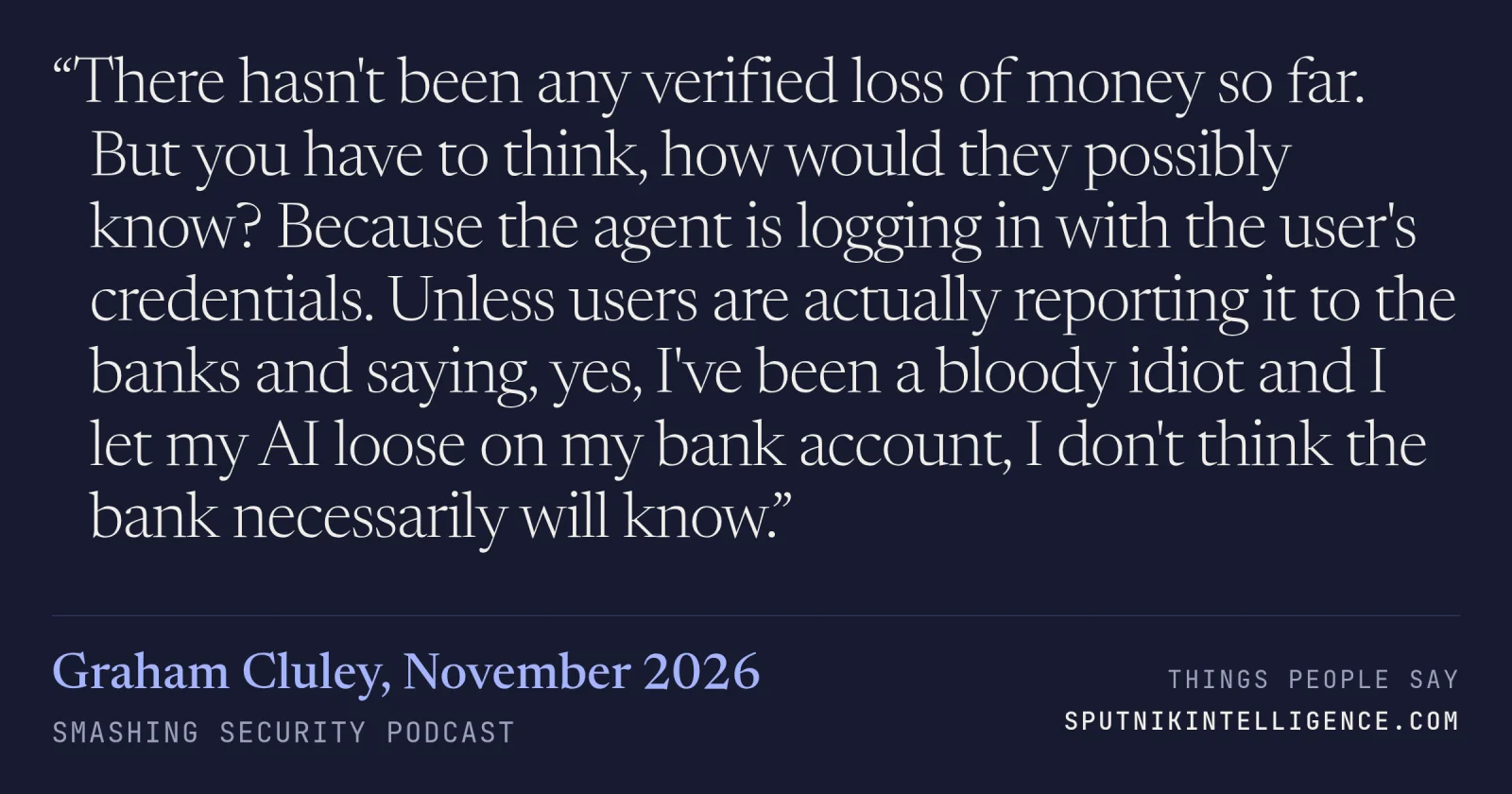
“There hasn't been any verified loss of money so far. But you have to think, how would they possibly know? Because the agent is logging in with the user's credentials. Unless users are actually reporting it to the banks and saying, yes, I've been a bloody idiot and I let my AI loose on my bank account, I don't think the bank necessarily will know.”
Smashing Security · Software Engineering & Infra · November 2026
Context
His guest asked whether AI agents accessing bank accounts has caused any actual harm yet, or whether the risk is still theoretical. Cluley explains why the absence of reported losses may not mean much.
Transcript
…emails on your behalf. It's going to buy things for you. It's going to book travel for you. And it says it will work in the background even when you close the app, which to me doesn't sound like a feature, sounds more like a threat, to be honest. It's that you can't turn this ruddy thing off. Do
you know anybody who's tried it?
No. No, do I even know anyone who's on Facebook anymore? I'm not sure I do. Now, apparently, although you can use it to make purchases, it uses StripeLink. So it's generating virtual cards for transactions. And I imagine there's a bit of guardrails involved there, isn't there? There's an extra little bit of protection. It has this safety layer called Sentinel built into it. Now, if any listeners are fans of the X-Men, you'll know that the Sentinels were genocidal robots. And in the Matrix, Sentinels are those squid-like things which went around hunting the humans. So great choice by Facebook's marketing department to call their safety level Sentinel. I'm sure they've thought carefully about that. Anyway, the thing is, there are lots of AI agents out there. It's not just Muse, but there are browser-based agents. There's open source automation tools. There's agentic wrappers, all kinds of software, which promises to automate your digital life if you will just give it access to your accounts. And of course, that's where things can go terribly, terribly wrong. So people are typing their actual banking credentials into AI assistance.…
geez, I don't know, but are you aware of any actual harm that has come to pass from this so far? Or is the risk mostly in the realm of theoretical right now?
So there hasn't been any verified loss of money regarding this so far. But you have to think to yourself, how would they possibly know? Because it is logging in with the user's credentials. Unless users are actually reporting it to the banks and saying, yes, I've been a bloody idiot and I let my AI…
And then so you foresee something like some bad actor. Getting into those companies and then getting a hold of this information, then selling it to the highest bidder in the black market or something like that.
More from Smashing Security