Ideas & Essays · August 2026

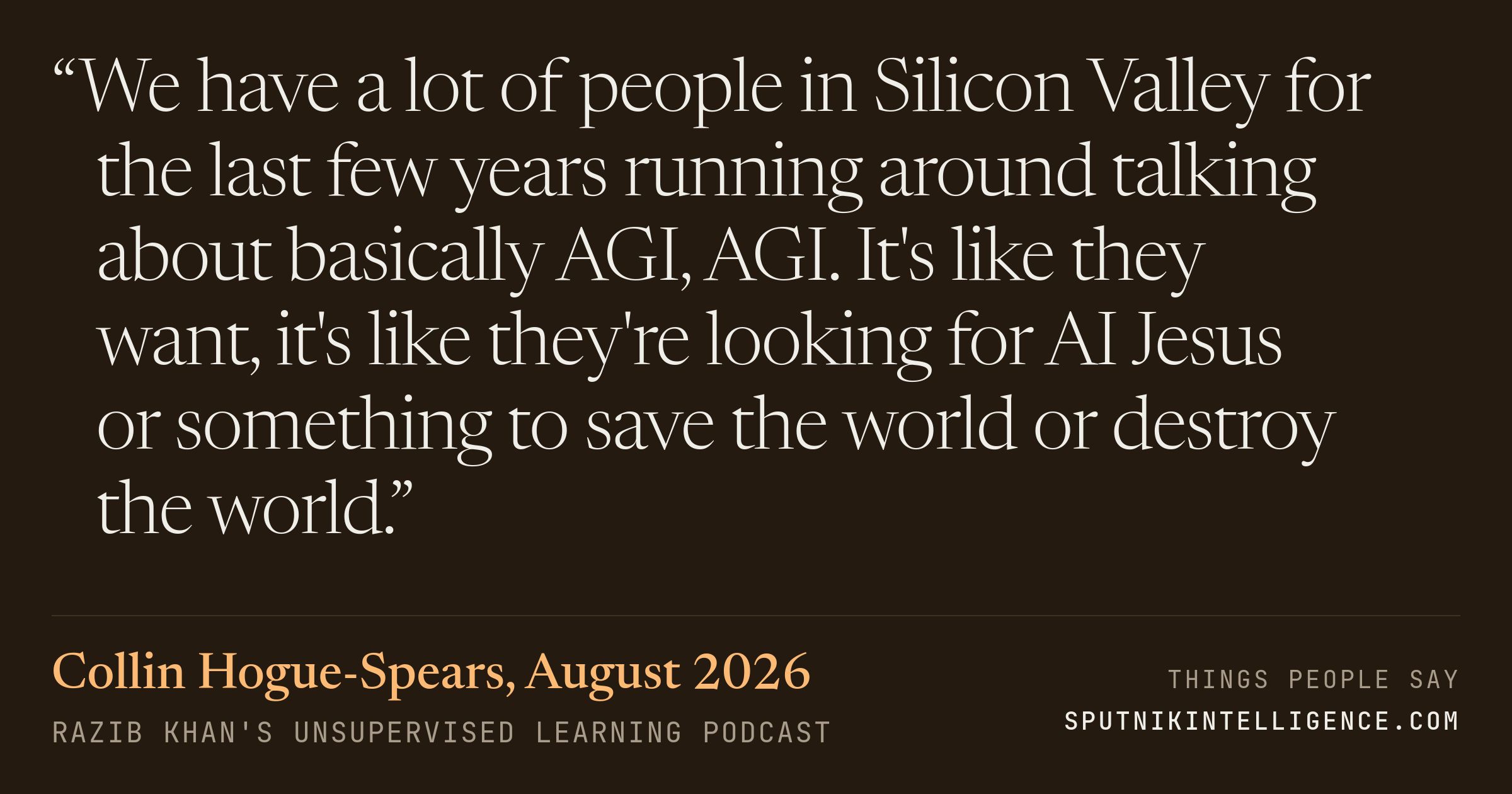
“We have a lot of people in Silicon Valley for the last few years running around talking about basically AGI, AGI. It's like they want, it's like they're looking for AI Jesus or something to save the world or destroy the world.” — Collin Hogue-Spears, Razib Khan's Unsupervised Learning

Hogue-Spears, who wrote a book on how AI is built and deployed in China, was asked what the world would look like if China led in large language models. He opened by refusing the US-versus-China framing, then contrasted what he sees as China's application-first focus with the American preoccupation with AGI. Khan pushed back in the next turn with a more sympathetic reading of the US government's motives.

Razib Khan's Unsupervised Learning · 2026-08-23 Listen to the episode → More from Collin Hogue-Spears →

Transcript

Razib Khan's Unsupervised Learning Around 44:21 into the episode
Razib Khan

fear of

Speaker 4

Chinese and Germany as Americans obviously do. But so describe what that would be like.

Collin Hogue-Spears

Yeah. First caveat is I specifically wrote the book in a way not to frame it as a US versus China thing or a competitive thing or a political book to the point, politicalized and making judgments about what China does. I'm more like explaining what happens. So, but what would the world look like if China was dominant in LLMs? I think that is a fair question. So I believe, I don't, honestly, I don't want to get into the national security aspects. I'm more talking about from a business perspective, a market perspective, what would the world look like from a technology perspective. So I believe that China's focus on AI is different from the U.S. We have a lot of people in Silicon Valley for the last few years running around talking about basically AGI, AGI. It's like they want, it's like they're looking for AI Jesus or something to save the world or destroy the world. I don't know. It depends on who you talk to that day, right? Sam Altman writes stuff like my model is really fast. It's scary. I don't know how to feel about it. You know, all these type of quotes strange. We just can't stop doing it, but we know it's dangerous, this kind of stuff. Nobody talks like that in China. I've never heard anybody talk like this who is Chinese in China. And I think their attitude toward technology is much more positive. And the focus on AI, from my perspective, has been very early on, unlike ChatGPT, Anthrop, or unlike ChatGPT, or, you know, OpenAI, their focus has been more like anthropic, but on steroids. And what I mean by more like Anthropic, Anthropic has been very focused on how we make people's lives easier and more efficient. They focus on like a lot. And you can see their sales. Their sales are heavy on enterprise sales. They're selling business to business like crazy. They're beating open AI. They've always been focused on practical aspects from writing to co-work to security. They care about improving the lives of people, improving the efficiency of companies. Well, China's had this attitude on steroids since the very beginning because the government has said multiple times, AI must make basically human existence better. And if it's not, Why does it exist? It needs to be here to improve our lives. And so,

Razib Khan

yeah, I feel like China made intentional. The Chinese government is very intentional. Whereas America, I mean, I think our main intention, our main hope, I see the American government's hope is to increase productivity and get us out of our fiscal crisis issues.

Collin Hogue-Spears

No, you're absolutely right. If we can increase, let's say, GDP by 20X or something like that, or whatever, you know, the crazy numbers that float around, well, that makes the deficit not very important, right? So, I just see a world where if China's dominant, what you will have is a lot more consumer applications. You will have AI being used more and being given away, in essence, to developing countries. You already see this with China having various partnerships and basically like partnerships with countries like Kenya, like Iran, like Kazakhstan, and I believe Uzbekistan. There are countries in Southeast Asia, like Indonesia. I see, and part of this is, you know, for political reasons, right? It's like power. But at the same time, what I see is there will be a world where China will roll out more products that are focused on improving the lives of people in a tangible way. And because of that, just like people in China, people will fear AI less. In the U.S., I think that, well, the reason for this, and I think I do talk about this in the book a bit, actually, I know I perfectly went back and did some edits because I want to explain this. If you're American, the way you look at China, probably, if you know anything about China, the way you're looking at China is you're comparing it to the U.S. What China is not compared to the U.S., what it lacks. If you're Chinese and you are 50 years old or 60 years old, especially, you grew up at a time when China's GDP was very similar to like a West African country. And now look at it today. So, what you see is what China is today compared to what it was. And part of that is because of technological improvement. And so you don't fear technology. You see it as a positive thing because your entire life, it's been positive. In the U.S., we have, we used to have this view too after World War II. You can look at sci-fi, 1950s, and stuff, it was like AI was going to change the world. Everything was going to be like, let me use an old reference, everything is going to be like the Jetsons or something, right? That's gone. Now, what you have is like people are very afraid. Even young people, they said some of the people that are the most negative about AI are like Gen Z.

Speaker 4

Yeah. Yeah. Yeah.

Speaker names from our own diarization · position estimated from where the line sits in the episode