
David Heinemeier Hansson

Things David Says on Podcasts

Created Ruby on Rails in 2003 and serves as chief technology officer and co-owner of 37signals, the company behind Basecamp and HEY. His commentary spans web development practices, software business economics, and skepticism toward conventional startup and venture funding paths. Hosts REWORK, the 37signals podcast where he and Jason Fried talk through how they run the company, from product decisions to hiring to pricing. He also writes at his own blog and on Substack, and appears as a guest on shows including Lex Fridman's podcast and The Pragmatic Engineer.

Where to Find Them

David Heinemeier Hansson hosts REWORK , writes David Heinemeier Hansson , writes Remote Ruby , writes Maintainable and writes Pirate Wires . They have also been a guest on The Changelog (3 times) , Ruby Rogues (2 times) , Workspaces (2 times) , Podcasting Made Simple (2 times) , Lex Fridman Podcast , Semaphore Uncut , Test & Code , The Vergecast , CoRecursive: Coding Stories , Grit , The Standup with ThePrimeagen , This Week in Startups , The Learning Leader Show With Ryan Hawk , The Pragmatic Engineer , Command Line Heroes , Software Engineering Radio - the podcast for professional software developers , David Senra , The Twenty Minute VC (20VC): Venture Capital | Startup Funding | The Pitch , The Peter McCormack Show , AppleInsider Podcast and My First Million . They also write for David Heinemeier Hansson on Substack.

Recently: “One-way Doors” on REWORK (August 2026); “Competing with giants, the end of SaaS & other listener questions” on REWORK (August 2026); “Rapid Fire Q&A with Jason Fried and David Heinemeier Hansson” on REWORK (August 2026); “We'll do it live” on REWORK (August 2026); “What's the worst that could happen?” on REWORK (July 2026); “I'm sorry, Dave” on David Heinemeier Hansson (July 2026).

What They Said

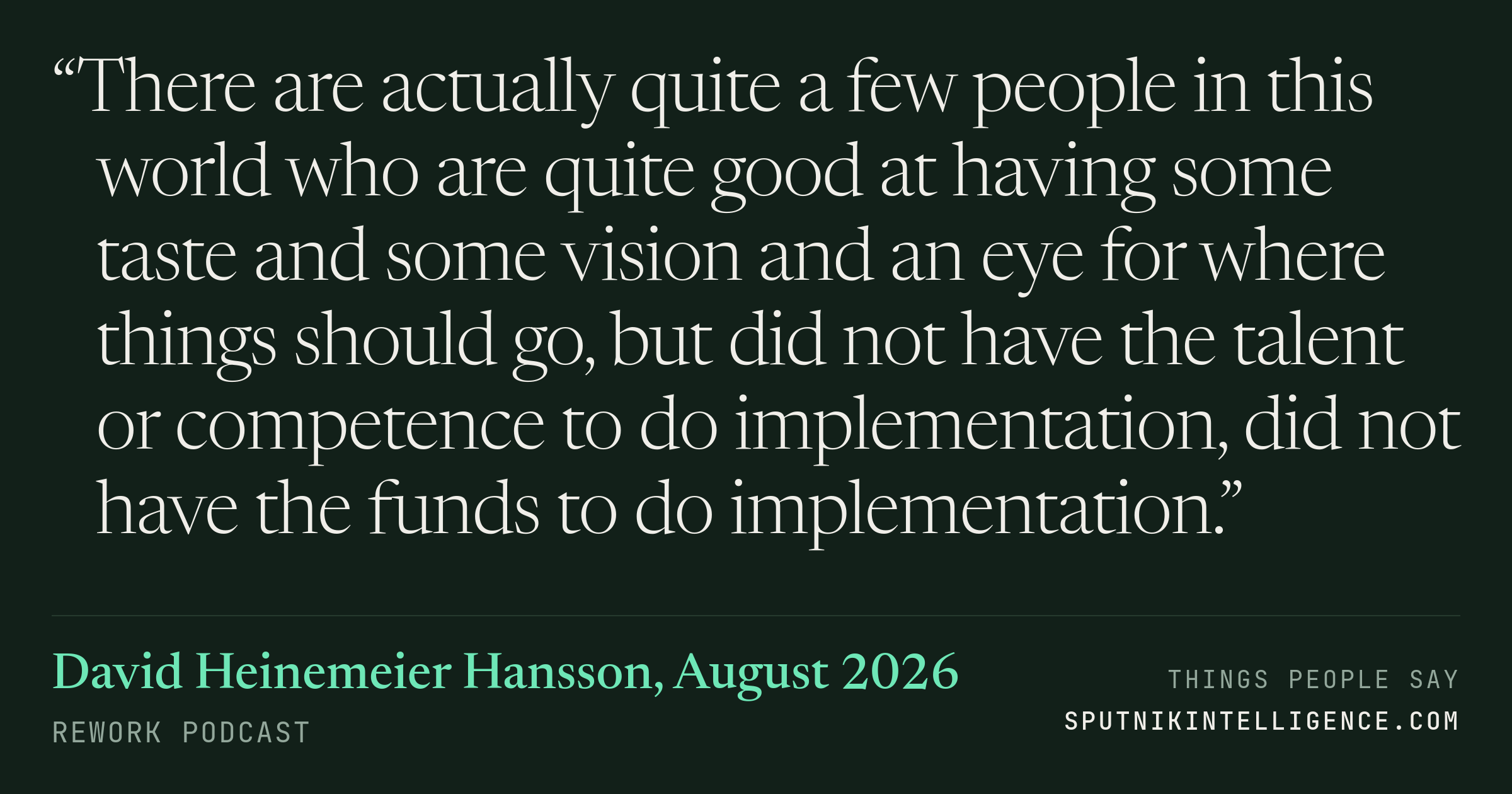
“There are actually quite a few people in this world who are quite good at having some taste and some vision and an eye for where things should go, but did not have the talent or competence to do implementation, did not have the funds to do implementation.” — David Heinemeier Hansson, REWORK

David Heinemeier Hansson was discussing who AI coding tools actually threaten. His view: the real shift isn't agents replacing product builders, it's that people with taste and vision but no ability to build now can bring ideas to life themselves.

REWORK · 2026-08-19 Permalink → Listen →
REWORK Around 12:12 into the episode
Kimberly Rhodes

I also think it's interesting that I've seen so many unattractive products, unattractive apps. And yes, it could be programmed by AI, but there is a design element of taste that I don't think we've gotten to quite yet.

Speaker 3

I think that's actually the main charge against slob, which is this framing for AI just producing a bunch of stuff. No, no, the slob is not coming from the agents. It's coming from you. It's coming from you, the instructor of the agents that you don't

David Heinemeier Hansson

have the vision and the eye for developing something good. And why would it be otherwise, right? Like, this is why you have product designers sit down and think carefully about building things. It's not just about making something happen. That is the big change that has happened. And I do think that that's perhaps also the other flank of this that's very interesting. There are actually quite a few people in this world who are quite good at having some taste and some vision and an eye for where things should go, but did not have the talent or competence to do implementation, did not have the funds to do implementation. So at least for the foreseeable future, I think that's the bigger threat to anyone running a software company is that someone else, another human out there is suddenly capable of making their ideas come true. I'm actually quite certain that if AI had been around in, say, 2000, when Jason put the post out for a programming question that I answered and we started working together, I'm not so sure I would have ended up moving to Chicago because Jason would have been able to build a lot of things by himself. Because at that time, that was the constraint on his ability to create software. He had all these ideas and the designs and how it should go, but was lacking the mechanism of turning those into software. Now a lot of people have suddenly gotten a really good mechanism for that.

Kimberly Rhodes

Okay, let's go to this question. It's an email from Alex. Hi, Jason and David. It seems that the two of you promote your business through your own personal brands, most notably on X, although I'm sure you're also probably on LinkedIn. I'm starting a business soon, and I always thought that I wanted to keep my personal social accounts like X, Instagram, and TikTok completely separate from my business. But seeing that you two are using your personal brands to promote your company makes me wonder if this is the right play. Would love to hear your thoughts from Alex.

Jason Fried

I mean, I don't think there's such a thing as a personal brand, by the way. I've always been bugged by that whole thing. It's just me talking on the internet. Where do I work? I work here. What do I talk about? I mean, that is your brand.

Kimberly Rhodes

Like your style of writing, your personality, the things you're saying.
Speaker names from our own diarization · position estimated from where the line sits in the episode
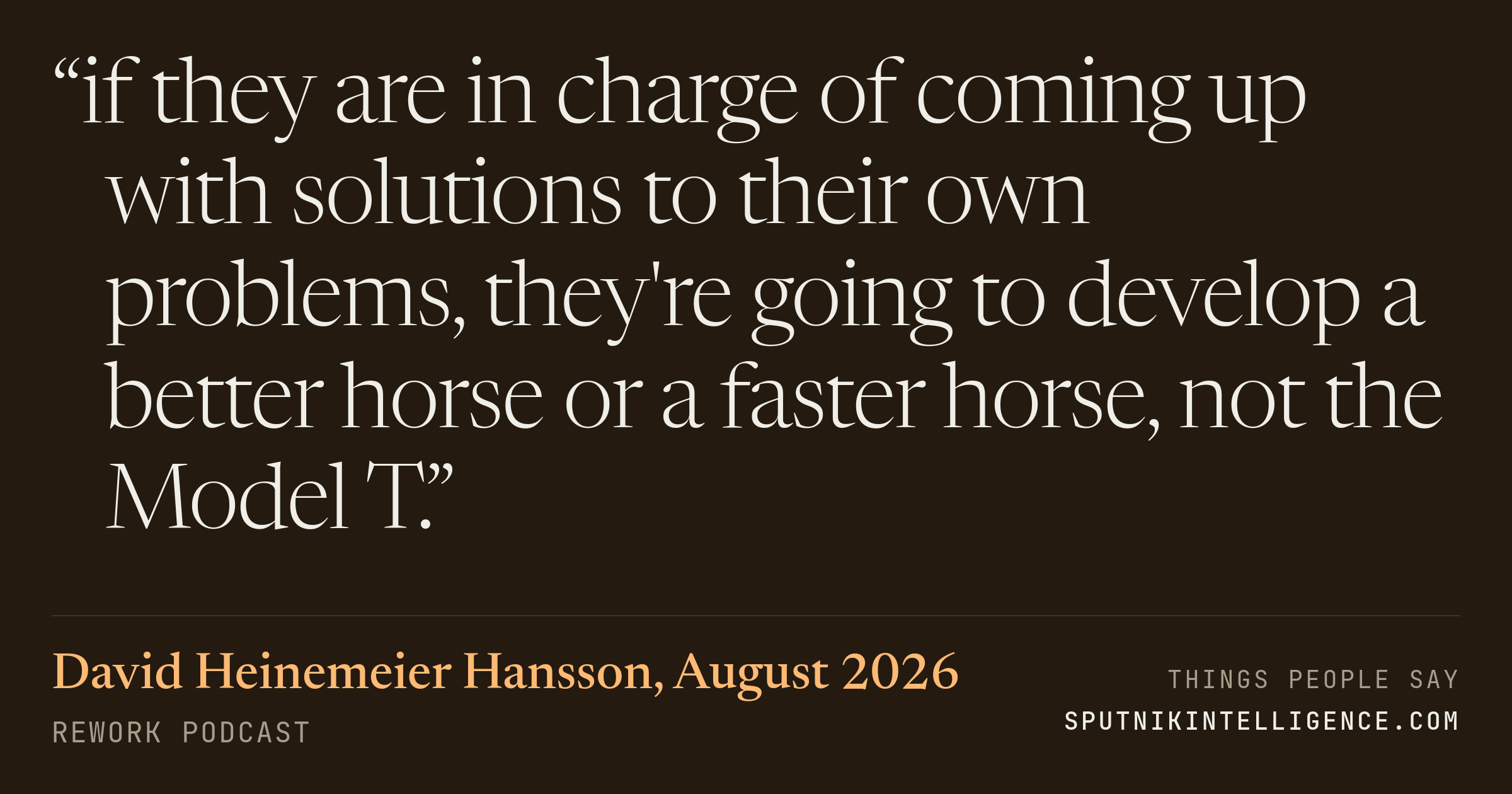
“if they are in charge of coming up with solutions to their own problems, they're going to develop a better horse or a faster horse, not the Model T.” — David Heinemeier Hansson, REWORK

David Heinemeier Hansson was arguing against the idea that AI agents will let customers design their own software. He says customers understand their problems but not the best solutions, which is why they hire product builders in the first place.

REWORK · 2026-08-19 Permalink → Listen →
REWORK Around 09:46 into the episode
Jason Fried

have customers who leave every day. We have customers who come back. We have customers who leave other products and come to us. There's a constant churn of people moving around anyway, regardless of AI. AI is another option. If someone wants to build their own tools, it's another way for someone to leave your product, but the other reasons are already there. So let's start there. Second, like David mentioned, I wrote this piece on, I just. Don't think people are going to want to build bespoke software. Most businesses are not going to want to build bespoke software. Building software takes a lot of work, even if it's become way easier. Someone still has to maintain it. Someone has to think about it. Someone has to think about the workflows. Someone has to adjust things. If that person leaves, then what happens? And people are busy already with their own things. It's understandable that, like, online on X, on places like that, where everyone's talking about software, people think everyone in the world is talking about software. Most people just don't care about software. They care about the plumbing business they run, the electric business they run, the whatever business they run. And yeah, could they build their own thing? They probably could, but why would they? Now, this also gets back to David's point about price. So, like David said, most of the stories I've been hearing are when people are trying to like potentially save a million bucks a year or whatever on something they didn't like to begin with. So, when I look at our business, you know, a lot of people pay us 50 bucks a month. That's 600 bucks a year. Okay. If you look at how much it would take to build Basecamp, even if you're using AI and you took one or two or three employees to kind of do it and mess around with it, whatever, it's going to cost you thousands and thousands and thousands of dollars anyway in opportunity costs and things they could have been doing otherwise to save 600 bucks a year. And then, like, you don't have something that's quite right. And then you've got to keep maintaining it and things might break. And then, who do you blame? A lot of buying products is about actually ultimately being able to blame someone and put someone else on the hook to take care of you. That's why you pay them money. So, you know, there's all these reasons why it doesn't make sense, especially on the low end. But again, as David said, like, we'd be foolish to think that everything is safe and nothing's going to change. Of course, things are going to change, but also we're going to change and we are changing. We're able to build things faster and better. And we have 25 plus years of experience understanding what software is about. It's not just about compiling code and having software do things. It's about what do people actually want to do? Why do they want to do it? How do they want to do it? How do these things all work together? How do these pieces fit together? You can dream up all sorts of things, but that's not what software has ever been about. Great software, I should say. Great software is still about a cohesive concept, an idea, a product, borders, boundaries. That's what this is all about. So, no, are we all immune? No. Are things going to change? Yes, absolutely. But you got to think about where you are. This is not a monolithic thing. Software is not a monolithic thing. There's different levels of different prices, and the kinds of companies and customers you have may or may not be interested in getting involved in doing their own stuff at all. We all hire contractors. We all hire vendors. We all hire people to do things for us that we could do ourselves, but we don't want to because it makes more sense to hire them to do those things. I have a housekeeper that comes once a week to clean her house. I could clean my house that day too, but like, what does it cost me to take a day off of work from doing that? Or my wife and I doing that? Or a kid, whatever. Like, we keep the house kind of clean, but we also have someone who comes by and cleans the house. Like, it just makes sense to do that, right? So, if you just pile up all the things in your world that you do or you kind of have other people do or whatever, it just makes sense sometimes to buy something off the shelf or from a company that you like that makes a great product that supports what you do. So, you don't have to do it yourself. These things remain true, will always remain true. But yes, of course, things are changing.

Speaker 3

I think a great illustration of this is the episode of The Simpsons, where Homer is given the opportunity by GM to design his own car. And

David Heinemeier Hansson

individually, all his little ideas for, oh, there should be extra cup holders here, there, and everywhere. They're probably fine. And that's what a lot of customer feedback we get too is individually, everything makes sense in that moment, narrowly for that person at that time. But you take it all together and you end up with homeless car, an absolute abomination of lack of vision, lack of cohesion, lack of something people want to use. Most people have just not thought that carefully about the problems that they have and may not be blessed with the competencies or even the talent to come up with solutions to those problems. They know their problems. I think this is what you'd always have to respect as a product builder: the customer knows their problems. They do not know the best solutions. That's why they're coming to you. That's why they're hiring you. So, if they are in charge of coming up with solutions to their own problems, they're going to develop a better horse or a faster horse, not the Model T. Now, I think the tipping point is actually not AI doing what a customer tells the AI it should do and makes the software that they want to make. I think the real tipping point is once the AI tells you the kind of software that you should have. It looks at your problems and places itself in the role that we have as problems. Solvers and product developers. We're not there yet, or I haven't seen that at least be very successful in any shape. All the best use cases right now that exist in the world for AI aiding development is someone with taste, vision, problem space knowledge, feeding all that in and steering a bunch of agents to build that for them. If you flip it around and say, Well, I don't know what I want, I've not seen good things come out of that. And I've tried quite a few times where I'm like, let's just see where it goes with this if I just let it drive. And as of yet, it's not. But that's the part where give it another five minutes, six months, two years, five years. Who the hell knows when this whole thing is going to tip in that direction where it's AI telling us what the world should look like?

Kimberly Rhodes

I also think it's interesting that I've seen so many unattractive products, unattractive apps. And yes, it could be programmed by AI, but there is a design element of taste that I don't think we've gotten to quite yet.

Speaker 3

I think that's actually the main charge against slob, which is this framing for AI just producing a bunch of stuff. No, no, the slob is not coming from the agents. It's coming from you. It's coming from you, the instructor of the agents that you don't

David Heinemeier Hansson

have the vision and the eye for developing something good. And why would it be otherwise, right? Like, this is why you have product designers sit down and think carefully about building things. It's not just about making something happen. That is the big change that has happened. And I do think that that's perhaps also the other flank of this that's very interesting. There are actually quite a few people in this world who are quite good at having some taste and some vision and an eye for where things should go, but did not have the talent or competence to do implementation, did not have the funds to do implementation. So at least for the foreseeable future, I think that's the bigger threat to anyone running a software company is that someone else, another human out there is suddenly capable of making their ideas come true. I'm actually quite certain that if AI had been around in, say, 2000, when Jason put the post out for a programming question that I answered and we started working together, I'm not so sure I would have ended up moving to Chicago because Jason would have been able to build a lot of things by himself. Because at that time, that was the constraint on his ability to create software. He had all these ideas and the designs and how it should go, but was lacking the mechanism of turning those into software. Now a lot of people have suddenly gotten a really good mechanism for that.

Speaker names from our own diarization · position estimated from where the line sits in the episode

Collections They Appear In