
Adam Gordon Bell

Things Adam Says on Podcasts

Software developer who hosts CoRecursive, a podcast where each episode someone shares the story behind a piece of software being built. Recent episodes cover the history of reinforcement learning, data compression and the Hutter Prize, and how programmers age. Hosts CoRecursive: Coding Stories and has appeared as a guest on Ruby Rogues, The Stack Overflow Podcast and Software Misadventures.

Where to Find Them

Adam Gordon Bell hosts and writes CoRecursive: Coding Stories , hosts Software Engineering Radio - the podcast for professional software developers and writes Programming Throwdown . They have also been a guest on Ruby Rogues (2 times) , Semaphore Uncut , The Stack Overflow Podcast and Software Misadventures .

Recently: “Random to Whom? Dice, Tetris, and a lunch bet over what random means” on CoRecursive: Coding Stories (November 2026); “The Hutter Prize: Compression, prediction, and the limits of intelligence” on CoRecursive: Coding Stories (August 2026); “The Hutter Prize: Compression, prediction, and the limits of intelligence” on CoRecursive: Coding Stories (August 2026); “The Bitter Lesson: The history of reinforcement learning” on CoRecursive: Coding Stories (June 2026); “The Bitter Lesson: The history of reinforcement learning” on CoRecursive: Coding Stories (June 2026); “The Pre-Training Wall and the Treadmill After It” on CoRecursive: Coding Stories (May 2026).

What They Said

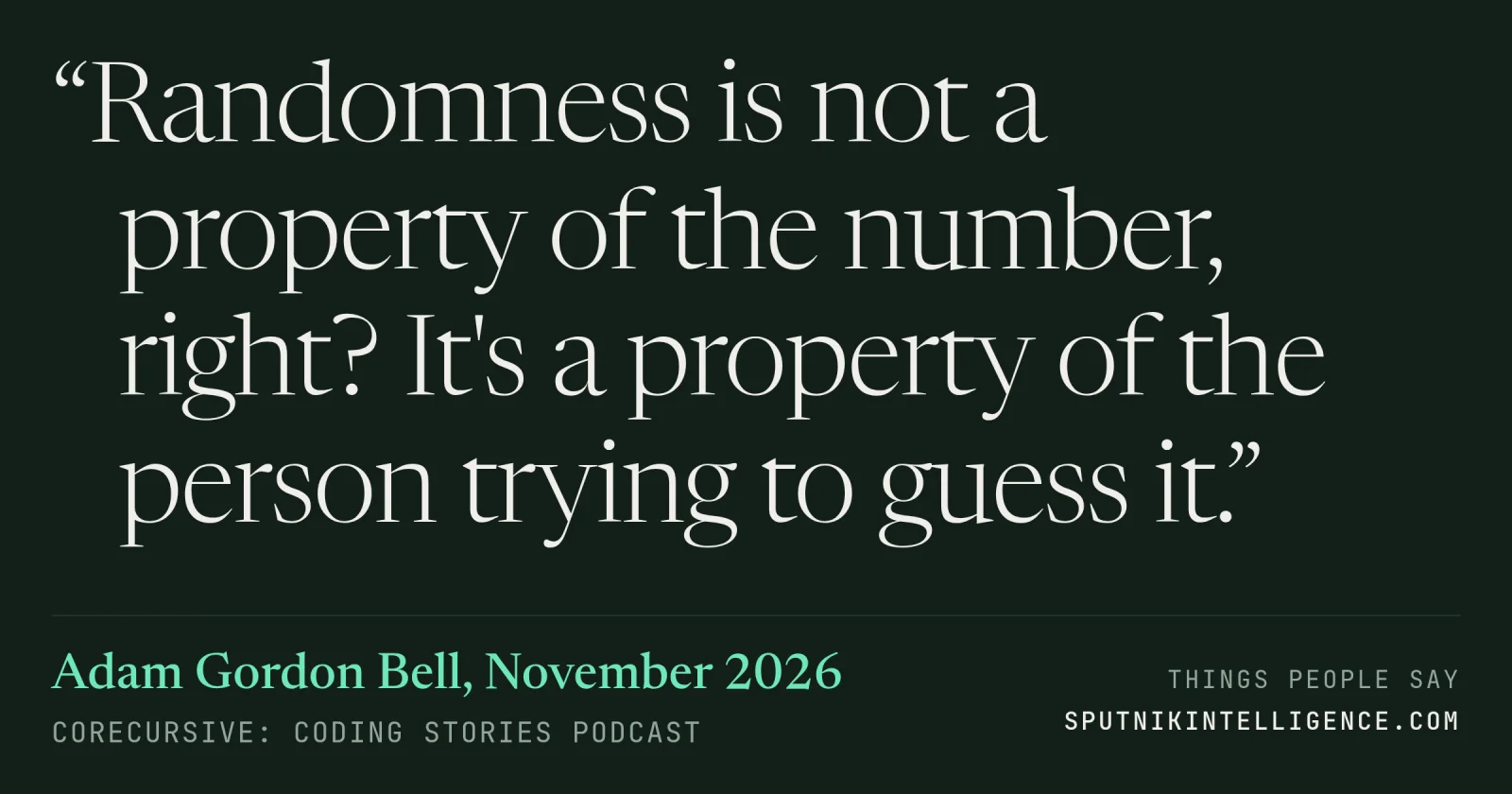
“Randomness is not a property of the number, right? It's a property of the person trying to guess it.” — Adam Gordon Bell, CoRecursive: Coding Stories

After testing Tetris, Doom, pi, Python's generator and the OS random source against his randomness detector, Adam draws the episode's lesson: randomness lives with the observer, not in the value.

CoRecursive: Coding Stories · 2026-11-03 Permalink → Listen →
CoRecursive: Coding Stories Around 54:12 into the episode
Adam Gordon Bell

…from U random on my computer, it's less clear to say where it's from. They have more legitimacy. They can stamp on it like it came from a radio wave. But that doesn't mean it's more random because I think there's no observer that we're aware of that could predict ours but couldn't predict theirs.

Don Mckay

Oh, I see. Until you find that person.

Adam Gordon Bell

When you find that person and they're like, no, there's a vulnerability on the Mac and actually it's not truly random and whatever, then there's a difference. But right now, there's no measured difference that anyone could find, right? Yeah, which is why randomness is not a property of the number, right? It's a property of the person trying to guess it. Yeah, that's why this person, Dylan, on Hacker News, I think they sum it up well.

Don Mckay

There is actually no such thing as a random or not random number. There are only random and not random generators.

Adam Gordon Bell

But the all cops guy at the beginning and the blackjack poster and the guy who is angry about XCOM and even Von Neumann, right? They're all kind of getting at the same idea. Randomness is a process.

Don Mckay

Yeah, the property of randomness isn't inherent in the value. It's derived from the observers of the value. Yeah. So if, you know, you can't predict whether you're going to hit or miss a shot in XCOM, it's random enough.

Speaker names come from our own diarization. The position is estimated from where the line sits in the episode.

Collections They Appear In