AJ

Adam Jacob

Things Adam Says on Podcasts

Where to Find Them

Adam Jacob writes The New Stack Podcast . They have also been a guest on The Changelog (9 times) , Oxide and Friends (5 times) , Open Source Startup Podcast (2 times) , Arrested DevOps (2 times) , Syntax (Wes Bos & Scott Tolinski) , CoRecursive: Coding Stories , Hanselminutes with Scott Hanselman , Platform Engineering Podcast , The InfoQ Podcast and The Enterprise AI Show .

Recently: “1049: WTF is a Software Factory?” on Syntax (Wes Bos & Scott Tolinski) (October 2026); “Automation at the speed of Swamp (Friends)” on The Changelog (May 2026); “Agentic infra changes everything (Interview)” on The Changelog (October 2025); “Can AI save DevOps? with SystemInit's Adam Jacob” on Hanselminutes with Scott Hanselman (September 2025); “From Chef to System Initiative (remastered) (Interview)” on The Changelog (August 2025); “Shootout at the CNCF Corral” on Oxide and Friends (May 2025).

What They Said

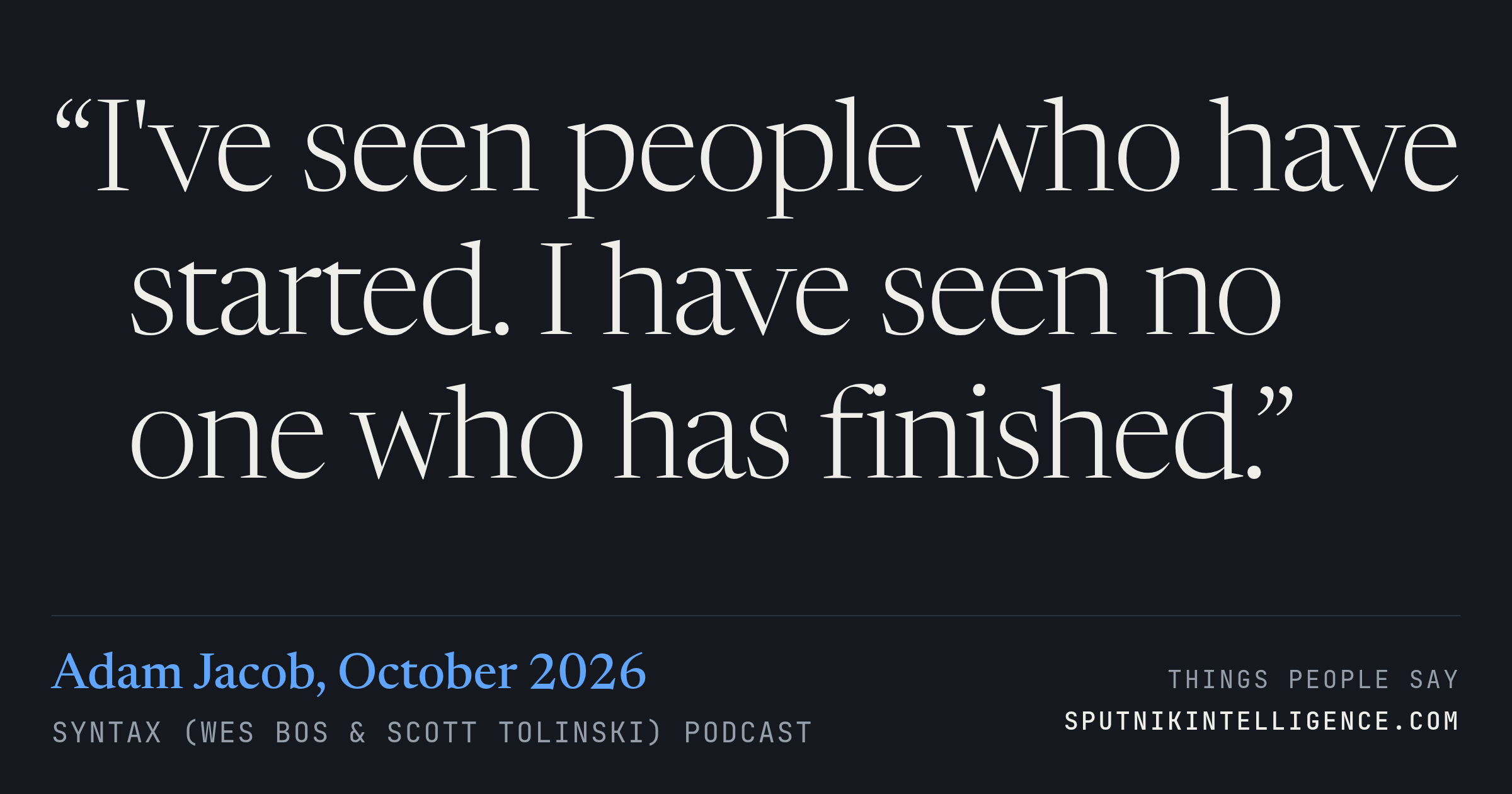
“I've seen people who have started. I have seen no one who has finished.” — Adam Jacob, Syntax (Wes Bos & Scott Tolinski)

Asked whether any large companies have moved to AI-driven software factories. Jacob says the industry is still in the phase of discovering which techniques work.

Syntax (Wes Bos & Scott Tolinski) · 2026-10-21 Permalink → Listen →
Syntax (Wes Bos & Scott Tolinski) Around 23:59 into the episode
Adam Jacob

…everybody gets to be more creative. And so people tend to love it actually when they get to the other side, even though in the middle, they're like, ooh, I don't know how I feel about it. Cause, you know, because I really loved being a programmer the way I was a programmer two years ago, you know?

Speaker 4

Have you seen any large companies that have like at least started to take this on or switch toe?

Adam Jacob

I've seen people who have started. I have seen no one who has finished. Okay. And that's, you know, and I think that's true even amongst my peers. You know, like there was an era, it's slowing down now, but I would say six months ago, I was averaging three calls a week from friends who, you know, my company was failing at that moment six or eight months ago. So I was in the, I was in the position of having to wrestle with this, but not having customers or, you know…

Wes Bos

Yeah. And I, and I, I, I, I feel like you have such a good like your thumb on this type of stuff because I'm, I'm just, I keep thinking about big companies like LinkedIn. And once they get this, something like this in place, what do they do with? I just looked it up. They have 10,500 engineers. And…

Adam Jacob

I don't, I don't know. Nobody knows. And here's my guess: my belief is that the answer is yes, they can. What we don't know is what that is yet. Because what happens when you get this increase? Like what happens when a system changes that dramatically, when that order of magnitude jump occurs?…

Wes Bos

Yeah.

Speaker names from our own diarization · position estimated from where the line sits in the episode
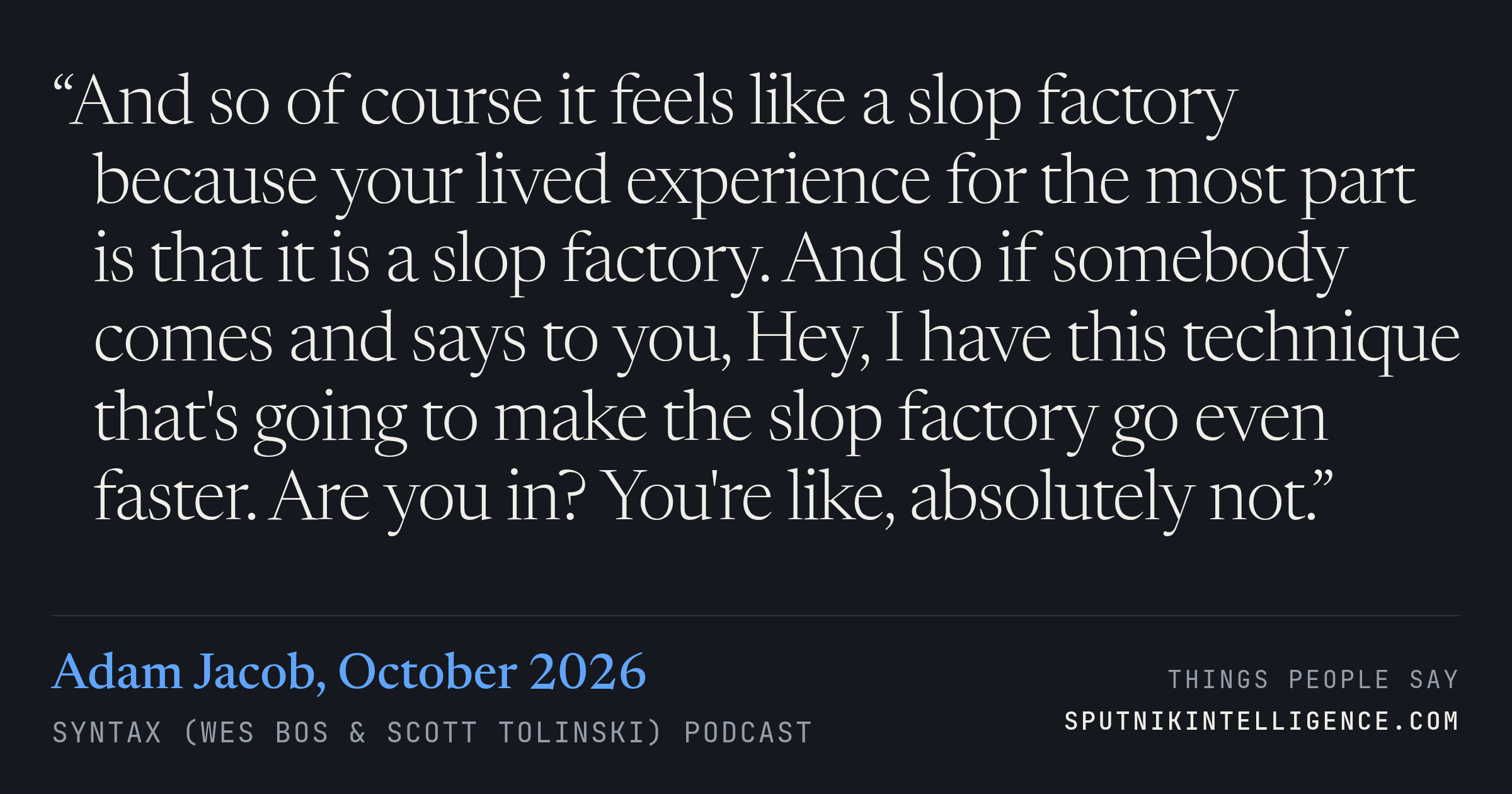
“And so of course it feels like a slop factory because your lived experience for the most part is that it is a slop factory. And so if somebody comes and says to you, Hey, I have this technique that's going to make the slop factory go even faster. Are you in? You're like, absolutely not.” — Adam Jacob, Syntax (Wes Bos & Scott Tolinski)

Jacob explains why developers distrust the "software factory" idea. Teams that kept their old process while shipping thousand-line AI pull requests nobody understands are stuck in the surf zone. Paradoxically, he says, the way out is more automation and structure, not less.

Syntax (Wes Bos & Scott Tolinski) · 2026-10-21 Permalink → Listen →
Syntax (Wes Bos & Scott Tolinski) Around 21:14 into the episode
Adam Jacob

…because you're talking about those, those, those elements of like, of trust, of repeatable automation, right? Like, how do I get the system to behave the same way every time as we go through this process, regardless of who the engineer or the product person is that's putting in the inputs, right?

Scott Tolinski

…that trust, or let's say we want to standardize the process for something that happens over and over again. I think most people would agree with that being something that they needed. But in the same regard, a lot of people might look at a software factory as just being like a slot factory, right?

Adam Jacob

…I didn't come up with the software factory word, but it is what people are calling it. You know, like I helped come up with like DevOps, for example, and I have regrets about how that work went out into the world. And like, I'm sure the software factory people probably have some regrets about how that metaphor has taken hold. But like, you know, ultimately, that process is the critical piece. And so of course it feels like a slop factory because your lived experience for the most part is that it is a slop factory. And so if somebody comes and says to you, Hey, I have this technique that's going to make the slop factory go even faster. Are you in? You're like, absolutely not. You know, like the thing that's killing me, I do not want more of it. You know,

Wes Bos

I have a question about like specifically companies that have lots of engineers and are sort of like looking at like, how do we tackle this, right? You, like, you just gave an example of like 10 engineers, but I think about like, I remember hearing a stat that like LinkedIn has like 300 engineers…

Adam Jacob

Yeah, man, that's a good question. And I, I sort of believe that there's two emerging frontiers happening in AI. So like one frontier is the labs and all the things that they're doing. The other frontier is the answers to these questions. You know, like, how do we as regular mortal? You know, like…

Speaker 4

Have you seen any large companies that have like at least started to take this on or switch toe?

Speaker names from our own diarization · position estimated from where the line sits in the episode
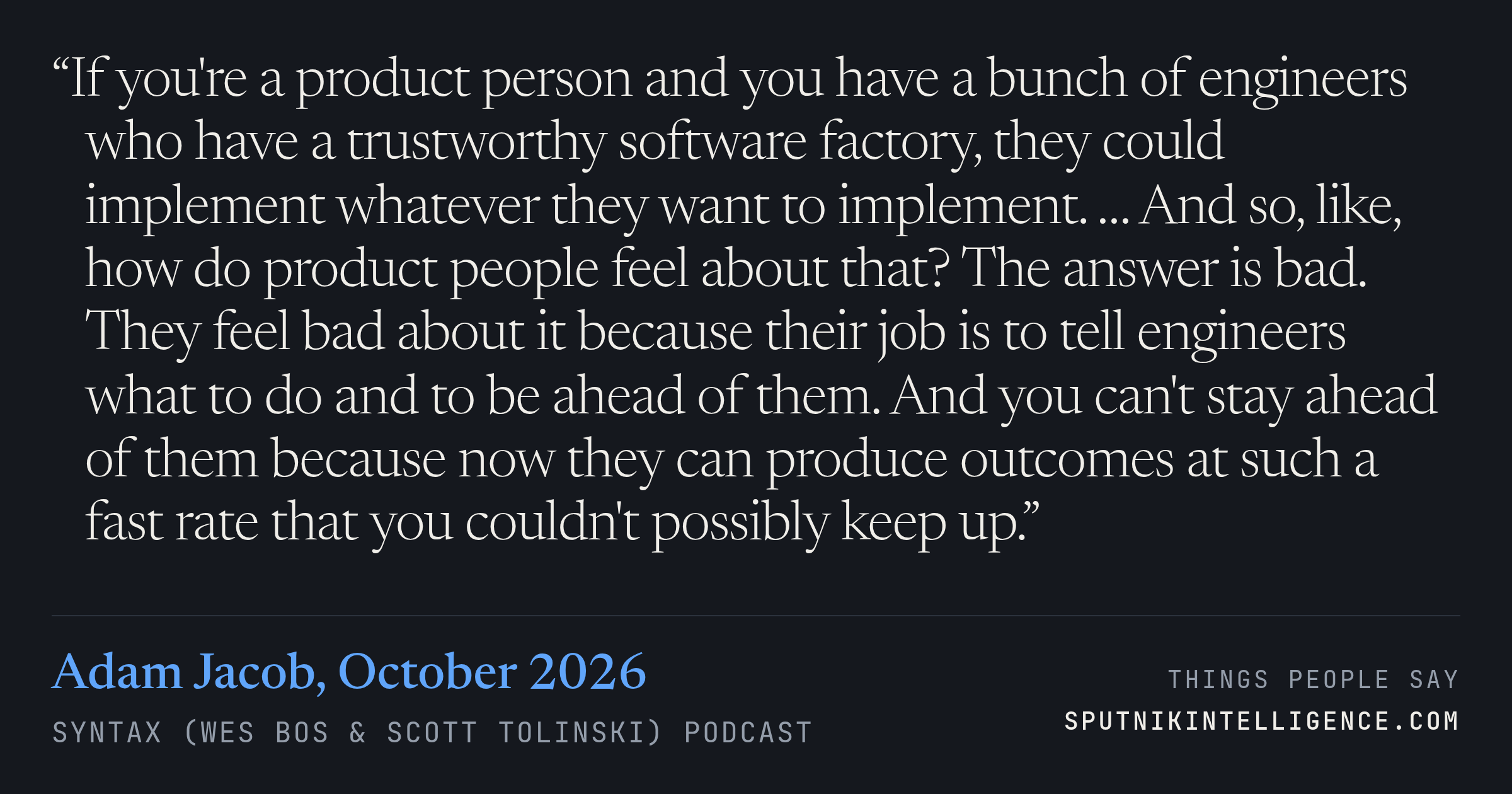
“If you're a product person and you have a bunch of engineers who have a trustworthy software factory, they could implement whatever they want to implement. … And so, like, how do product people feel about that? The answer is bad. They feel bad about it because their job is to tell engineers what to do and to be ahead of them. And you can't stay ahead of them because now they can produce outcomes at such a fast rate that you couldn't possibly keep up.” — Adam Jacob, Syntax (Wes Bos & Scott Tolinski)

Asked how large engineering organizations should adopt AI "software factories," Jacob says the hard part isn't the technology. It's that the shift breaks existing points of control. His advice is to start with a team of five that is allowed to break every rule.

Syntax (Wes Bos & Scott Tolinski) · 2026-10-21 Permalink → Listen →
Syntax (Wes Bos & Scott Tolinski) Around 22:37 into the episode
Adam Jacob

…for the most part is that it is a slop factory. And so if somebody comes and says to you, Hey, I have this technique that's going to make the slop factory go even faster. Are you in? You're like, absolutely not. You know, like the thing that's killing me, I do not want more of it. You know,

Wes Bos

…300 engineers committing CSS every single day. You know, like just the scale of some of these things is like, what would you recommend to a company that has hundreds, thousands of engineers of like, like, how do you re-architect? How do you even start to change how you work with this type of stuff?

Adam Jacob

…your existing work process, about the points of control, right? If you're a product person and you have a bunch of engineers who have a trustworthy software factory, they could implement whatever they want to implement. They could refactor whatever they want to refactor. They could ship whatever feature comes to mind without having to ask you questions and without having to need your permission. And so, like, how do product people feel about that? The answer is bad. They feel bad about it because their job is to tell engineers what to do and to be ahead of them. And you can't stay ahead of them because now they can produce outcomes at such a fast rate that you couldn't possibly keep up. And so now your job is to look at it exclusively from the end. Your job is to like review the outcomes of your engineering teams, try to align them to the theme. And then, and then, because it's the cost of rework is so low, if you don't like it, you can change it. That is such a weird organizational pivot that very few people have figured out how do I restructure my organization in order to get…

Speaker 4

Have you seen any large companies that have like at least started to take this on or switch toe?

Adam Jacob

I've seen people who have started. I have seen no one who has finished. Okay. And that's, you know, and I think that's true even amongst my peers. You know, like there was an era, it's slowing down now, but I would say six months ago, I was averaging three calls a week from friends who, you know…

Wes Bos

Yeah. And I, and I, I, I, I feel like you have such a good like your thumb on this type of stuff because I'm, I'm just, I keep thinking about big companies like LinkedIn. And once they get this, something like this in place, what do they do with? I just looked it up. They have 10,500 engineers. And…

Speaker names from our own diarization · position estimated from where the line sits in the episode

Collections They Appear In