
Wes Bos

Things Wes Says on Podcasts

Teaches web development through free and paid video courses, including JavaScript30, React for Beginners, and Learn Node, which together have sold tens of thousands of copies and reached hundreds of thousands of students. Works as an independent web developer based in Ontario, Canada. Co-hosts the Syntax podcast with Scott Tolinski, where he has argued the industry had a real opening to replace passwords with passkeys and mishandled the usability side of the rollout.

Where to Find Them

Wes Bos hosts and writes Syntax (Wes Bos & Scott Tolinski) . They have also been a guest on Whiskey Web and Whatnot (2 times) , CodeNewbie , Indie Hackers Podcast , Elixir Wizards , JS Party: JavaScript, CSS, Web Development , React Native Radio and Web Rush .

Recently: “1056: Convince us that Effect.ts is good” on Syntax (Wes Bos & Scott Tolinski) (November 2026); “1055: What the hell is going on with GitHub?” on Syntax (Wes Bos & Scott Tolinski) (November 2026); “1054: Reddit Closing it’s Doors” on Syntax (Wes Bos & Scott Tolinski) (November 2026); “1052: Github Universe Keynote Recap” on Syntax (Wes Bos & Scott Tolinski) (November 2026); “1051: Mourning the Death of Code” on Syntax (Wes Bos & Scott Tolinski) (October 2026); “1050 - Everyone Is Hacking Their TV” on Syntax (Wes Bos & Scott Tolinski) (October 2026).

What They Said

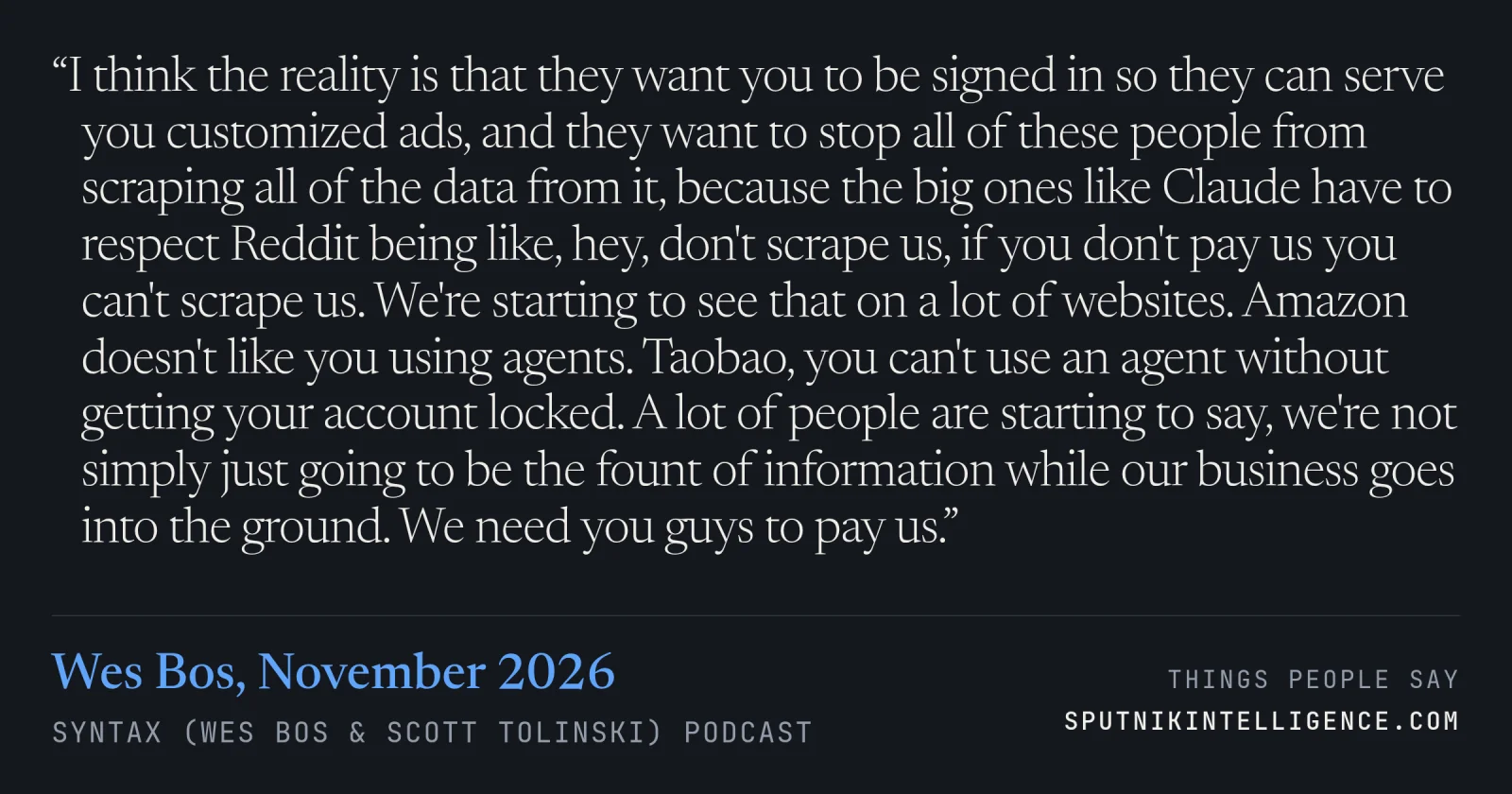
“I think the reality is that they want you to be signed in so they can serve you customized ads, and they want to stop all of these people from scraping all of the data from it, because the big ones like Claude have to respect Reddit being like, hey, don't scrape us, if you don't pay us you can't scrape us. We're starting to see that on a lot of websites. Amazon doesn't like you using agents. Taobao, you can't use an agent without getting your account locked. A lot of people are starting to say, we're not simply just going to be the fount of information while our business goes into the ground. We need you guys to pay us.” — Wes Bos, Syntax (Wes Bos & Scott Tolinski)

Introducing the news that Reddit is making everyone log in, Bos gives his reading of why: it is part of a wider move by websites to stop free scraping and make AI companies pay for content.

Syntax (Wes Bos & Scott Tolinski) · 2026-11-09 Permalink → Listen →
Syntax (Wes Bos & Scott Tolinski) Around 19:34 into the episode
Wes Bos

Now you know it's good.

Scott Tolinski

Yes. Cool. And you don't have to log in to use it, which was one of the things people are always grumping about. You don't got to log in to use this. You just use it. Yeah.

Wes Bos

All right. Let's talk about Reddit. You guys ready for Reddit? Let's do it. Reddit is closing its doors. So let me tell you what we mean by that. Reddit took, I don't know, a couple, about a year ago, Reddit took $60 million from Google to allow Google to use their data in their search summaries, right? You search something, you get the little summary that comes up. And as much as us like tech guys say, say we hate it, it's actually pretty good. It's pretty good. Like for a lot of quick little queries, it actually is pretty good. And a lot of that data of like what happens when you do X, Y, and Z, a lot of that comes from Reddit, right? So Reddit took that money. Then they don't see people actually click through to Reddit to read it anymore. So their traffic has like gone quite down. Their stock has dropped 29%. And I think in addition to that, Reddit is just getting absolutely hammered. Like every website with any valuable information, they're getting absolutely hammered by agents just scraping them for data so that when somebody queries how to do X, Y, and Z, they can use that as context in the result, right? And we're starting to see like cracks on that is if you search, if you ask Claude to like solve something, it will not find Reddit threads. And like at one point, I was just like doing a little bit of Googling myself and asking Claude some questions and it like clearly didn't know the answer. And…

Scott Tolinski

yeah well it would be i think that's totally fine honestly i'm never not logged into reddit i always have reddit login so for me not being logged in is not a problem i i don't have any any issues with that personally uh just because i've been a user of that site for like yeah a billion and a half…

Wes Bos

well daniel in the chat who works on a third-party reddit app i think he was the guy that initially informed us of the like react native loophole where if you sign in with a web view you can then close that web view and use that as a portal back and forth between that they they've been sending…

CJ Reynolds

yeah i i don't like it but i know it's needed um because i mean i'm a long time reddit user like i'm actually not logged into reddit in a lot of places uh just because like i don't want the cookie tracking and all of that and and i like search for something i find the results and then click into…

Speaker names come from our own diarization. The position is estimated from where the line sits in the episode.
“People underestimate the Teamsification of Enterprise: nobody wants to use Microsoft Teams, but more people use Microsoft Teams than Slack because it's just there.” — Wes Bos, Syntax (Wes Bos & Scott Tolinski)

The Syntax hosts were asking whether GitHub's Universe announcements would pull developers back to Copilot. Wes argues that bundling and existing enterprise contracts, more than quality, will decide which AI tools win inside big companies.

Syntax (Wes Bos & Scott Tolinski) · 2026-11-02 Permalink → Listen →
Syntax (Wes Bos & Scott Tolinski) Around 30:41 into the episode
Wes Bos

here, well, here's a question. Do you think this is going to, do you think these announcements of like, are going to pull people back to you? I mean, I think

CJ Reynolds

…already had enterprise plans. It's not like you drop that overnight. So I think it's like you're already locked into your plan. Yeah. So now you have all these other features. Like, why not use them instead of trying to adopt a whole new stack or get a different subscription somewhere else? I think

Wes Bos

people underestimate the Teamsification of Enterprise is that like nobody wants to use Microsoft Teams, but more people use Microsoft Teams than Slack because it's just there. And like we're, we're going to see it with like, I think Salesforce or something. I forget who it was, but one of these companies was just like, you can only use models through our Microsoft provider. You know, we're going to start seeing that. It's like, well, we, we pay for this plan and it includes like Google's doing this already as well. Like you pay for Google AI Ultra, you get YouTube premium with it. Yeah, yeah. And like cloud storage and photos and AI. Like you get it all. That's happening in enterprise as well. People are going to be like, well, we're already paying for. Yeah, we bought

Scott Tolinski

the meal. Now you have to eat it. Now we're just going

Wes Bos

to include it all. So I think people underestimate that the power of enterprise buy-in.

CJ Reynolds

Definitely. And they did say that if you're an enterprise, you can use all of the features that they announced today without a separate subscription. So that's definitely what they're doing. It

Speaker names come from our own diarization. The position is estimated from where the line sits in the episode.
“It's no longer enough to say, how do we use this tech to do what we have done previously? If you're looking at this and be like, this was my job, and now I'm going to do my job faster with this piece of stuff, it's not going to cut it, because anybody's going to be able to do that type of thing.” — Wes Bos, Syntax (Wes Bos & Scott Tolinski)

A listener without a computer science background asked how to stay employable as AI takes over coding. Wes Bos's advice was to apply the technology to new problems and industries, using AI-generated sewing patterns as his example.

Syntax (Wes Bos & Scott Tolinski) · 2026-10-28 Permalink → Listen →
Syntax (Wes Bos & Scott Tolinski) Around 08:34 into the episode
Wes Bos

…out 3D, checking them against, you know, it's quite a bit. So that's an interesting thing to talk about in terms of the compute is it's not just about, yeah, being able to run your own models locally, but it's about being able to like run your verification as fast as possible as well. Yeah,

Scott Tolinski

that's going to be crazy.

Wes Bos

Next question from not your traditional CS developer in this AI-fueled era for developers, what do you suggest people do to develop technical expertise to be better to embrace AI as a tool and become less expendable in this job market, especially for developers who do not have a traditional computer science background, no algorithm classes or theory classes taken? Yes. This is the question that we've probably had this question a hundred times over the last year or so. People are like, what, what do I focus on right now? Right. Like, do I, do I double down and learn a lot about like algorithms in GetAt? And the mathematicians might tell you no, because the AI is getting really good at that as well. So I think it's really important to understand that it's no longer enough to say, how do we use this tech to do what we have done previously? If you're looking at this and be like, this was my job. And now I'm going to do my job faster with this piece of stuff. It's not going to cut it because anybody's going to be able to do that type of thing. I think if you are looking at this…

Scott Tolinski

Yeah.

Wes Bos

Well worth your time, it totally blew up. Like something like five, six thousand people went and bought a photo frame and have been doing stuff like this. And it was really interesting to me to see how different people approach this type of thing. You know, like a lot, some people very quickly…

Scott Tolinski

some people? Yeah. Exactly.

Speaker names come from our own diarization. The position is estimated from where the line sits in the episode.
“A lot of these companies will approach you and say, hey, do you want early access? And we're like, yes, please. Free tokens and early access. I'm all over that. And people are afraid to soil that relationship by actually saying what it really is, because then they don't get access next time. Same thing happens with iPhone as well. There's all these iPhone reviewers that only say good stuff and kiss Apple's butt all day long because they're afraid of getting their access revoked.” — Wes Bos, Syntax (Wes Bos & Scott Tolinski)

Wes Bos on why early-access reviews of new AI models tend to be glowing, during a discussion of a new model the hosts had tried. He called it "a little bit of insider baseball."

Syntax (Wes Bos & Scott Tolinski) · 2026-10-19 Permalink → Listen →
Syntax (Wes Bos & Scott Tolinski) Around 50:34 into the episode
CJ Reynolds

…are all the places where it introduced bugs. So I think it's fine. It kind of felt like using Claude a year ago. I've seen people mentioning that it's like astra level. Like I do not have that experience, at least on the test that I tried it with. I don't see it either. I think it's just the domain

Scott Tolinski

too that I was using it in. But I think that a lot of people are

Wes Bos

afraid to get their early access revoked. Because what happens with a little bit of insider baseball is a lot of these companies will approach you and say, hey, can we give you, you want early access? And we're like, yes, please. Free tokens and early access. I'm all over that. And people are afraid to soil that relationship by actually saying like what it really is because then they don't get access next time. You know, same thing happens with iPhone as well, right? There's all these iPhone reviewers that only say good stuff and kiss Apple's butt all day long because they're afraid of getting their access revoked.

CJ Reynolds

Shout out to Rody Davis. He's the one that gave me access. Yeah, like I'm happy I got early access, but I'm going to be honest because like it was like if it was good, I would tell you it was good. I don't know if things have changed because we did technically have early access and like the point…

Scott Tolinski

Yeah, I tried it on a completely different thing. I tried it on a Godot game. One thing, I had the game kind of some bones for it already. So we had a strong kind of setup. The one thing I did really like about it is that I wanted to mess around with some actual pixel graphics for this thing…

Wes Bos

Scott said like one thing when we were talking about it. He says it's good enough. Like it thinks what it's building is good enough. And I think that's a really great way to put it because I was tasking it to recreate my invoicing software absolutely from scratch. And And what that was, is it had…

Speaker names come from our own diarization. The position is estimated from where the line sits in the episode.
“I would love to go through the last 12 months of our podcast of being like, yeah, I can write the code, but you still need to review it. Or yeah, you can get help with tab completions, but you still need to review. … The level of cope that we've had over the years. Do you think that after the year we have had that it's going to just stop where it is?” — Wes Bos, Syntax (Wes Bos & Scott Tolinski)

The hosts were discussing a conference talk in which a well-known framework author said he no longer reads or writes code himself. One co-host doubted the industry is ready to stop reading code, and this was the reply.

Syntax (Wes Bos & Scott Tolinski) · 2026-10-05 Permalink → Listen →
Syntax (Wes Bos & Scott Tolinski) Around 17:56 into the episode
Speaker 2

…it's, it's not like just one prompt, but you can certainly get there. And the need for abstractions and the need for actually reading the code and having it beautiful and look beautiful and all that stuff is is not as necessary anymore as as much as that is a bit of a gut punch to a lot of people.

Speaker 1

…produce and now they're easier to produce. So, you know, needing, needing the types of things that we used before, you know. Oh, what was this one thing about Ruby was that, you know, Ruby is the language of his dreams, but he's not writing code anymore. So why does it matter what the language is?

Speaker 2

And if you even just go, like, I would love to go through the last 12 months of our podcast of being like, yeah, I can write the code, but you still need to review it. Or yeah, you can, you can get help with tab completions, but you still need to review, you know, like, like the level of cope that we've had over the years. And you, do you think that after the year we have had that it's going to just stop where it is? Yeah.

Speaker 1

Yeah. And it's just done. Oh, yeah, yeah. As much as you

Speaker 2

hate it, also the answer to a lot of the stuff of the problems of AI, the answer is often just more AI. And, you know,

Speaker 3

yeah, I mean, that's why, like, I don't, I don't think it's cope. I just think that the like code, like AI can poop out code 100x, what a human can do, but that still means you need evals and you still like, I guess the process has changed for evaluation because maybe you're not doing it by hand.…

Speaker names come from our own diarization. The position is estimated from where the line sits in the episode.
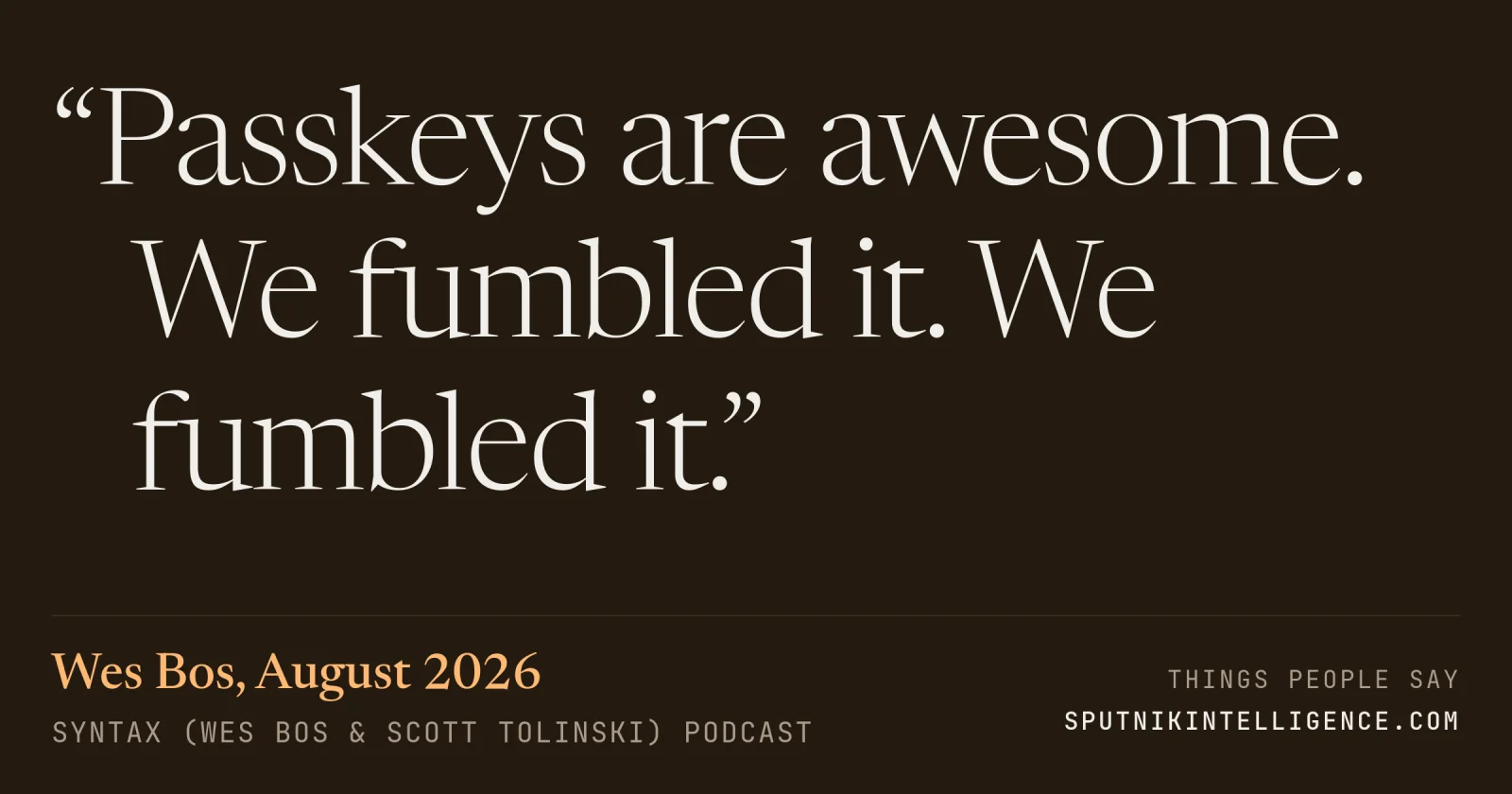
“Passkeys are awesome. We fumbled it. We fumbled it.” — Wes Bos, Syntax (Wes Bos & Scott Tolinski)

Bos is reacting to a TikTok comment section full of ordinary users complaining they hate passkeys and don't understand them. He argues the industry had a genuine chance to replace passwords and botched the rollout on usability.

Syntax (Wes Bos & Scott Tolinski) · 2026-08-19 Permalink → Listen →
Syntax (Wes Bos & Scott Tolinski) Around 21:05 into the episode
Wes Bos

…I just can't see them doing something like this. And there's just so much sense. You have your own data, you control it all, but like, and people aren't going to be able to manage their own data. People lose everything all the time. People can't even manage their own passwords. Even like I was.

Scott Tolinski

You should see my Google Drive and I'm a tech guy.

Wes Bos

…made a funny TikTok about like how I don't want to think about remember a single password. And all the comments were like, what the hell is a passkey? I hate passkeys. No chance. Passkeys never work. And it's just all normal people being like, passkeys suck. I hate passkeys. No, no, no, no. And it's like, I was so sad because like, that was our chance. That was our chance. Our final chance. Passkeys are awesome. We fumbled it. We fumbled it. And like now, regular people just don't understand what a passkey is and they hate it and it doesn't work very well. And it's too confusing to them. They just want to be able to log into their thing and they don't care about security. So I don't think that it's, it's exciting. It's interesting. And I love it from like a holistic techie point of view, but I just don't see something like this…

Scott Tolinski

Yeah. And also, you got to make it look good. I'm sorry. You got to make it look good. You got to make it be easy to use. You know, I think too oftentimes, like techie people, they have techie good ideas and then they just like don't focus on the usability of things, you know?

Wes Bos

Yeah.

Scott Tolinski

Okay. Tim Smith. If you only have a budget to subscribe to one. AI, which AI would you choose? Oh, oh, you know what, Tim? This is the worst possible question for me because I like to change my stuff all the time. I like to change. I'm like, oh, well, let me try this. Let me try that. Let me try…

Speaker names come from our own diarization. The position is estimated from where the line sits in the episode.

Collections They Appear In