 Wes Bos
Teaches web development through free and paid video courses, including JavaScript30, React for Beginners, and Learn Node, which together have sold tens of thous...
Wes Bos
Teaches web development through free and paid video courses, including JavaScript30, React for Beginners, and Learn Node, which together have sold tens of thous...
“I would love to go through the last 12 months of our podcast of being like, yeah, I can write the code, but you still need to review it. Or yeah, you can get help with tab completions, but you still need to review. … The level of cope that we've had over the years. Do you think that after the year we have had that it's going to just stop where it is?”
Syntax (Wes Bos & Scott Tolinski) · Hands-On Engineering Podcasts · October 2026
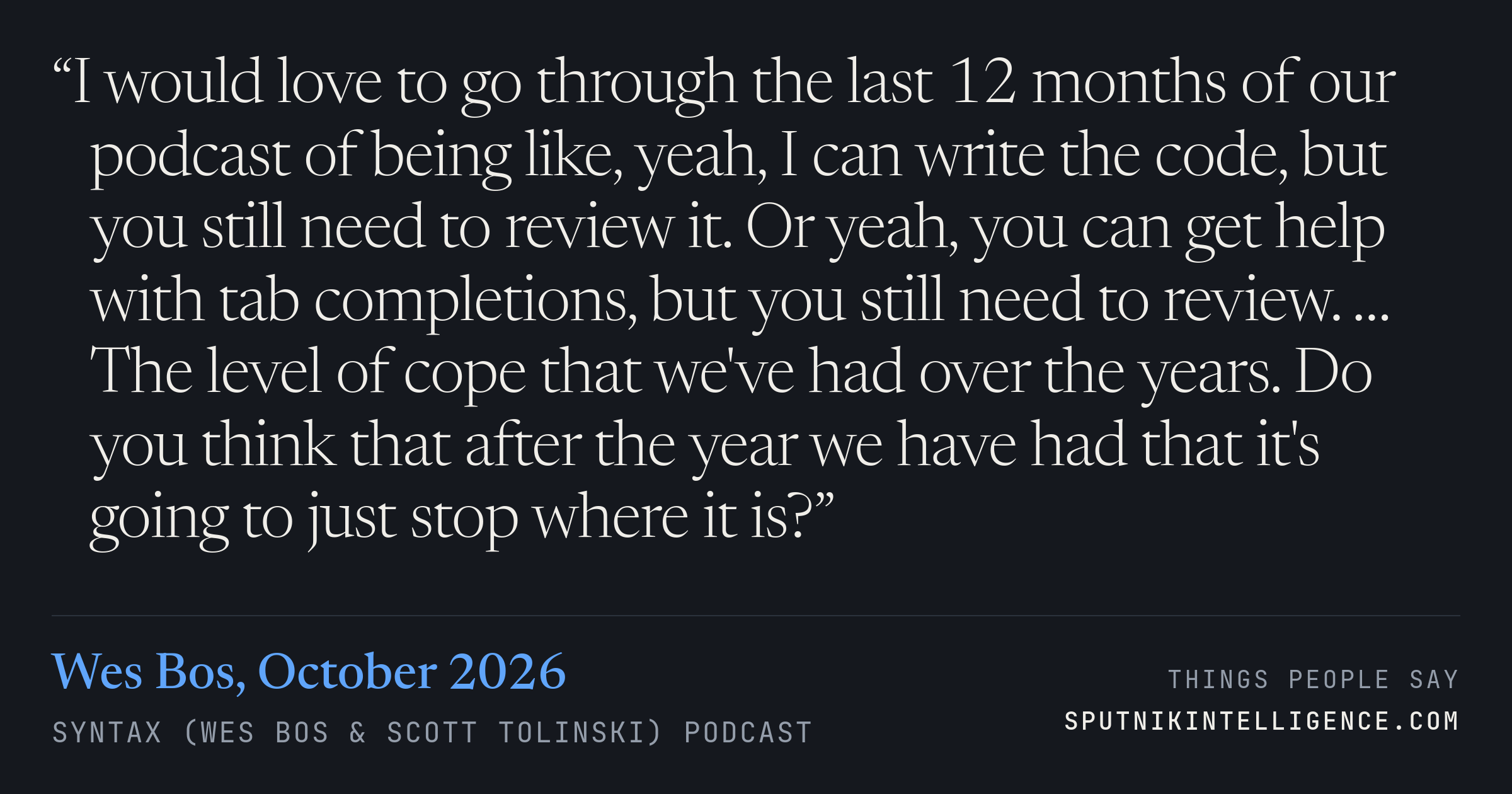
The hosts were discussing a conference talk in which a well-known framework author said he no longer reads or writes code himself. One co-host doubted the industry is ready to stop reading code, and this was the reply.
Transcript
Yeah. Or like, like you are the person that should be making sure that those evals are good and are satisfactory to what it he's not saying that like we're done building software. He's saying that the abstraction that we needed, a la Rails, is no longer necessary. We say this, see the same thing with Shopify going off of React Native because they're saying it's, it's much easier to write a website and a native app that work exactly and look exactly the same these days. It's not, it's, it's not like just one prompt, but you can certainly get there. And the need for abstractions and the need for actually reading the code and having it beautiful and look beautiful and all that stuff is is not as necessary anymore as as much as that is a bit of a gut punch to a lot of people.
Yeah, totally. I mean, he even brought up directly, Wes, that the Shopify thing saying like, you know, native apps used to be a lot harder to produce and now they're easier to produce. So, you know, needing, needing the types of things that we used before, you know. Oh, what was this one thing about Ruby was that, you know, Ruby is the language of his dreams, but he's not writing code anymore. So why does it matter what the language is?
And if you even just go, like, I would love to go through the last 12 months of our podcast of being like, yeah, I can write the code, but you still need to review it. Or yeah, you can, you can get help with tab completions, but you still need to review, you know, like, like the level of cope that we've had over the years. And you, do you think that after the year we have had that it's going to just stop where it is? Yeah.
Yeah. And it's just done. Oh, yeah, yeah. As much as you
hate it, also the answer to a lot of the stuff of the problems of AI, the answer is often just more AI. And, you know,
yeah, I mean, that's why, like, I don't, I don't think it's cope. I just think that the like code, like AI can poop out code 100x, what a human can do, but that still means you need evals and you still like, I guess the process has changed for evaluation because maybe you're not doing it by hand. Maybe you're having an agent do it. But it also comes down to like, can you trust that agent? And I mean, we're not at the point with zero hallucinations. Like agents still hallucinate. Agents still get things wrong. So yeah, I don't feel like it's cope. I just feel like we're just the answer to AI, we're saying is more and more AI, but I don't think it's inevitable. I think that's just the direction that the industry is headed because everybody's put their eggs in the AI basket. So yeah. I do want to read this comment from Stony who says, he has valid points and I get where he's coming. From, but it does show as a big F you to the community has built up over the years. And I think that's just a general sentiment about like what AI is doing in general to development. Because if you think about like the world of open source, like it's very hard for people to make money or even have the energy to work on open source projects anymore. Same thing, like you built up this community around a language to build apps and you have conferences and meetups and people that are craftsmen and care about building with this. But if you're all of a sudden saying that the framework doesn't matter anymore, now you just have meetups talking about how we prompt AI. Like there's no, there's no community to there's nothing for people to rally again around like a framework or a library or like a community of sorts. And that's happening in multiple places. So that's something else to be cognizant of. Like, do we want a world where there is no community? It's only AI. I don't. I mean, that's one of the reasons I enjoy this job and this thing is like the community, the people, the people watching this, the people listening right now. So yeah,
More from Syntax (Wes Bos & Scott Tolinski)