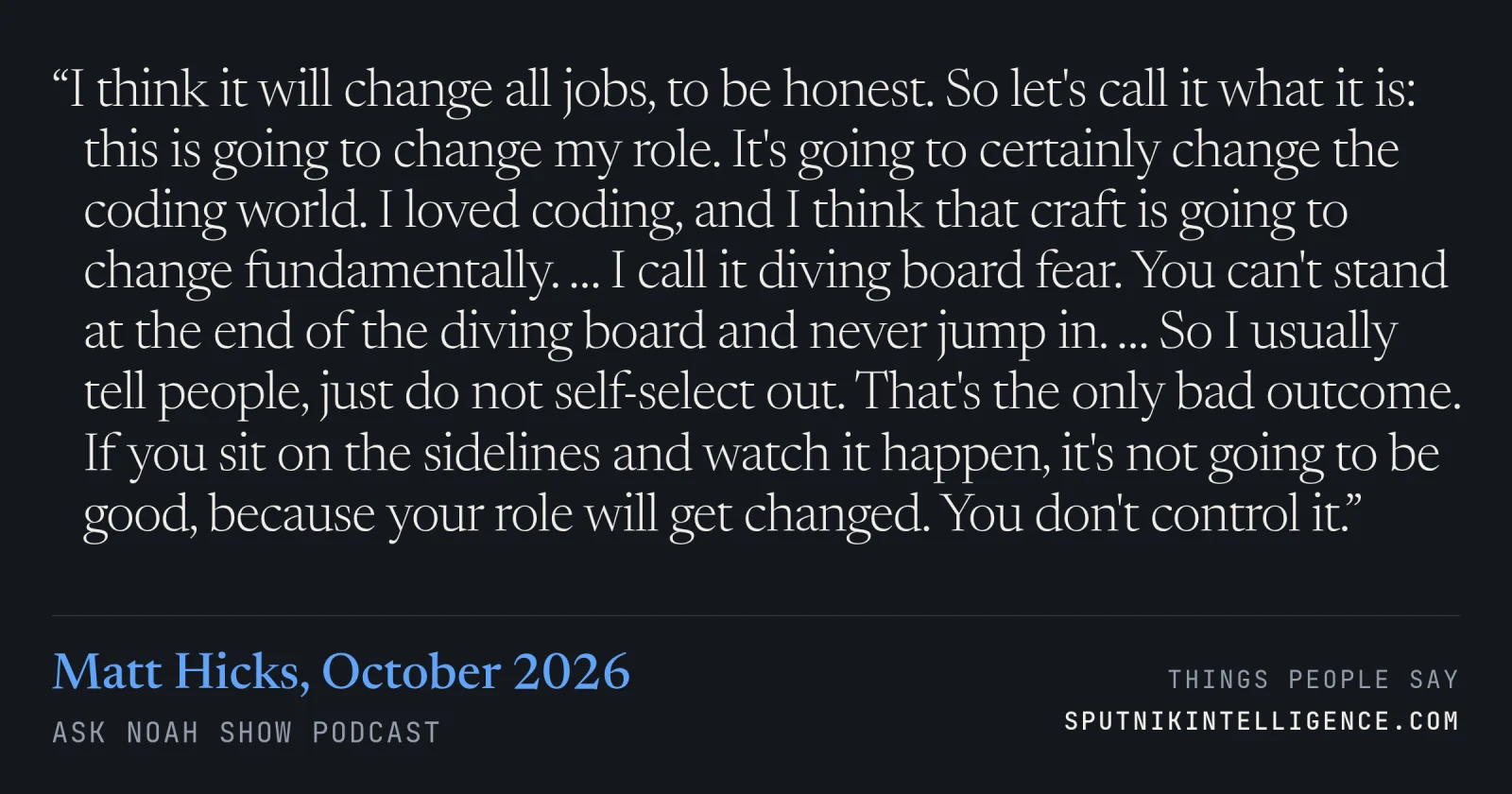
Asked what he tells non-technical people who fear AI will replace jobs, Hicks says he expects every job to change, including his own as CEO, and urges people to engage rather than watch.
…things that I can't easily program. And framed like that, I'm like, it's not magical. It doesn't replace all of humanity. It's just a really powerful tool for solving more open-ended problems. I don't think I'd be this deep in AI if I hadn't started with my Fedora-based machine learning doorbell.
…like the normies, if I can use that term, that are walking around that you run in and they find out that you're the CEO of a software company that is focused on AI? What do you tell them to alleviate their concern of the threat of AI, replacing people, replacing jobs, those sorts of things?
Yeah, I do. I think it will change all jobs on it, to be honest. So it's like, hey, let's call it what it is. This is going to change my role. It's going to certainly change the coding world. Like, I loved coding. I think that craft is going to change fundamentally. But an engineering mindset, if that's what you're driven by and doing, still applicable. For the people that say, but this is a techie thing and I'm not techie, I call it diving board fear. I'm like, you can't stand at the end of the diving board and never jump in. You'll be fine. In fact, that business curiosity I find is more powerful with AI a lot of times than engineers who still just want to code. I'm like, no, you have to get to an engineering mindset to shape new problems. And on the business side, it's like, this is going to be your best tool and coach. Engineers will know what it's doing better. They'll understand the code that it's writing. The business users will have to get closer to that. But it is a foot race. And I couldn't tell you, you know, I talked about how we've had contributions from every group in the company. I couldn't tell you the most impactful group at this point. Evaluations, absolutely. Engineering has been leading in that space. But just shaping a deep research agent wouldn't have happened without non-technical users making that…
So one of the
things that I think is really interesting is getting contributions from everywhere. And there's a difference between getting a code contribution from someone that doesn't understand more or less what the code is actually doing versus a contribution. Like I've been working to educate my wife on what…
that same balance has played out internally. So one, if we rolled out clawed code to everyone and said, like, send us your code, it would be very hard to just take non-technical contributions on a very complicated system. But they still would have contributed. And so part of the engineering…