Joe Weisenthal

Things Joe Says on Podcasts

Markets journalist and Executive Editor of News for Bloomberg's digital brands, covering finance, macro and the mechanics of the economy. He previously led financial blogging at Business Insider. Co-hosts the Odd Lots podcast with Tracy Alloway and co-anchors What'd You Miss? on Bloomberg Television.

Where to Find Them

Joe Weisenthal hosts Odd Lots , hosts Big Take , hosts and writes a16z Podcast , hosts Zero: The Climate Race , hosts Notes on the Crises , hosts Trillions and writes Why Is This Happening? The Chris Hayes Podcast . They have also been a guest on TBPN (13 times) , Bloomberg Surveillance (7 times) , Bloomberg Intelligence (3 times) , Bloomberg Crypto (2 times) , Plain English with Derek Thompson (2 times) , Everybody's Business (2 times) , Here's Why (2 times) , Recode Media (2 times) , ChinaTalk , Bloomberg Daybreak: US Edition , The Vergecast , Uncanny Valley | WIRED , The Ezra Klein Show , Money Stuff: The Podcast , The Compound and Friends , TFTC: A Bitcoin Podcast , Slate Money , Mixed Signals from Semafor Media , FreightCasts , The Peter McCormack Show , Big Technology and Unchained .

Recently: “What Nvidia's Megaspeed Scandal Is Really All About” on Odd Lots (November 2026); “The Perfect Storm That Clobbered Hedge Funds” on Odd Lots (November 2026); “This Is How New York City Takes Out Its Trash” on Odd Lots (November 2026); “The Macro Implications of the Blue Tsunami” on Odd Lots (November 2026); “An Election Day Special With Nate Silver” on Odd Lots (November 2026); “Anthropic Q3 Revenue, Europe’s Freezer Hack Scare, Northwood Raises $375M | Diet TBPN” on TBPN (November 2026).

What They Said

“This is a remote access. What does that even mean? It's a cloud. Of course it's remote access. … It's always been very baffling to me that we have these intense conversations about, oh, you can't sell into China. But actually, it's really not that big of a deal, and it's not illegal currently to sell into anywhere else who then rents that capacity to Chinese firms.” — Joe Weisenthal, Odd Lots

After the guest left, the hosts reflected on the fact that Chinese firms can legally rent Nvidia chips in Southeast Asia that they cannot buy directly. Weisenthal finds the line between selling chips and renting access hard to defend.

Odd Lots · 2026-11-12 Permalink → Listen →
Odd Lots Around 45:42 into the episode
Joe Weisenthal

She's so great. Like, man, what a comp. These are such complicated stories. They really are. They're really complicated. There's so many different dimensions to them. Also, there's a lot of

Tracy Alloway

…more public knowledge, as politicians become aware of it, that that legal loophole of Chinese companies being able to rent GPUs via Southeast Asia, even if they can't actually buy certain chips, like that comes under scrutiny. And you can imagine if that, like, it's such a weird one. It's so

Joe Weisenthal

weird. This is a remote access. What does that even mean? It's a cloud. Of course it's remote access. It's like, oh, as opposed to like the tenant of the user of the chips walking into the data instead of themselves and plugging in a laptop. It's all remote access. So it's a, it's always been very baffling to me that we have these intense conversations about, oh, you can't sell into China. But actually, it's really not that big of a deal to sell into, and it's not illegal currently to sell into anywhere else who then rents that capacity to Chinese firms. Like, what? I don't know. I do like, who couldn't explain this adjustment?

Tracy Alloway

Yeah. The other thing that I thought was really interesting and I wasn't aware of was Mackenzie Hawkins that there's basically like a handful of U.S. customs officers in Southeast Asia. And you can imagine like, if you're going to ramp up export controls and expect them to be effective, you're…

Joe Weisenthal

You know, I really think actually, and I hadn't appreciated this until McKenzie brought up Huawei's sale to Egypt. That is like, I forget, you know, what is it? We did the story with Eva Doe, who wrote the book, House of Huawei. And what was the story there? The story there was this is a company…

Tracy Alloway

Well, the other thing I just want to reiterate is like, again, with NVIDIA itself, there's a weird like contradiction here where if chip demand is as strong as they describe, they should be very selective with their customers, right? Like, there shouldn't be any question marks over anyone…

Speaker names come from our own diarization. The position is estimated from where the line sits in the episode.
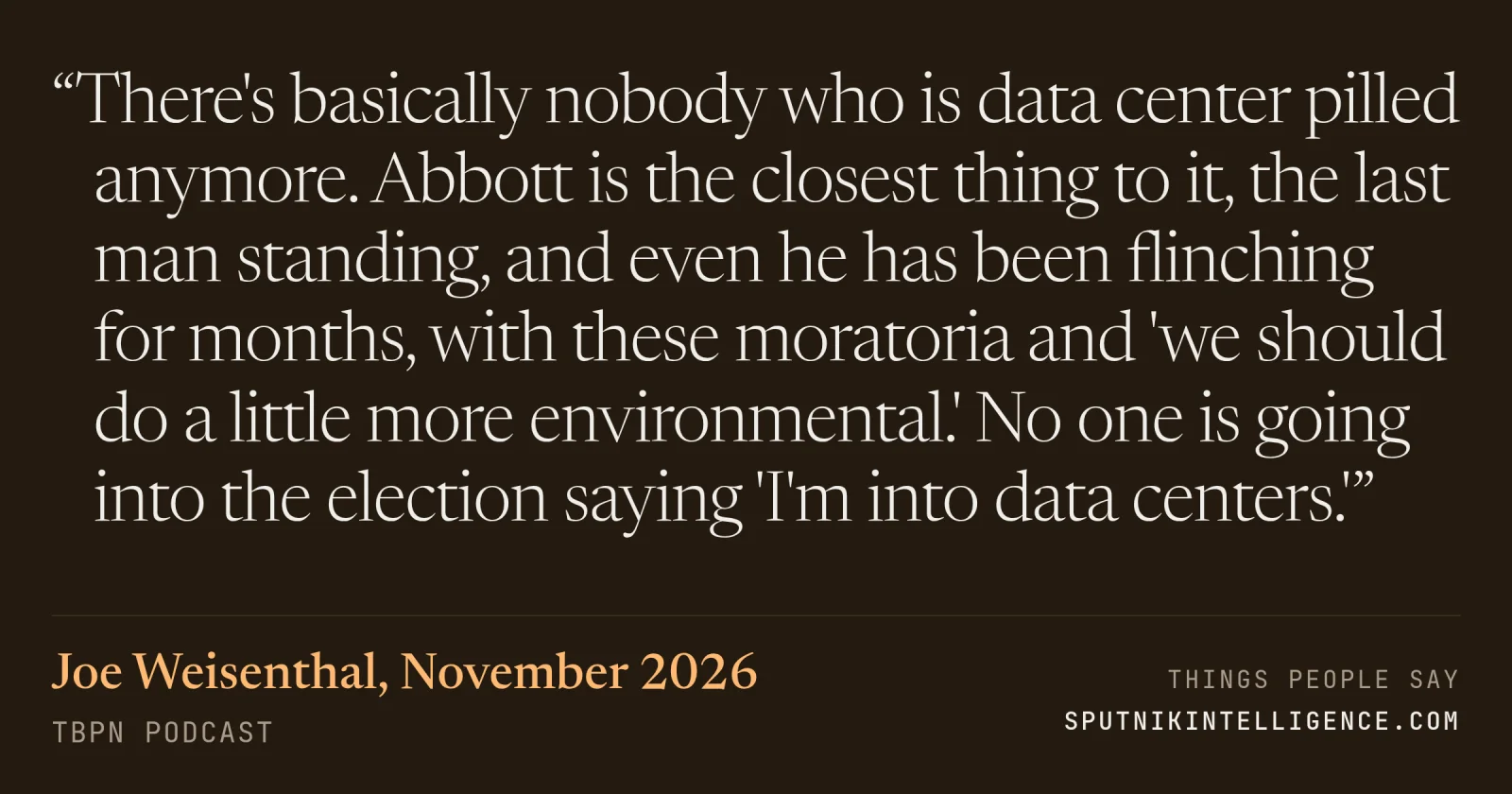
“There's basically nobody who is data center pilled anymore. Abbott is the closest thing to it, the last man standing, and even he has been flinching for months, with these moratoria and 'we should do a little more environmental.' No one is going into the election saying 'I'm into data centers.'” — Joe Weisenthal, TBPN

Asked about the midterms, Weisenthal says the AI-relevant race to watch is the Texas governor's, and that data centers have become politically toxic for candidates of every stripe.

TBPN · 2026-11-03 Permalink → Listen →
TBPN Around 03:09 into the episode
Joe Weisenthal

AI world, you guys should just be paying attention to the Texas governors. Explain what's

John Coogan

going on. So I got it.

Joe Weisenthal

There's basically nobody who is data center pilled anymore, right? But Abbott is the closest thing to do. The last man standing. Yeah, basically. And even he isn't. Is he flinching a little bit? Yeah, he's been flinching for months. So it's like he's like, weird, like, moratoria that are like, oh, we should do a little more environmental. Yeah, you can't. It

Jordi Hays

wouldn't make sense for him to go into the election and super protein. Like, I was talking with a city council candidate who got endorsed by this crazy group in White Town, right? And we're like, that's a little suspicious. Like, right? Yeah. And he's like, we're just, you know, like, you know, I'm…

Joe Weisenthal

no one is going into the election saying I'm into data centers. Okay, okay. But some people might actually believe in things like progress and development and technology and stuff like that. You know, obviously so much of the tech world, so much of the manufacturing world, et cetera, sort of sees…

John Coogan

Yeah, yeah. I thought they built a crystal mall.

Speaker names come from our own diarization. The position is estimated from where the line sits in the episode.
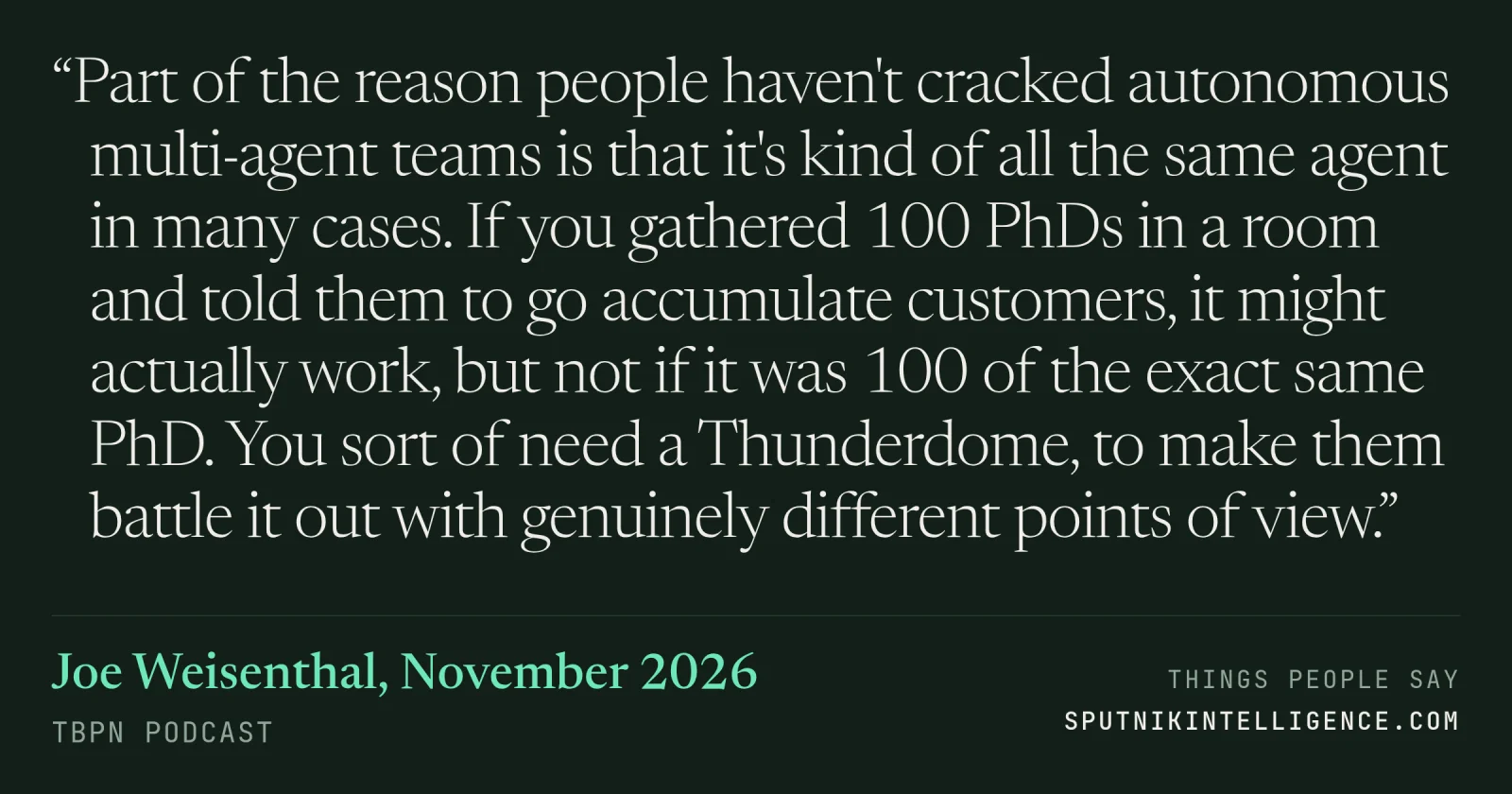
“Part of the reason people haven't cracked autonomous multi-agent teams is that it's kind of all the same agent in many cases. If you gathered 100 PhDs in a room and told them to go accumulate customers, it might actually work, but not if it was 100 of the exact same PhD. You sort of need a Thunderdome, to make them battle it out with genuinely different points of view.” — Joe Weisenthal, TBPN

TBPN's Jordi Hays had said today's agents lack real agency. Joe Weisenthal adds a second problem: multi-agent systems fail because the agents are clones of each other.

TBPN · 2026-11-03 Permalink → Listen →
TBPN Around 18:39 into the episode
Joe Weisenthal

I've played around. And that's

Jordi Hays

…Get me as many customers as you can. And I do feel like what's missing is still true agency, right? And so agents are like almost like the agents that we have today are like really all like sub-agents in some ways. Yeah, that's right. They'll only do things that they're told to do. And so... Well,

Joe Weisenthal

they're also clones of each other. Like this is like another issue, which is like you think like, oh, if you gathered 100 PhDs in a room and told them to go accumulate customer, do whatever, it might actually work. But if it was 100 of the exact same PhDs who had all done the exact, Alex Emos, who's over at Google Deep Mystica, yeah, he's a cool guy. He's talked about this. Like part of the reason this hasn't really, like people haven't really cracked like sort of like autonomous multi-agent teams is that it's actually kind of all the same agent in many cases. You sort of need to get a thunderdome, like battle, make them battle out with like, get them like genuinely different points of view. I don't know if anyone's like cracked the right orchestration for that. I

John Coogan

mean people used to just like turn up the temperature on these. Do you remember this thing? I forgot about

Joe Weisenthal

temperature. Some of these things still feel like going back and

John Coogan

forth for just getting a weirdness up and get it to let's get some more hallucinations. Yeah, I mean people were saying like hallucinations are sometimes like a feature more than a bunch of people. You don't always want to hammer it out because you want some creativity. The other big news, there's…

Speaker names come from our own diarization. The position is estimated from where the line sits in the episode.
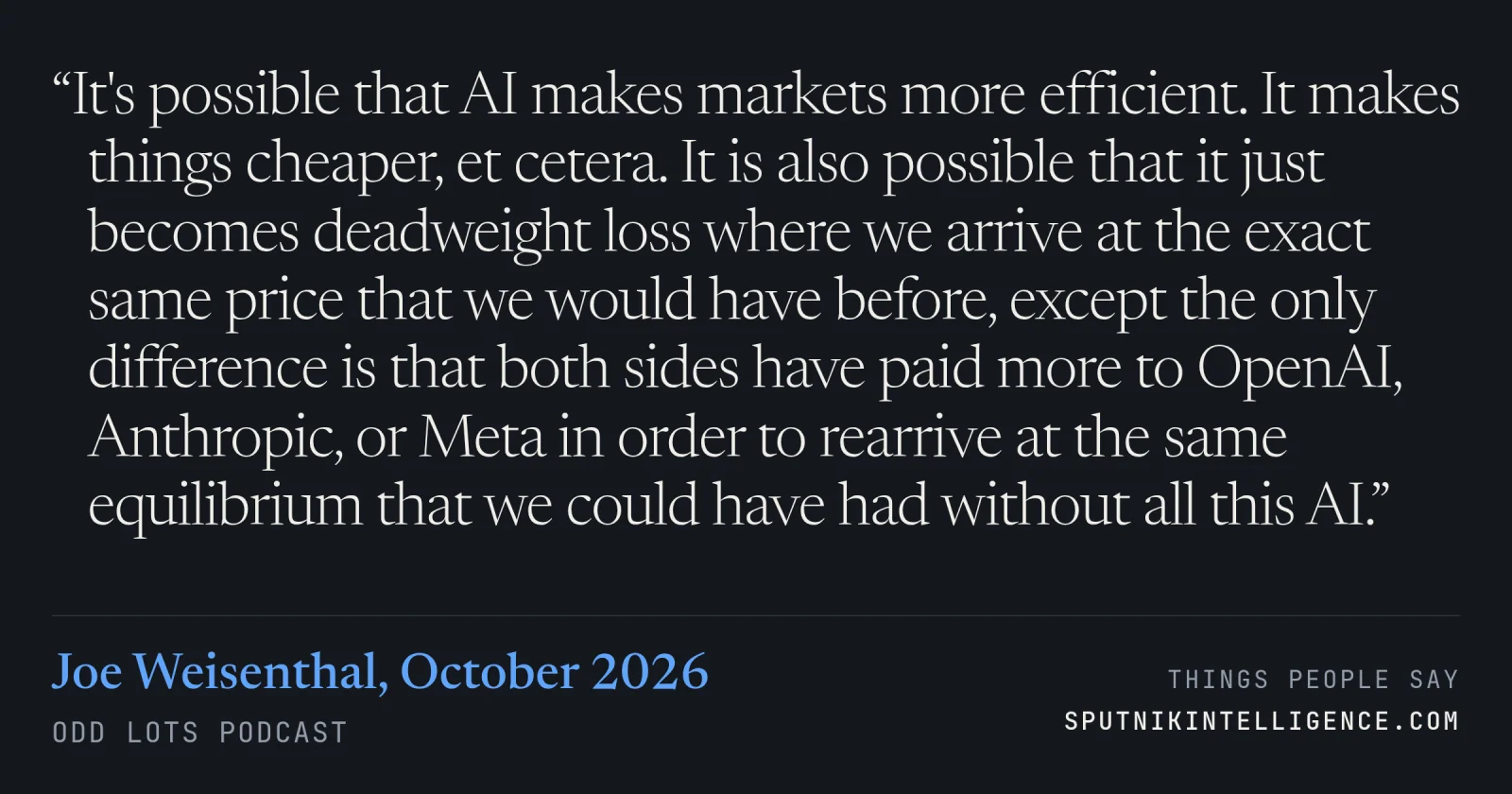
“It's possible that AI makes markets more efficient. It makes things cheaper, et cetera. It is also possible that it just becomes deadweight loss where we arrive at the exact same price that we would have before, except the only difference is that both sides have paid more to OpenAI, Anthropic, or Meta in order to rearrive at the same equilibrium that we could have had without all this AI.” — Joe Weisenthal, Odd Lots

Lindsay Owens argued that AI could help shoppers catch up with retailers' pricing algorithms. Weisenthal worries it becomes an arms race instead: your agent against their pricing model, each side upgrading to beat the other. He makes the same point about cybersecurity.

Odd Lots · 2026-10-26 Permalink → Listen →
Odd Lots Around 43:48 into the episode
Tracy Alloway

having me. This is great.

Lindsay Owens

…touch of your fingertips, versus if you're someone, you know, working a nine to five or whatever who's just trying to buy, I don't know, a car or a computer, you don't have that much time or that much technological prowess to actually devote to it. AI could, in theory, solve some of that for sure.

Joe Weisenthal

Yeah, except. But no, like I'm hopeful that AI could solve some of these imbalances. But what I worry about, and not just with pricing, but with the range of fields, cybersecurity, very much in the news today. We're recording this October 22nd. The dynamic that I'm worried about is that it's just going to be arms races. Right. So you're going to have an agent and maybe it truly does work on your behalf, et cetera. And then someone else is going to have an AI pricing model that tries to figure out more about you and overcome that. And then you have to upgrade to the next version of the model to overcome that. And that in many respects, it's possible that AI makes markets more efficient. It makes things cheaper, et cetera. It is also possible that it just becomes deadweight loss where we arrive at the exact same price that we would have before, except the only difference is that both sides. Have paid more to OpenAI, Anthropic, or Meta in order to rearrive at the same equilibrium that we could have had without all this AI.

Lindsay Owens

This is my busy work theory of AI where everyone's just going to have agents that like file lawsuits at any time. And we get to the same place. Someone makes a lot of money

Joe Weisenthal

selling tokens to us.

Lindsay Owens

Also, I thought the history behind like the single public price tag is really interesting because if you think about it, to some extent, with Agentic AI and all these new pricing strategies coming out of companies, we're kind of going back to that customized era of haggling where like you have to…

Speaker names come from our own diarization. The position is estimated from where the line sits in the episode.

Collections They Appear In