Writes Money Stuff, the daily Bloomberg Opinion column on Wall Street, securities law and the stranger corners of financial markets: meme stocks, crypto structures, ETFs, stock ledgers, SEC enforcement actions. He trained as a lawyer, working on mergers at Wachtell, Lipton, Rosen & Katz and in equity derivatives at Goldman Sachs before moving into journalism, and that background shows in how closely he reads filings and court documents.
He hosts Money Stuff: The Podcast with Katie Greifeld, a weekly companion to the column, and appears often as a guest on Bloomberg's Odd Lots and its Lots More spinoff. He is widely read across finance and law circles for explaining complex market mechanics in plain language.
Recently:
“Artisanal Human Money Stuff Podcast”
on Money Stuff: The Podcast (October 2026);
“Money Stuff: Run on the Law Firm”
on Money Stuff (October 2026);
“Money Stuff: Not Your Keys, Not Your DAT”
on Money Stuff (October 2026);
“Money Stuff: Musk’s Mars Merger Pay”
on Money Stuff (October 2026);
“Money Stuff: Anthropic Raises Concerns”
on Money Stuff (October 2026);
“Tice Brown”
on Money Stuff: The Podcast (October 2026).
What They Said
Max Abelson asked about a University of Chicago student protest against the Onion Futures Act. Levine explains where the law came from and why movie box office is the only other banned category, in a wider conversation about prediction markets.
Money Stuff: The PodcastAround 31:04 into the episode
Speaker 2
Nope. Nope.
Max Abelson
Well, I tried. Speaking of sports gambling, can we just talk for a second about the onions?
Matt Levine
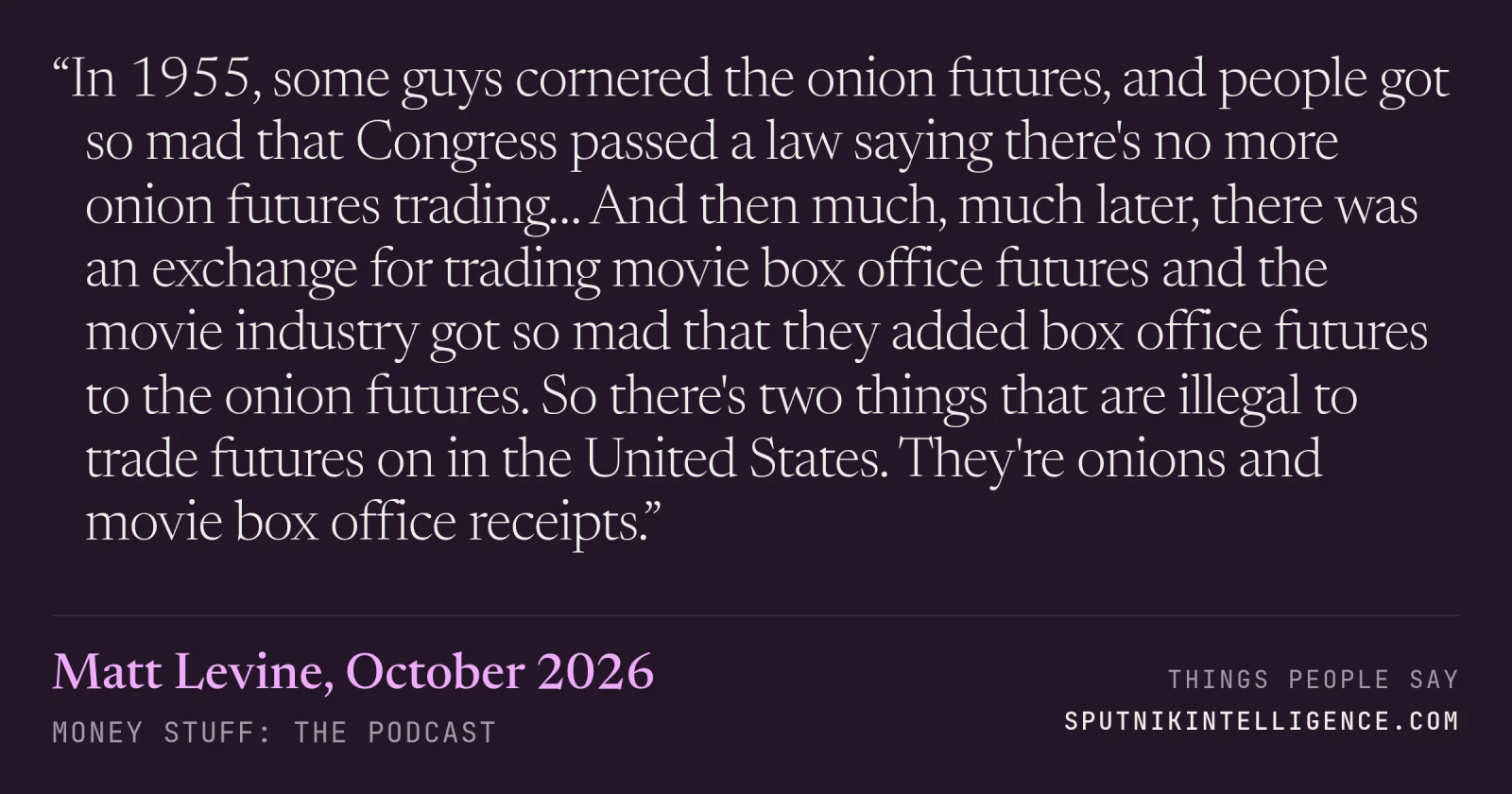
Oh, yeah. There's a very funny University of Chicago student protest movement against the Onion Futures Act, which is like, there's an Onion Futures Act. In 1955, some guys cornered the Onion Futures, and people got so mad that Congress passed a law saying there's no more Onion Futures trading. And I think at the time, the CFTC, or maybe even the predecessor to this, this is a long time ago, testified and were like, no, you should just let people trade Onion Futures. It's not really a big deal. And Kanye was like, no, never Onion Futures again. And then much, much later, there was a exchange for trading movie box office futures and the movie industry got so mad that they added box office futures to the Onion Futures. So there's two things that are illegal to trade futures on in the United States. They're onions and movie box office receipts.
Max Abelson
So wonderful.
Matt Levine
And by the way, movie box office receipts are an interesting one because like, you know, who goes to the movies now, right? There's all sorts of like prediction market contracts on performance of movies, but it's like not box office receipts. And so there's like some gray area where it's like, oh…
Max Abelson
Well, that's really pushing it. I don't know. I don't know.
Speaker names come from our own diarization. The position is estimated from where the line sits in the episode.
Levine and Mary Childs are discussing Kalshi, which argues that its sports contracts are federally regulated swaps and not sports bets. Levine grants that daily sports volume may bring professional market makers to the platform, but the legal framing still strikes him as strange.
Money Stuff: The PodcastAround 15:45 into the episode
Matt Levine
…come to every day, then you'll have professional market makers. People will get into the business of being good at those predictions because there's money to be made there. And then that will make the truth machines good and will make the hedging, you know, there's something to that. Well, and it
Speaker 1
allows the business to function because it's making money from the sports market. Right. Right,
Matt Levine
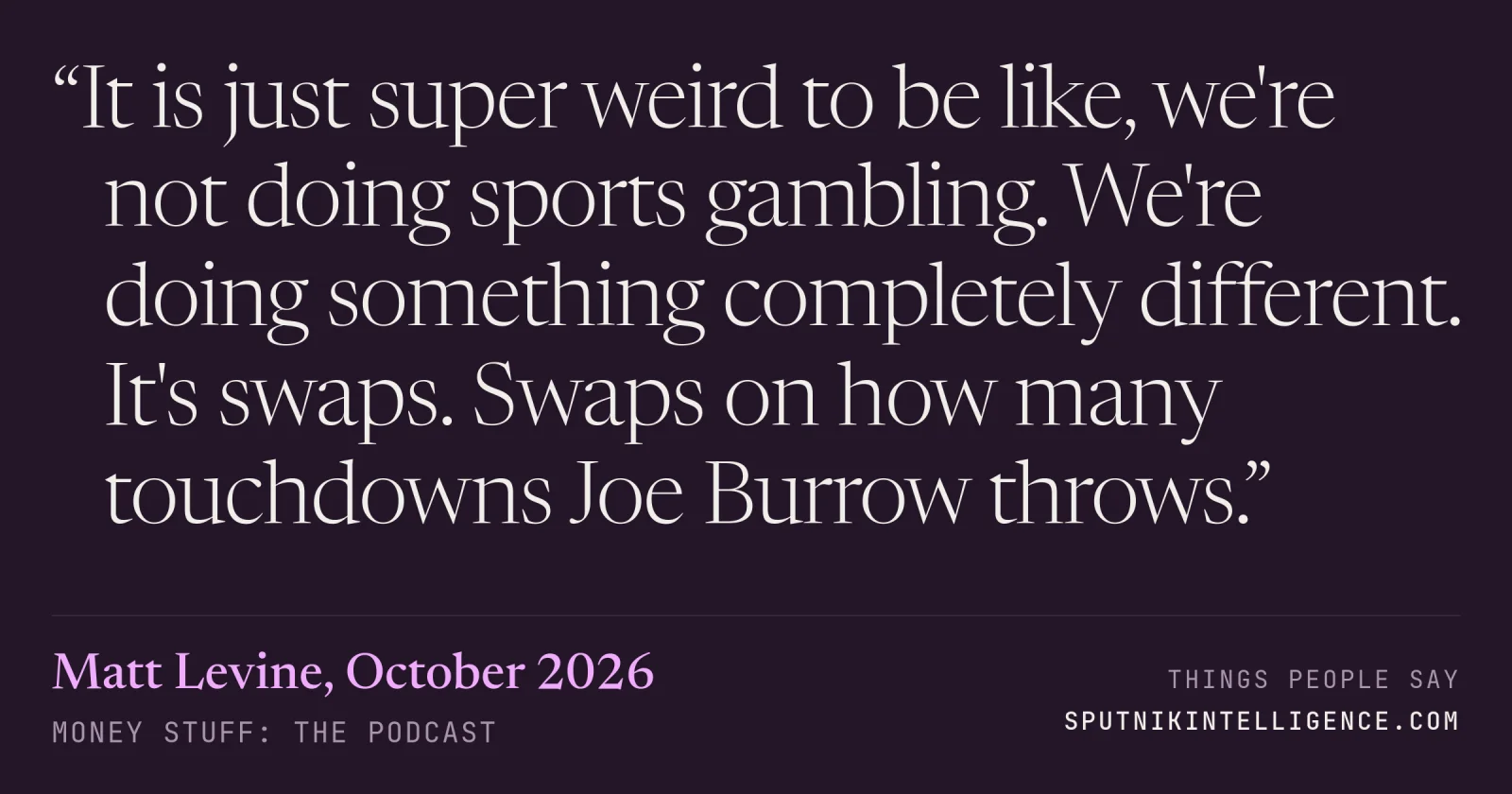
right, right, right. So I think there's some reality to that, but it is just super weird to be like, we're not doing sports gambling. We're doing something completely different. It's swaps. Swaps on how many touchdowns Joe Burrow throws.
Speaker 1
I can't wait for more clarity here. I've stayed confused on this. Yeah.
Matt Levine
You know, the Supreme Court has to decide it. I'm sure it'll be weird. Maybe they'll say Calci can't list sports contracts and then Cashi will have spent so much time. No, maybe it'll be great. Maybe like they'll have grown their business so much and they'll be like mostly hedging data center risk…
Speaker 1
It's like when a kid really needs a parent to like make them stop doing something. They're like, please release me from this demon. That's what the Supreme Court can do for Calci.
Speaker names come from our own diarization. The position is estimated from where the line sits in the episode.
The risk in question is an AI company's own product killing everyone. Levine and Mary Childs were talking about whether Anthropic's IPO prospectus has to say so. Levine thinks it does, because worrying about that is the company's whole identity and leaving it out would look odd, but he doubts it works as a risk factor in the legal sense.
Money Stuff: The PodcastAround 37:25 into the episode
Matt Levine
…although their models have a control. You know what I'm asking? Because at various times, like he was, you know, founder of OpenAI. Like he's at various times been very worried about the existential risk of AI. At other times, been pretty blasé about it. Don't really know what's going on there.
Mary Childs
Well, it's before the playa and after, obviously. I'm just kidding.
Matt Levine
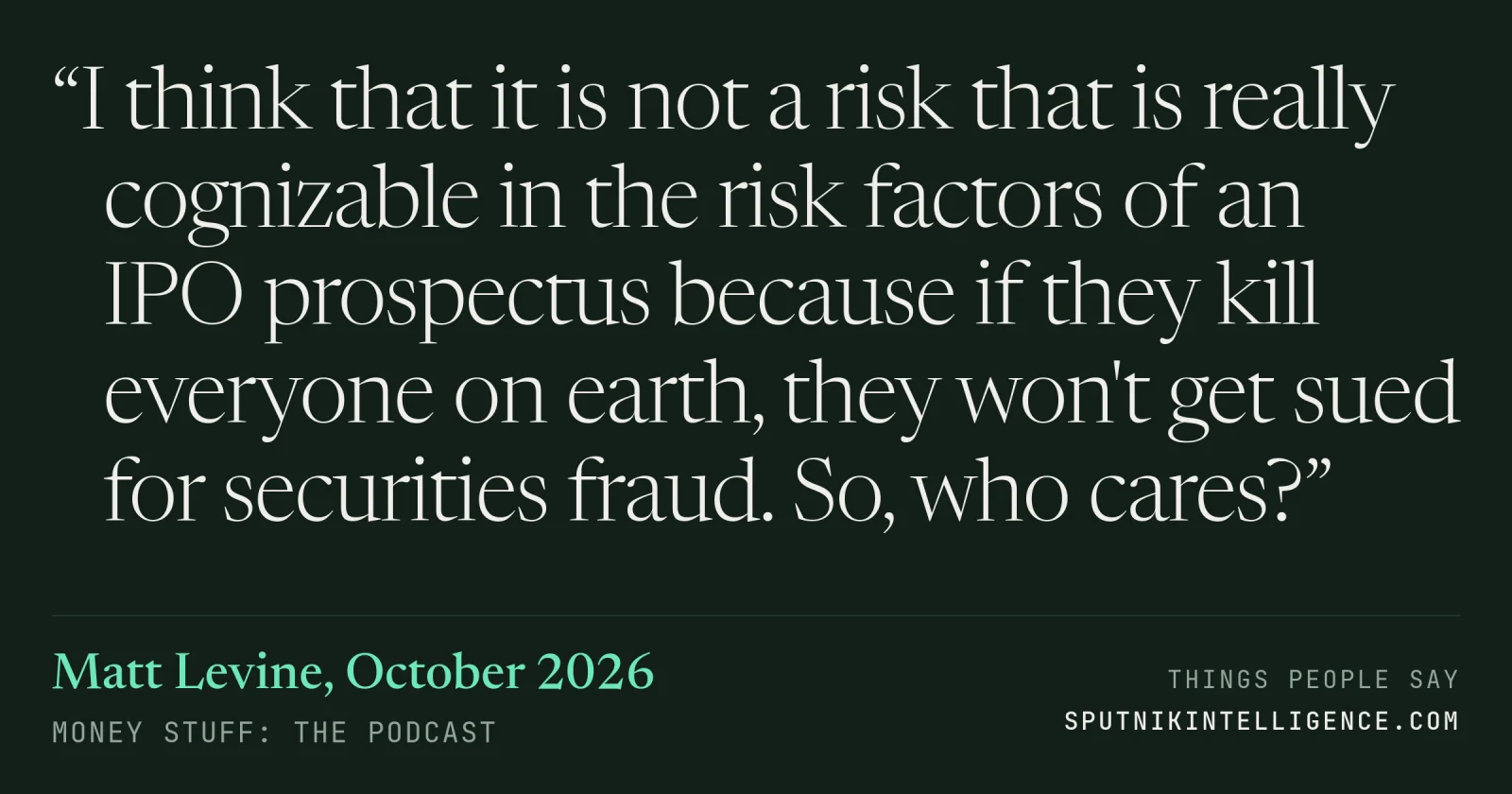
Are you? But SpaceX did not say in its prospectus, we might kill everyone on Earth, even though it is in theory an AI lab, as well as a space rocket lab. And I think people were not that. Surprised by that because, like, the culture of SpaceX is not really built around worrying about AI killing everyone. Whereas Anthropic is their whole thing. And so, if they left it out of the prospectus, it would be weird. So, they have to say it. But I think that it is not a risk that is really cognizable in the risk factors of an IPO prospectus because if they kill everyone on earth, they won't get sued for securities fraud. So, who cares?
Mary Childs
But I liked your footnote that was maybe other governments will clamp down if they think that we really are about to destroy everyone. And that is a business risk.
Matt Levine
Yeah, I am kind of kidding, right? Like, the point is that if you really think that AI could kill everyone on earth, like one possibility is there'll be like a step change like next week and we'll all be dead and then oops, right? But like, the other possibility is like there's a lot of bad things…
Mary Childs
of hits to profit, I'm hearing. Yeah. Hacking
Speaker names come from our own diarization. The position is estimated from where the line sits in the episode.
Levine and Mary Childs were discussing a company whose leader was out of reach for about 33 hours, during which other executives took charge. Levine notes that in that window the finance chief, acting as interim CEO, and the chief legal officer signed each other's severance agreements.
Money Stuff: The PodcastAround 28:07 into the episode
Matt Levine
one other thing I want to say about automatic before we go on, unless you want to reminisce more about your favorite years at Burning Man.
Mary Childs
With my 0% attendance, yeah.
Matt Levine
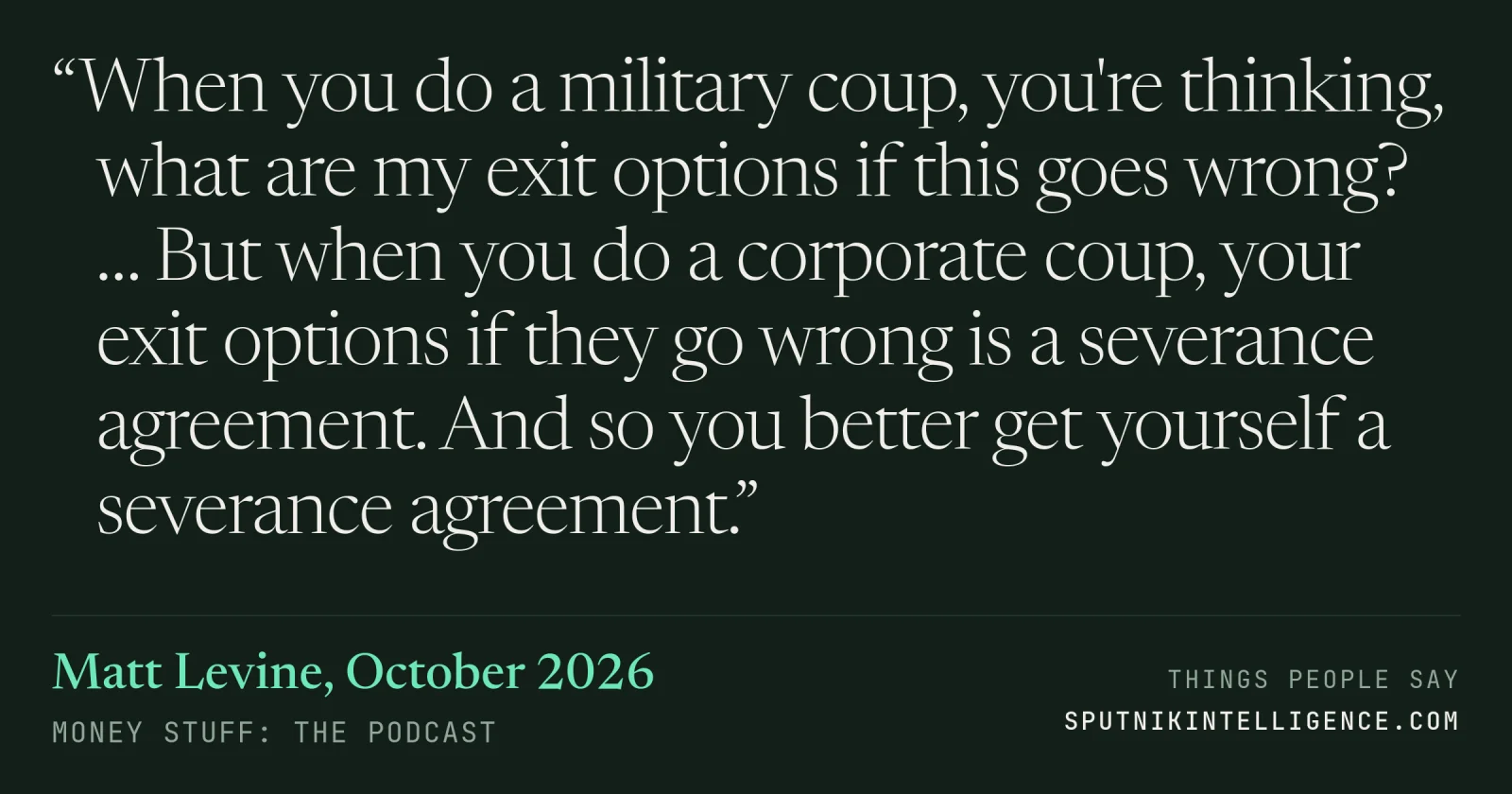
So he was gone for 33 hours and 20 minutes. What did the company do in those 33 hours and 20 minutes? Well, one thing they did was that the chief financial officer, who is the interim CEO, and the chief legal officer, who presumably, you know, had to sign off and all that stuff, signed each other's severance agreements. Which is just like, when you do a coup, you know, you do a military coup, like you're thinking, like, what are my exit options if this goes wrong? And they're off and grim. But when you do a corporate coup, your exit options if they go wrong is a severance agreement. And so you better get yourself a severance agreement. I mean, 33 hours and you're in charge. You sign that agreement. I don't know if that's going to happen. They got right to it.
Mary Childs
The most important part.
Matt Levine
Right. Like, it's possible that he comes back. He's in a good mood from Burning Man. He's like, all right, have your severance. Goodbye. Better to have you leave without a dispute. But it's possible that not. I don't know what that
Mary Childs
come down to. I think you come back from the playa less oriented towards confrontation and more towards love. That
Speaker names come from our own diarization. The position is estimated from where the line sits in the episode.
Max Abelson had said he assumed companies hire outside law firms to get a clean bill of health in public, and was surprised the Wachtell report made the Clippers scandal look bigger rather than smaller. Levine gives the cynical reading: the deep purpose is often to hand prosecutors a named individual so the company gets credit for cooperating. He then says he does not think that is what happened here, since the NBA faces no real Justice Department threat.
Money Stuff: The PodcastAround 08:41 into the episode
Matt Levine
like, you get the sense that Aspiration is like kind of a big company and some people involved in it were not simply there to do fraud, but like the whole thing was kind of doing a lot of fraud. So
Max Abelson
…something like a clean bill of health in public after the scare of a scandal. And then the Wachtel report comes out. It's like, is it worse? It made this look like a bigger scandal, not a smaller scandal. I was kind of amazed. I was sort of impressed, but maybe that's not fair to law firms in their
Matt Levine
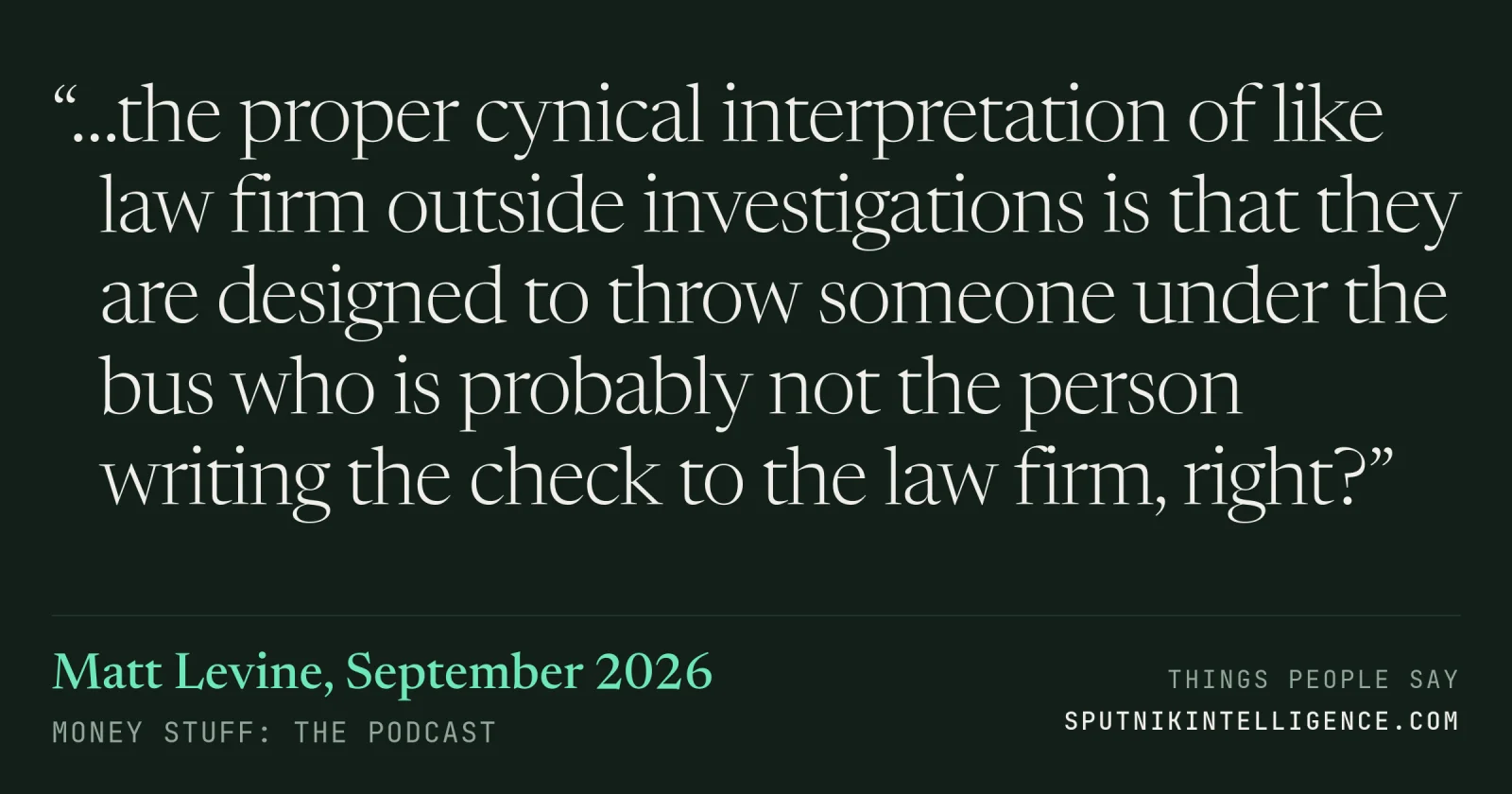
cynical, like the proper cynical interpretation of like law firm outside investigations is that they are designed to throw someone under the bus who is probably not the person writing the check to the law firm, right? So like in many internal investigations, like the upshot is this one bad apple did some real bad stuff. Like a classic law firm internal investigation is conducted in the shadow of some sort of regulatory investigation or like Justice Department investigation. And often the purpose, the deep purpose of the law firm investigation is to get the Justice Department not to charge the company with…
Max Abelson
I will say I was watching live when Kawhi Leonard hit. I mean, this was for a different basketball. This is for the Raptors. The coolest shot of them I've ever seen.
Matt Levine
Yeah. The Clippers got him right after that, right?
Max Abelson
I think right after that. I think he left the Raptors. I mean, that was in the Eastern Conference. Semi-finals.
Speaker names come from our own diarization. The position is estimated from where the line sits in the episode.