The host suggests AI companies have done a poor job of showing ordinary people why their products are useful. Sun's answer is partly economic: she says the companies put most of their computing power into better coding tools so they can build the next model faster. Everyday uses improve slowly as a result.
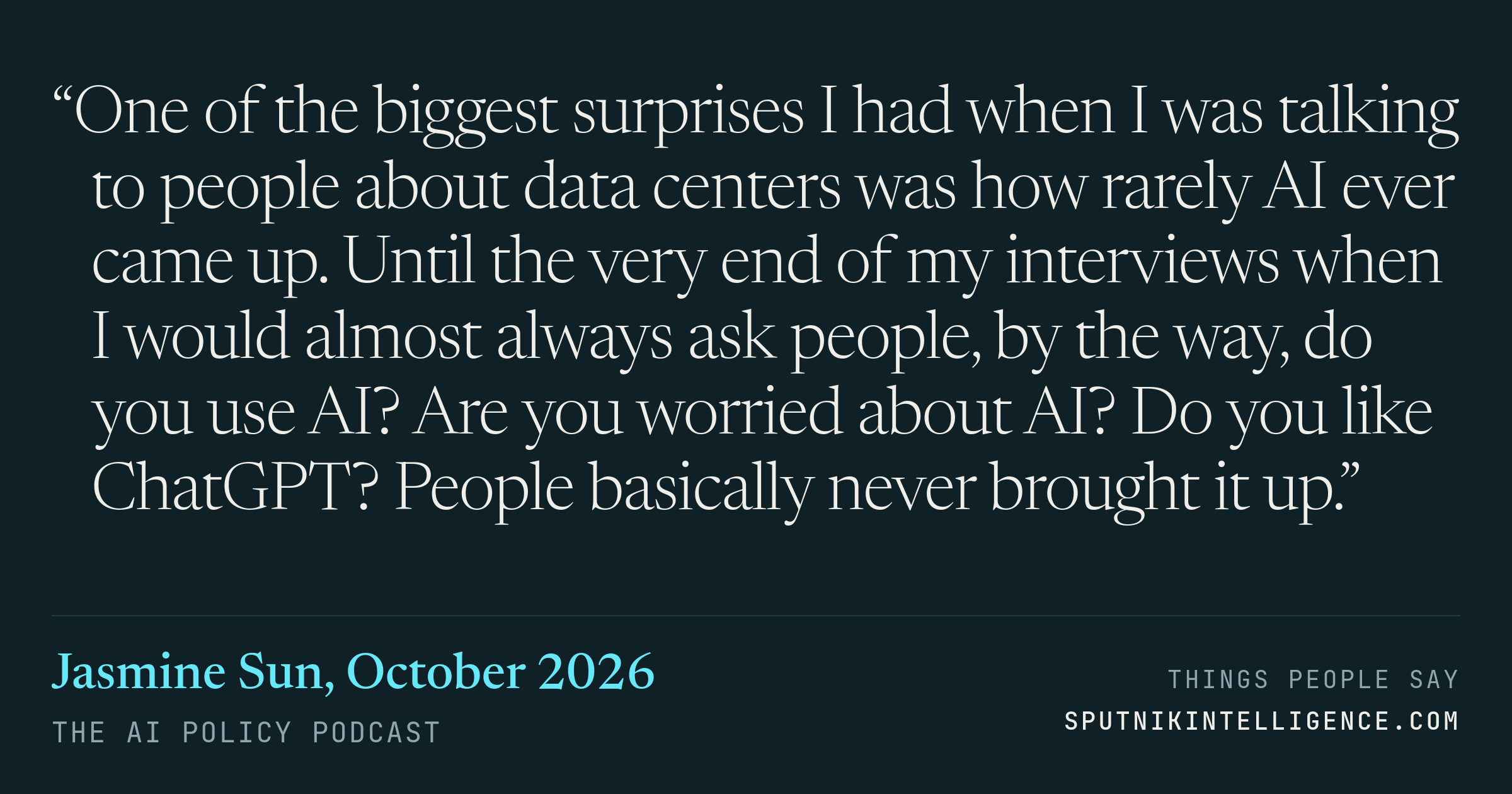
Yeah, I mean, the China point is super interesting because I sort of my vague, you know, outsider's impression of Washington is pretty similar. It's like, oh, but China on both sides, you know, like we gotta do these export controls because of China. No, we have to accelerate American open source because of China. We don't want their open source to win, right? And actually, like, if you look at the polling, for example, I was looking at a Fox poll from last December saying, would you rather have the U.S.'s primary approach to AI policy be that we take a more careful and slow approach to focus on mitigating domestic risks, or would you rather we accelerate AI development in order to beat China? And it was 80% for careful and slow, and only 19% for accelerate to beat China. And so I think there's like a huge gap. You probably see this in a lot of national security issues in general, which tend to be more shaped by Washington elites than by the public. But there's very, very little appetite, I think, right now from the public for entering this AI race, which I think does feel abstract to people. And I heard really, I don't think I heard anything about China at all when I was on the road. I think that folks were very much concerned about the hyper-local impacts of data centers in their communities rather than seeing this as part of a broader economic and geopolitical competition. And I think probably notably as well, when we're talking about, say, the post-industrial Midwest, we're talking about places and people where they have seen how just because the US's GDP goes up, for example, that doesn't mean that workers in their community are going to get a slice of it and are going to benefit. So again, you have this pre-existing distrust of pursuing, say, economic growth at all costs because maybe outsourcing is great for American companies, but it's not great for workers in Michigan, right? And that means that similar logics don't apply. But yeah, I mean, as to why is there such a divide, I think you touched on a lot of the big things. People in startups in SF are using coding agents all day. They have their favorite harnesses that they're trying out every new model. When I ask people in other cities, it's like better Google, better emails, but like, you know, if you're a nurse or you're a retail worker or something, AI is not transforming your life, right? It's like a nice to have, I think. And so that's just like a very different case. And so the place where I feel like AI has had the most product market fit for the broad population is probably kids cheating on their homework or something. And I'm not sure that that either presents kind of like the best picture of what AI can do to help you. It just doesn't feel like a sort of economically transformative technology to a lot of people. And one of the concerns I have here is also the closing of the frontier and the way that people are getting priced out of AI, right? This is, I think, another reason for this divide. Where in San Francisco and Silicon Valley, people are all more than happy to pay 200 bucks a month to get the most frontier models that they can and to actually accelerate their work because they have 10 agents running at once on different research and coding tasks. I was talking to someone the other day who's also a tech reporter and she told me, I just tried a paid plan for ChatGPT for the first time in like September 2026. And oh my god, it's actually really smart. And she had never realized this because on the free plan, it hallucinates all the time. It's not that good. This is what almost everybody in the world is using. And if it's not very good on the free plan, it's not really encouraging you to like go and pay even more money to this company, right? And so the other thing I'm worried about is like, I think that folks's primary experiences with AI being not very advanced and like prone to slip-ups and hallucinations also causes probably a lot of the public to underestimate some of the more economically transformative capabilities as well as the ones that people in say the national security world are worried about, like cyber capabilities. And the more that the internal model, That the companies have, that maybe the intelligence agencies have, that the corporations that are affording, you know, extremely expensive AI subscriptions and AI credit API credits. I think that we're just going to see the gap widen between the kind of AI that normal people have access to if they're not paying versus the kind of AI that you get if you are the U.S. government or you are a company that has a lot of money to spend on tokens. And so I think that this actually creates an even bigger gap that I'm a little bit worried about, frankly, because that's going to really stretch out, I think, the backlash against AI versus what folks who are policy decision makers want to do with it.
I mean, it's my sense that I think the AI companies have done a really bad job at sort of demonstrating the utility of their products. You know, I think their approach is like, if we build really cool technology, some, you know, like it's self-evident, people will figure out cool uses for it. And so we don't need to do as much work sort of like convincing people that it's useful. So I don't know if that sort of aligns with your experiences.
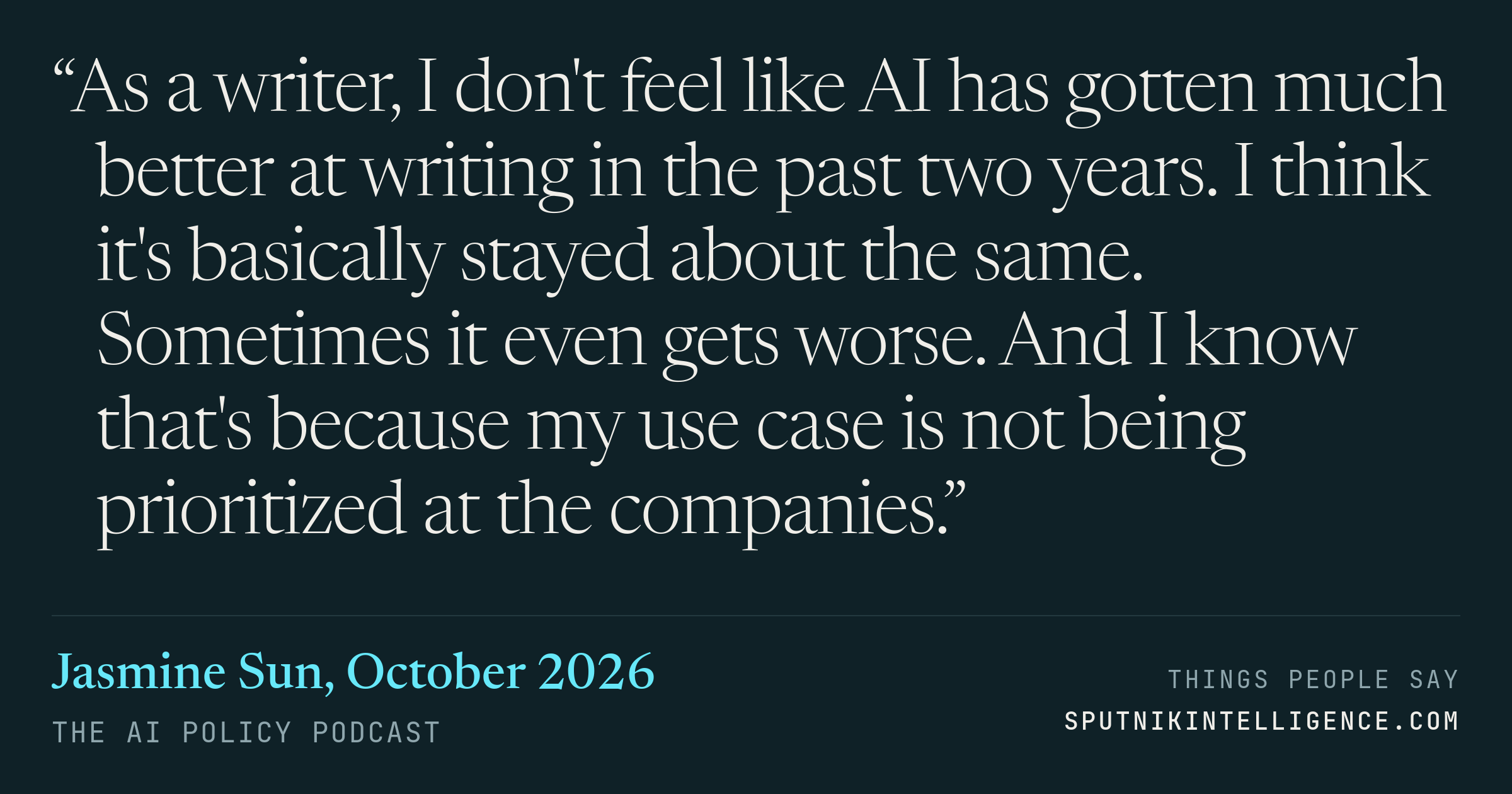
I mean, yeah, I mean, I agree that they are not trying that hard. I guess I sometimes wonder like how much is it conscious versus an accidental thing? Like how much is it that the AI companies are tone deaf and they don't really know what people like versus how much is it that they don't care what people like? And I actually don't know what the answer is here, but like, you know, some of the biggest PR moments I feel like are about the Navier Stokes or something or solving Millennium problems, which is it's like cool, but I don't think that's winning you, like winning you positivity points for the broad American public. I think it's cool to a pretty narrow slice of people who majored in math and did a lot of like math competitions as a kid or something. But I think the other thing is just from an economic perspective, you know, they're putting all of their the vast majority of their compute into improving coding so that they can try to hit recursive self-improvement and accelerate the development of the next AI model. And so it's also simply true that like marketing aside, the AI companies are not spending the majority of their own money and their own resources on trying to build applications that are broadly useful. They have some teams dedicated to like ChatGPT for health or something or Claude for biology, but most of the compute is definitely going towards let's build better coding tools so that we can build the next AI models. And so it's not that surprising, I think, that for more common uses of AI, it hasn't improved that much. Like as a writer, I don't feel like AI has gotten much better at writing in the past two years. I think it's basically stayed about the same. Sometimes it even gets worse. And I know that's because my use case is not being prioritized at the companies. It's just not that important to them compared to improving their cyber capabilities. And so I feel like that also causes a bit of an issue. I don't know. Do you feel like AI transforms your work?
In a lot of ways, it doesn't. I mean, part of that is like, you know, for institutions like CSIS, it takes a while to get comfortable with that technology. We're not particularly well suited to implement it in the same way as a tech company. We're not tech-centric in that way. But I think another thing is like we're a writing-centric organization. And I think writing-centric places, probably just as much as journalism think tanks are concerned that the way they differentiate themselves in an AI world is through the quality of their writing. And so there's a hesitation, I think, about AI in the sense of like muddling the impact of the product that we put out.
Yeah, I think that's right. I think that another thing that I hear from people, even people in a variety of white-collar jobs who are being asked to use AI in their workplaces, people don't necessarily feel that the AI makes their work quality better, but they feel like sometimes there's top-down pressure to use it to generate more work, but to really generate more slop, right? Like to write faster but crappier documents or reports or something like that. And so, again, while I can understand why people I know who are software engineers, the capabilities are actually ahead of humans, I think a lot of the way that people experience AI is not necessarily as this is smarter than what I could have produced, but this is more volume at potentially lower quality. At least that's how I feel in the writing world, personally.
Yeah, I mean, I think it is true that there's sort of like this a little bit of arms race dynamic in the sense of like when people can generate text really fast, then there's pressure on us and I think pressure across a lot of industries to also produce things more quickly. And then, you know, that can lead you to like try to use AI to accelerate your workflows. But it turns out that like The way you implement that is really hard to figure out.