 Jasmine Sun
anthropologist of disruption ✰ atlantic contributor ✰ san francisco
Jasmine Sun
anthropologist of disruption ✰ atlantic contributor ✰ san francisco
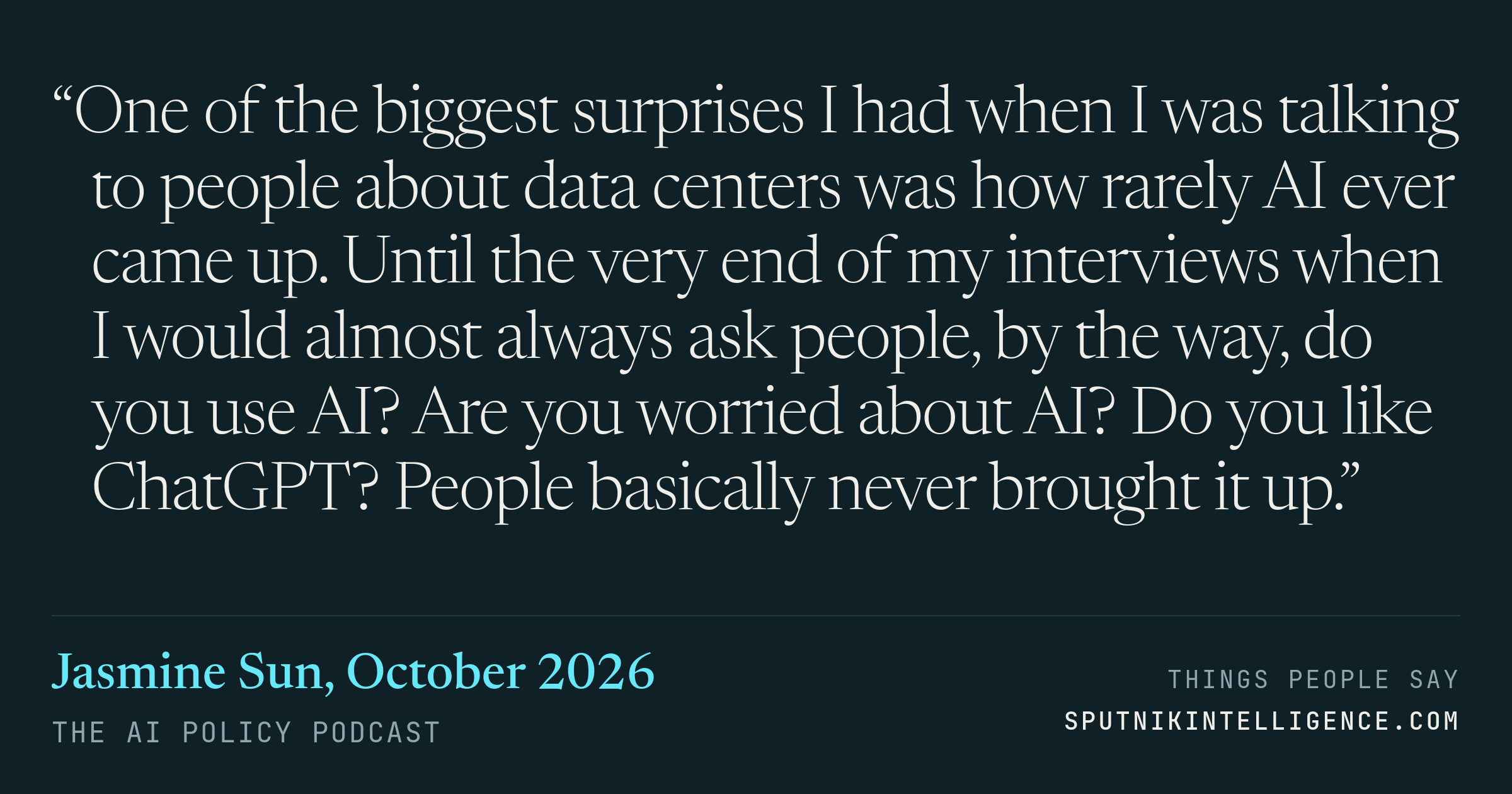
“One of the biggest surprises I had when I was talking to people about data centers was how rarely AI ever came up. Until the very end of my interviews when I would almost always ask people, by the way, do you use AI? Are you worried about AI? Do you like ChatGPT? People basically never brought it up.”
The AI Policy Podcast · Geopolitics & World Affairs · October 2026
Sun reported on local opposition to data centers. Asked whether the backlash is about AI as a technology or about the companies behind it, she says people's worries were almost all about the buildings' effect on daily life and about distrust of deals made behind closed doors. She adds that this may change as fears about AI itself become more mainstream.
Transcript
No, I don't think so either.
So one final question for you. We've talked a lot about sort of this national backlash to data centers and how it's a proxy for like anxiety about AI. I'd love to get your sense of whether this is mostly about AI as a technology or is it about the specific companies and the specific executives that have become the face of it?
One of the biggest surprises I had when I was talking to people about data centers was how rarely AI ever came up. Until the very end of my interviews when I would almost always ask people, by the way, do you use AI? Are you worried about AI? Do you like ChatGPT? People basically never brought it up. Almost all their concerns, again, were about the infrastructure and its quality of life effects, or about distrust of the corporations and the backroom deals that were being made that they thought were potentially screwing them over in this scenario. So far, my sense is that the broad backlash against AI is relatively more about the sense of disempowerment, vis-a-vis the trillion-dollar corporations that are building the data centers that the economy is concentrated in. But in the past couple months, as we started to see more scares caused by the crazy power of the actual agents and the AI and people are starting to talk more about extinction and such in the mainstream, I'm curious to see whether these concerns will link up and whether people who are protesting data centers will end up also protesting the technology and getting worried about that. But I'll say that it's not something I'm seeing a ton of yet.
Do you have any words of advice for data center developers? Are there things they can be doing better? Oh gosh. You don't have to answer that if you don't want to, but I think we've already seen a lot of innovations that are trying to address community concerns. Do you think there's other things they could be doing?
You know, I mean, I think that it's, I think that the deals that data center developers are making with local communities have actually gotten concretely and materially better in the last couple years because of the backlash. I mean, in 2023 and 4, oftentimes these small towns were literally subsidizing like meta or open AI and throwing like tax goodies at them in order to get them to build the data centers. And I personally don't think that Meta needs a tax subsidy to build their data center. They should really be offering more direct benefits to these cities, right? So I think a lot of the, from the perspective of the deals, things are already moving in the right direction. But again, I think that the question now is more about the broader political wins and whether the data center backlash has sort of gone so far past the level at which just tweaking the terms is going to fix anything. And so at that point, it might be more about the ability to manage relationships to, say, state politicians to set the terms of streamlined deals. Like I think one thing that I'm interested in here is there is a world where the positive outcome of say some of these moratoriums or stronger state regulations is that you get, rather than these data center developers negotiating like piece by piece with every 5,000 person town that they show up in, they can agree and negotiate with the governor's office on a set of like baseline terms that are agreed to as fair, that they're willing to pay, and that saves time and money for the developers. And that also means that no small town is getting a raw deal just because their local officials didn't know what to do. So I think that moving up data center deal-making terms to the state level is probably something I'm pretty optimistic about and that I hope to see happen more.
Well, I think we've touched on a ton of things and it was a really fascinating Conversation. Any last words before we wrap up?
More from The AI Policy Podcast