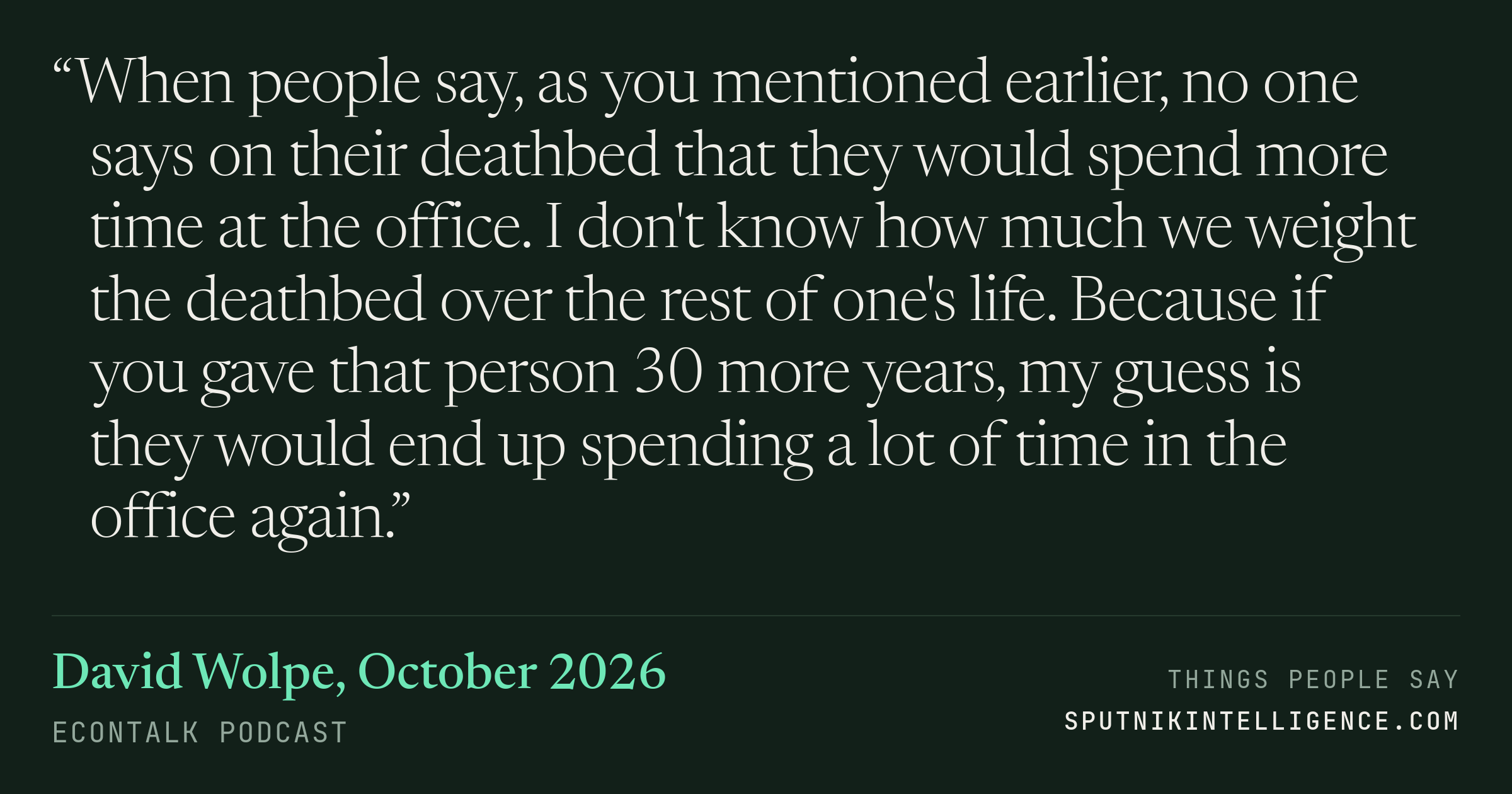
Russ Roberts asked the rabbi what he would tell a young person who doesn't want to die with regrets. Wolpe suggests choosing friends who want you to be better and finding a passion outside work. Then he pushes back on the familiar deathbed line, which Roberts had used earlier in the episode.
Yeah. But boy, what a remarkable. I mean, honestly, I can't imagine how in 50 pages you could get more of life and death. And if this isn't a tribute to the extraordinary genius of this writer, I can't imagine what is.
…the death of Ivan Ilyich. So I'm curious in your if I came to you and I said I'm a young person and I said, I don't want to be on my deathbed and think I didn't lead my life the way I should have. I didn't live as I ought to have lived. What would you recommend? What do you think about when that?
I would recommend, okay, I mean, I probably would recommend lots of things, but I'll start with, I'll recommend two things now. First is choose people to be close to you who want you to be better. Not that they're going to push you every single day, but they want the better version of you. They're not going to relax into your being less than you ought to be. To be. And the second thing that I would say is that you should choose something outside of your work that you love to enhance your life. For me, I mean, it's not exactly outside my work, but it was either literature or maybe chess. For others, it can be music. It can be theater. It can be movies. But I mean, you should have a passion that's not about the rest of your life. The obvious things are obviously you should spend time with the people you love and have deep relationships. That's the single most important thing. But everybody will tell you that, and it's true. But also make sure that those relationships elevate you and make sure that you explore. Life is so incredibly rich. Reach outside the thing you do every day to explore some…
One follow-up to that. I think the first thing you said is extremely novel to surround yourself with people who expect more of you. And a variation on that is really implicit in the story, which is don't surround yourself with people who care about the superficial and how their curtains look or…
that this is where, yeah, this is where meditation or prayer or a regular practice of stopping, of silence, of forcing yourself not to always be in front of a screen or a book or a person, but actually to take those moments of what the Jewish tradition calls hitbo to doot, which is aloneness, to…
My guest of the day has been David Wolpe. David, thanks for being part of Econ Talk.