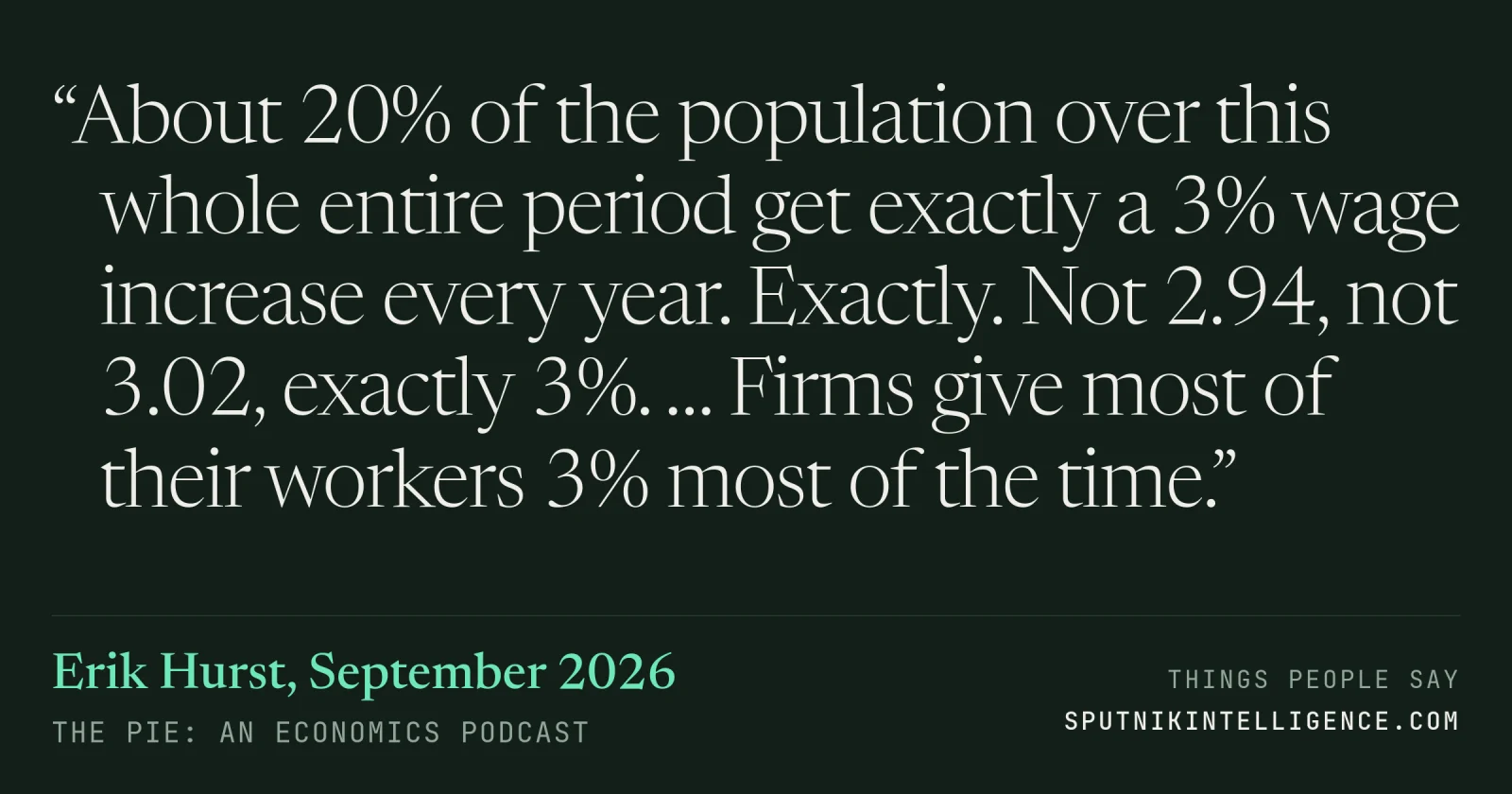
Hurst is describing what he found in ADP payroll records, which show exact wages rather than survey estimates. The 3% raise barely moves with inflation, which is his explanation for why workers who stayed in their jobs fell behind when prices jumped.
So I've worked with ADP data. Again, just to make sure ADP, for those who are in, they are a payroll processor.
You will often see them literally on your paycheck.
…wages are processed by ADP, every worker is processed by ADP because they process for all the workers. And so here I could see how wage setting looks like within a firm. How many people are exactly getting 3%? Are some of us getting 3% and some of us getting 10%? Some of us getting 1%. I could then see the distribution of wage changes to see how firms are changing their wages. And what you see, firms give most of their workers 3% most of the time.
This boggled my mind when I read this, that you found this huge share of raises that just cluster around this round number, and it's the same number year after year, regardless of what's happening with prices. So walk us through that. Like, what did you find when you looked at how these companies…
And I talked about 3%. Not all firms, to be fair, give 3%. Some firms give 2.5%. They had a bad year. Some will give, oh, it was a good year, 3.5%. Most firms give most of their workers somewhere in the 2% to 4% range. But if you're a 3% firm, most of your workers are 3%. If you're a 2.5% firm…
working so hard, Eric?