
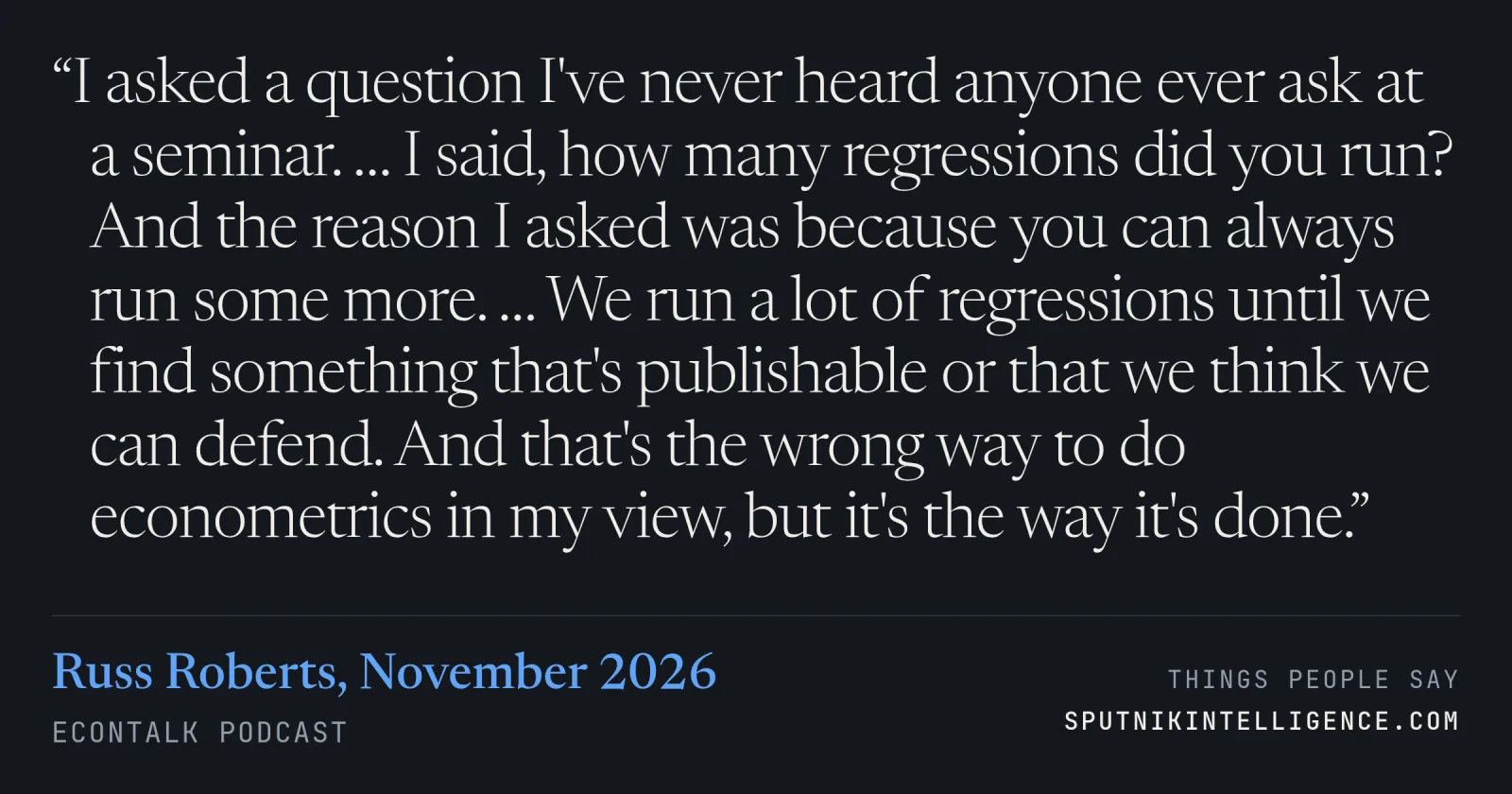
Russ Roberts recalls a seminar question he once asked, and put again to one of the China shock authors in a 2016 interview. He is describing how empirical economics actually gets done.
…And it's very much a change in their perspective on trade generally. In the past, they were much more comfortable and confident that while trade, of course, hurts certain people, while the general country might thrive, that this was of such a magnitude that we needed to do something about it.
…them who were discussing in the article as well. And they really looked at this result. In the original 2013 article, and they put a lot of time and effort into picking it apart, I suppose. And I'm really just the messenger who's bringing what they found to more kind of wider notice, maybe. Yeah.
…how the world works. And I'm curious to know how many times in all those regressions did your finding stand up, hold up, stand out. And it was, you know, it's a rhetorical question. So I asked David Otter that question. And I didn't let him answer because I knew it was, it's not a meaningful question. It's just a cheap shot in a way. It says, look, I know how the business, how we do our work. We run a lot of regressions until we find something that's publishable or that we think we can defend. And that's the wrong way to do econometrics in my view, but it's the way it's done.
Yeah, I think it is. I think what happened, there was what they call the credibility revolution in economics. So if I go back to when I was younger, say 20 years ago, my critique of economics was it was all too theoretical. Like economists, they were just kind of in this unreal world of pure…
Well, you called your paper, your article, Whimsy and Fragility in the China Shock Narrative, which is a whimsical title. But you're making a reference to Ed Lemur, who passed away recently. He was a guest on the program many times. He's one of my favorite economists. You mentioned in passing…
Yeah, I really love Lemur's work and his attitude as well. Lots of people didn't like his attitude. They said he was too aggressive, too mean. I think people say the same thing about me sometimes. But I think, honestly, I think you need to be a bit aggressive and mean in intellectual debates.…